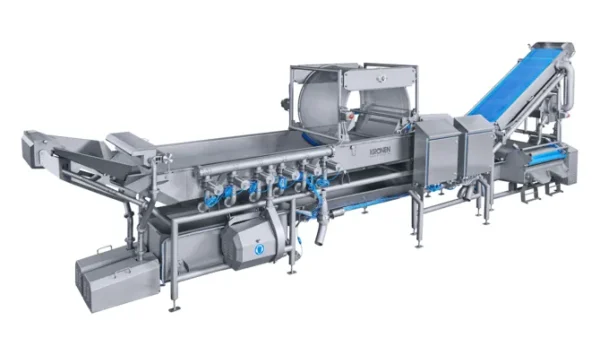
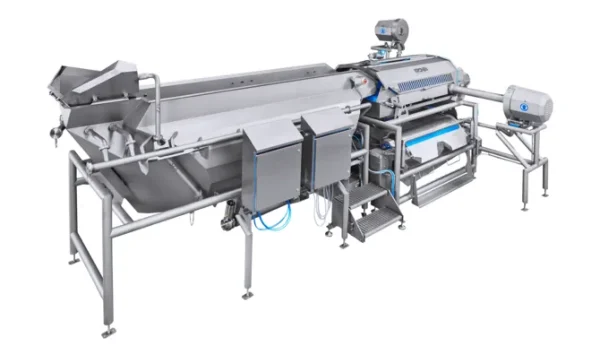
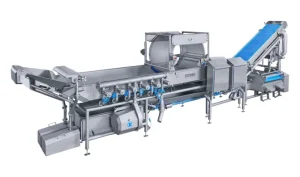
Air-bubble washing line for leafy vegetables, root crops and whole fruits that removes field soil and sand without bruising the product.
How it works
Product is fed into a stainless tank filled with water. A blower injects air through perforated plates, creating a rolling bubble current that lifts and separates the product, scrubbing soil off the surface. Heavier debris (stones, sand) sinks to a sediment zone, while floating light waste is removed by an overflow weir. A final spray bar rinses the product before discharge.
Suitable for
Leafy greens, root vegetables (carrot, potato), whole fruits (apple, tomato), cut produce before further processing.
Not suitable for
Very soft berries where bubble action causes damage; products that must stay dry (use dry cleaning instead); heavily muddy product without pre-soak.
Material & compliance
Tank and all product-contact surfaces in SUS304 (EN 1.4301); SUS316L (EN 1.4404) on request for salty or acidic rinse water. Food-contact welds ground smooth, Ra <= 0.8 um. Designed for CIP where line layout allows.
Supplied with CE declaration of conformity and DoC on request; material certificate EN 10204 3.1 available for contact parts; conforms to HACCP hygienic design principles (no dead legs, sloped drainage).
Selection notes
Size the tank on peak hourly throughput, not average — bubble washing is a residence-time process, so under-sizing the tank reduces wash quality before it reduces capacity. Check blower noise and whether your plant has compressed air or needs a dedicated blower. Ask whether the rinse stage uses fresh or recirculated water; recirculation cuts water use but needs filtration.
When you should not buy this machine: Do not buy a bubble washer if your product sinks in water — the bubble action will not lift it and you need a drum or brush washer instead. Also skip it if you have no water treatment capacity: bubble washers consume significant water and the discharge needs settling.
Key specifications
| Parameter | Value |
|---|---|
| Capacity | 500-3000 kg/h (TYPICAL, confirm with factory) |
| Tank material | SUS304 (EN 1.4301) |
| Blower power | 1.5-4.0 kW (TYPICAL) |
| Water consumption | 1.5-3.0 m3/h with recirculation (TYPICAL) |
| Power supply | 380V/3P/50Hz or 415V/3P/50Hz, customizable |
| Automation | Semi-automatic to fully automatic |
Specification values are industry-typical ranges for this machine class and are not verified against a specific factory datasheet. Replace them with measured factory data before publication.
FAQ
Can a bubble washer handle leafy greens without damage?
Yes, if the bubble intensity and water level are matched to the product. Leafy greens need lower air volume and a gentler current than root crops; most machines allow blower adjustment.
How is the wash water kept clean?
Sediment settles to a collection zone at the tank floor and is drained periodically; floating waste leaves via an overflow weir. Many lines add filtration to recirculate the rinse water.
What material certificate should I ask for?
Ask for EN 10204 3.1 for product-contact stainless parts. It ties the actual material batch to a verified analysis and is the standard way to detect 201/430 substitution.
Reviews
There are no reviews yet.