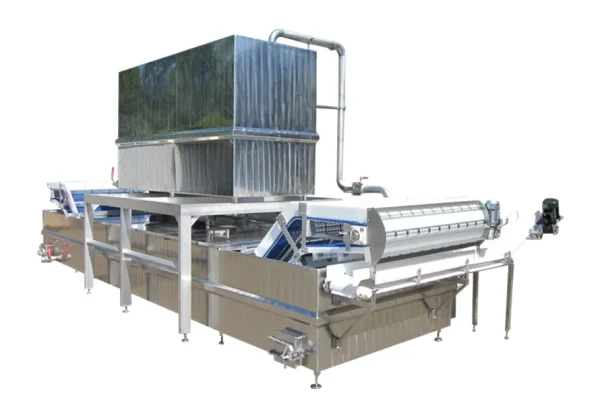


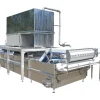


Immersion Freezer
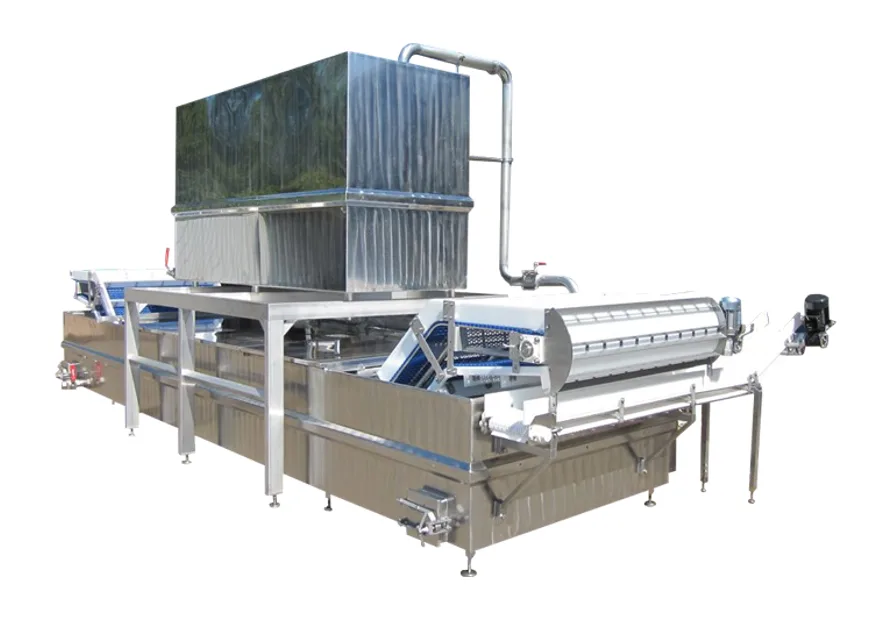
Immersion freezer that freezes product by carrying it directly through a chilled, food-grade liquid, giving heat transfer rates that air-based freezers cannot reach.
How it works
Product is conveyed into a tank of chilled food-grade brine or glycol solution held well below freezing. Because liquid conducts heat far better than air, the product surface freezes almost immediately and the freezing front moves inward quickly. Product is carried through the bath by a submerged belt or by the flow itself, then leaves over a drain section where surplus medium is recovered before a rinse or a packing step.
The medium is a secondary refrigerant: it is chilled by a refrigeration plant and recirculated, not consumed. Product is in direct contact with it, so the medium must be food-grade and its concentration must be controlled continuously, since dilution from product moisture raises its freezing point and quietly slows the process.
Suitable for
Berries and small whole fruit where fast freezing protects cell structure; cut vegetables and pieces with a high surface-to-volume ratio; seafood-adjacent and high-value produce lines; product where freezing speed drives quality and where a little surface contact with the medium is acceptable; lines looking for faster freezing than a mechanical air freezer without cryogen cost.
Not suitable for
Product that must not contact the medium, or where uptake into the product is unacceptable; unpackaged product destined for a dry pack unless a rinse step is included; very large pieces, where surface freezing outruns the core and causes cracking; operations that will not maintain medium concentration and filtration.
Material & compliance
Tank, belt, heat exchanger and pipework in SUS304 (EN 1.4301); SUS316L (EN 1.4404) where brine corrosion or chloride content warrants it. Medium food-grade and documented; concentration, temperature and filtration monitored; tank and circuit designed for draindown and cleaning.
Supplied with CE declaration of conformity and DoC on request; material certificate EN 10204 3.1 available for contact parts.
Selection notes
Ask what the medium is and what it costs to maintain — concentration control, filtration and make-up are the ongoing work on this machine, and they are what determines whether it performs in month twelve as it did in month one. Check whether a rinse or drain stage is included and what it does to your line layout. Confirm bath temperature against your product’s freezing point, not against a headline figure.
When you should not buy this machine: If your product cannot tolerate contact with the freezing medium, this is the wrong technology — use an air-blast, spiral or cryogenic freezer. Also skip it if you will not maintain the medium: a diluted, dirty bath does not stop working loudly, it just quietly stops freezing as fast as you think it does.
Key specifications
| Parameter | Value |
| Capacity | 500-8000 kg/h by tank size (TYPICAL, confirm with factory) |
| Bath temperature | -10 to -35 °C by medium (TYPICAL) |
| Freezing time | 1-10 min by product and size (TYPICAL) |
| Freezing medium | Food-grade brine or glycol solution (TYPICAL) |
| Contact material | SUS304 (EN 1.4301); SUS316L on request |
| Power supply | 380V/3P/50Hz or 415V/3P/50Hz, customizable |
Specification values are industry-typical ranges for this machine class and are not verified against a specific factory datasheet. Replace them with measured factory data before publication.
FAQ
Immersion or cryogenic — which is faster?
Both are fast because both avoid air as the heat transfer medium. Immersion has a lower running cost than cryogen at volume but requires medium handling; cryogenic has no medium to maintain but a per-kilogram consumable cost.
Does the product absorb the brine?
Some uptake is possible depending on product, surface and residence time. That is why a drain and often a rinse stage follows the bath, and why the medium must be food-grade without exception.
How do I keep the bath performing?
Control concentration continuously, filter out product fines, and monitor temperature. Dilution from product moisture is the most common cause of a bath that slowly stops performing.
Related equipment
This unit is one stage of a complete processing line. For the full range of freezing equipment, or to compare this model against the IQF Fluidized Bed Freezer 1000 kg/h, see the complete equipment catalogue. Capacity, material grade and utility requirements can be confirmed through a quote request.
Reviews
There are no reviews yet.