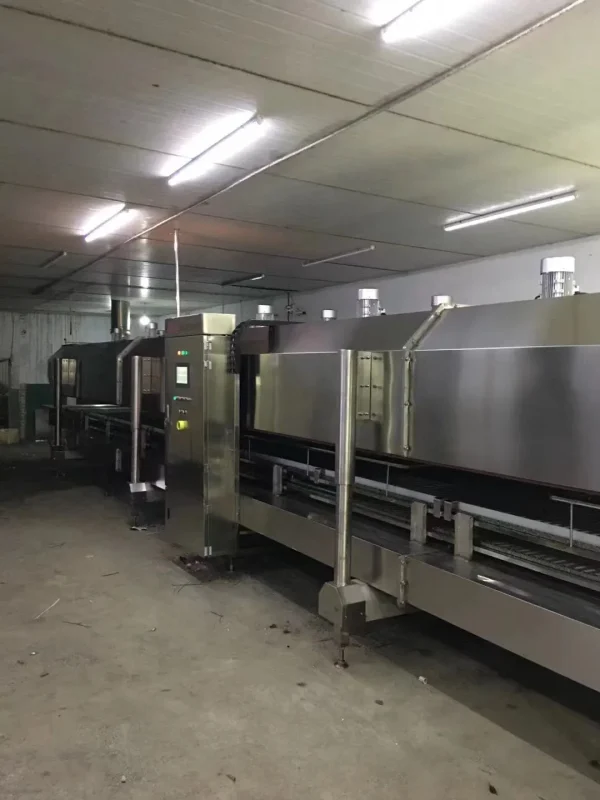
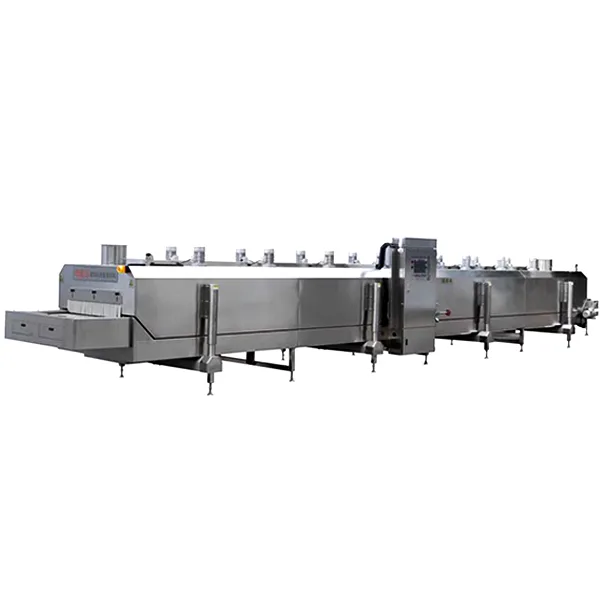
Cryogenic Tunnel Freezer
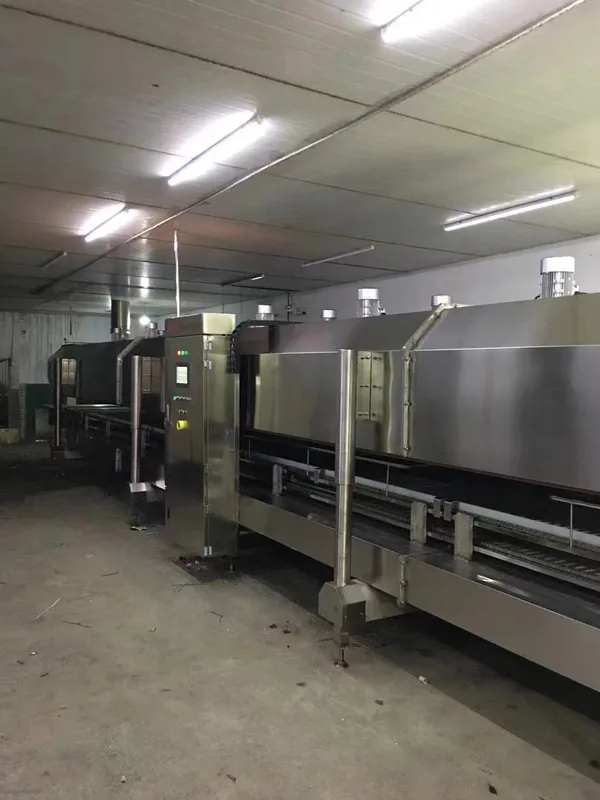
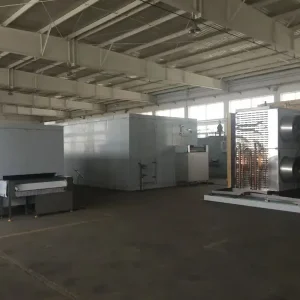
Cryogenic tunnel freezer that freezes product by spraying or immersing it with liquid nitrogen or liquid CO2, giving freezing rates that mechanical refrigeration cannot match.
How it works
Product travels on a belt through an insulated tunnel divided into zones. Cryogen is sprayed onto or injected around the product; as it boils or sublimates it absorbs an enormous amount of heat directly from the product surface. Fans circulate the cold gas to improve contact, and the spent gas is exhausted at the infeed end so that it pre-cools incoming product. Belt speed sets residence time.
Cryogen is consumed, not recirculated. That is the whole economic trade-off: no refrigeration plant, but a per-kilogram consumable cost.
Suitable for
Berries and soft fruit where individual quick freezing and cell integrity matter; high-value product where freezing speed drives quality; sticky or delicate pieces that mat together in a mechanical freezer; peak or seasonal capacity without capital in a compressor house; product where dehydration loss must be minimised.
Not suitable for
Low-margin, high-volume commodity freezing, where cryogen cost per kg dominates; sites without reliable cryogen supply or storage; very dense or thick product that cannot be frozen through in a short tunnel.
Material & compliance
Belt, tunnel and ducting in SUS304 (EN 1.4301), rated for cryogenic temperatures. Exhaust and ventilation designed so that oxygen levels in the working area stay safe; gas monitoring fitted where nitrogen is used.
Supplied with CE declaration of conformity and DoC on request; material certificate EN 10204 3.1 available for contact parts. Cryogen storage and supply equipment carries its own documentation and safety requirements.
Selection notes
Get a measured cryogen consumption figure on your own product — consumption per kg varies with product moisture, inlet temperature and target core temperature, and it is the number that decides whether the process is viable. Check belt material and its behaviour at cryogenic temperature. Confirm the exhaust and monitoring arrangements; nitrogen asphyxiation risk is the main safety issue and it must be designed out, not managed by procedure alone.
When you should not buy this machine: If you freeze large volumes of a cheap commodity, cryogen cost will exceed the capital saving within a year — a mechanical IQF freezer is the right answer. Also skip it if your cryogen supply is unreliable: a line that stops when the tanker is late is worse than a slower mechanical freezer.
Key specifications
| Parameter | Value |
| Capacity | 200-5000 kg/h by model (TYPICAL, confirm with factory) |
| Cryogen | Liquid nitrogen (LN2) or liquid CO2 (TYPICAL) |
| Operating temperature | Down to -80 °C or below (TYPICAL) |
| Freezing time | 3-15 min by product (TYPICAL) |
| Cryogen consumption | Product and model dependent, test required (TYPICAL) |
| Contact material | SUS304 (EN 1.4301) |
Specification values are industry-typical ranges for this machine class and are not verified against a specific factory datasheet. Replace them with measured factory data before publication.
FAQ
Cryogenic or mechanical IQF — how do I choose?
Cryogenic wins on freezing speed, product quality, footprint and capital. Mechanical wins on running cost at volume. Compare cryogen cost per kg against the capital and power of a mechanical plant at your annual tonnage.
How much liquid nitrogen does it use?
It depends on product moisture, inlet temperature and the target core temperature. Manufacturers quote a range, but the only reliable number comes from a trial on your product at your throughput.
Is it safe to operate?
Yes with proper design: adequate ventilation, oxygen monitoring, and exhaust of spent gas. The hazard is oxygen displacement, and it must be engineered out with fixed monitoring rather than relying on operator awareness.
Related equipment
This unit is one stage of a complete processing line. For the full range of freezing equipment, or to compare this model against the IQF Fluidized Bed Freezer 1000 kg/h, see the complete equipment catalogue. Capacity, material grade and utility requirements can be confirmed through a quote request.
Reviews
There are no reviews yet.