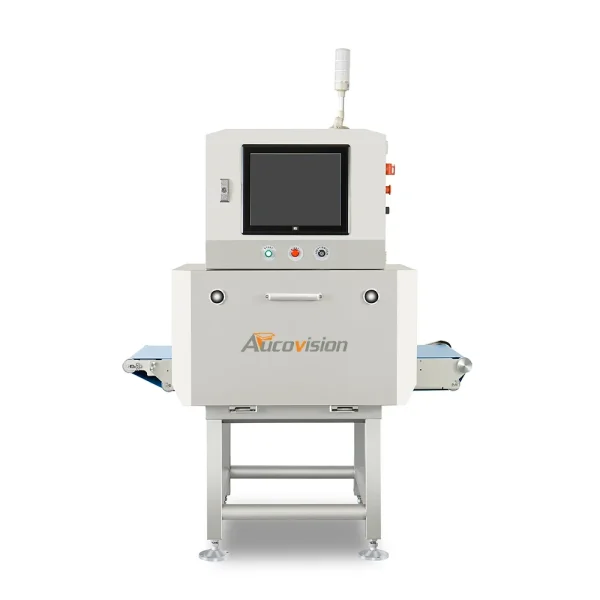
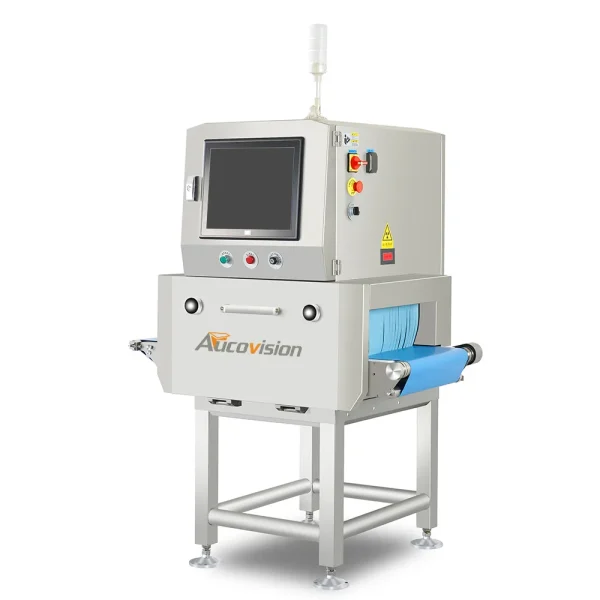


X-Ray Inspection System for Packed Produce
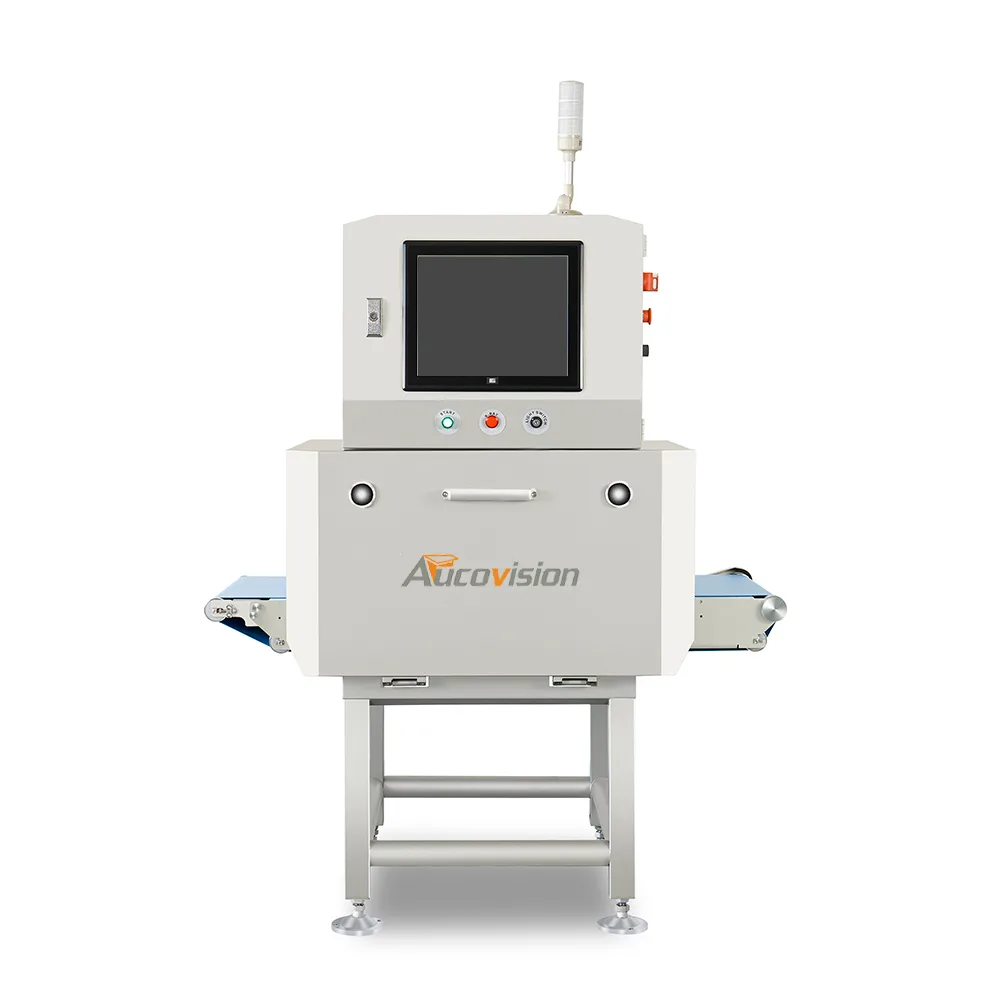
In-line X-ray scanner that images every pack as it passes and rejects any pack whose density pattern contains a foreign body, catching the contaminants a metal detector cannot see.
How it works
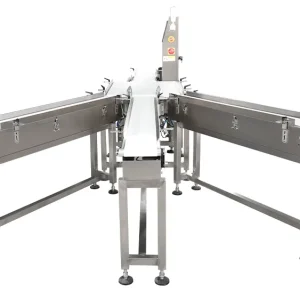
Product travels on a belt through a shielded tunnel. An X-ray source above (or below) the belt emits a beam, and a detector on the other side measures how much radiation gets through. Denser material absorbs more, so the system builds a greyscale image of each pack and compares it against thresholds by product. A region that is denser than the surrounding product — glass, stone, metal, bone, some plastics — triggers a reject signal, and the pack is pushed, blown or dropped out of the line.
Detection is by density contrast, not by conductivity. That is the entire difference from a metal detector, and it is why glass and stone are detectable here and invisible there.
Suitable for
Packed frozen vegetables and fruit where glass or stone risk exists; product in foil, metallised film or metal trays, which a metal detector cannot inspect at all; lines with a retailer code of practice requiring X-ray; product where bone, pit fragments or dense plastic are the risk; plants validating a critical control point for physical contamination.
Not suitable for
Very low-density contaminants in a low-density product, where contrast is too small; unpacked bulk product where pack-level reject is meaningless; operations without a procedure for handling rejects, which is where X-ray systems fail in practice — detecting is easy, disposing properly is not; anyone who needs to detect every contaminant type, because low-density plastics and hair are still outside X-ray capability.
Material & compliance
Tunnel, frame and belt in SUS304 (EN 1.4301); shielding integrated and interlocked; curtains at entry and exit; radiation monitoring and safety interlocks documented. Reject bin lockable; reject confirmation logged.
Supplied with CE declaration of conformity and DoC on request; material certificate EN 10204 3.1 available for contact parts.
Selection notes
Insist on a sensitivity trial with your own product and your own contaminant samples — detection limits quoted in a brochure are measured on a test block, not on a bag of frozen peas. Ask where the reject goes and how it is confirmed, because an unmonitored reject chute makes the whole system worthless. Check the pack handling: product presentation affects contrast, and overlapping or uneven product causes false rejects that operators then tune out.
When you should not buy this machine: If your risk is metal only, a metal detector does the job for a fraction of the cost and with far less regulatory burden. Also skip it if you have no resource to manage rejects, validation and radiation safety documentation — an X-ray system is a compliance programme, not just a machine on a belt.
Key specifications
| Parameter | Value |
| Throughput | Up to 200 packs/min by model (TYPICAL, confirm with factory) |
| Detection capability | Glass, stone, metal, bone, dense plastic (TYPICAL) |
| Minimum detectable size | 0.3-1.5 mm by product and density (TYPICAL) |
| X-ray power | Low-dose, shielded, by model (TYPICAL) |
| Reject system | Pusher, air blast or drop belt (TYPICAL) |
| Contact material | SUS304 (EN 1.4301) |
| Power supply | 380V/3P/50Hz or 415V/3P/50Hz, customizable |
Specification values are industry-typical ranges for this machine class and are not verified against a specific factory datasheet. Replace them with measured factory data before publication.
FAQ
Can X-ray replace my metal detector?
It can cover metal, yes. But a metal detector is cheaper, simpler and often more sensitive to fine ferrous and non-ferrous wire, so many lines run both — metal detection on bulk, X-ray on the packed product.
What size contaminant can it find?
Whatever the density contrast allows on your product. That number comes from a trial, not from a specification sheet, and it gets worse as product density or thickness rises.
Does X-ray affect the food?
No. The doses used in inspection are far below any level that changes the product, and the unit is shielded and interlocked for operator safety.
Related equipment
This unit is one stage of a complete processing line. For the full range of sorting and grading equipment, or to compare this model against the Metal Detector Conveyor 2000 kg/h, see the complete equipment catalogue. Capacity, material grade and utility requirements can be confirmed through a quote request.
Reviews
There are no reviews yet.