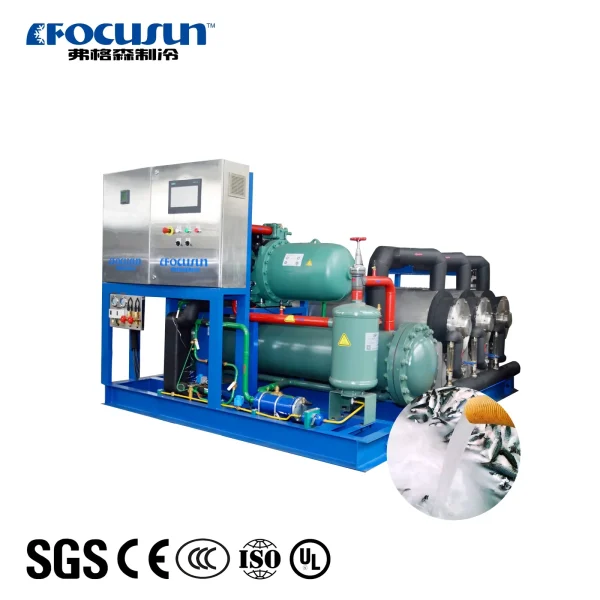
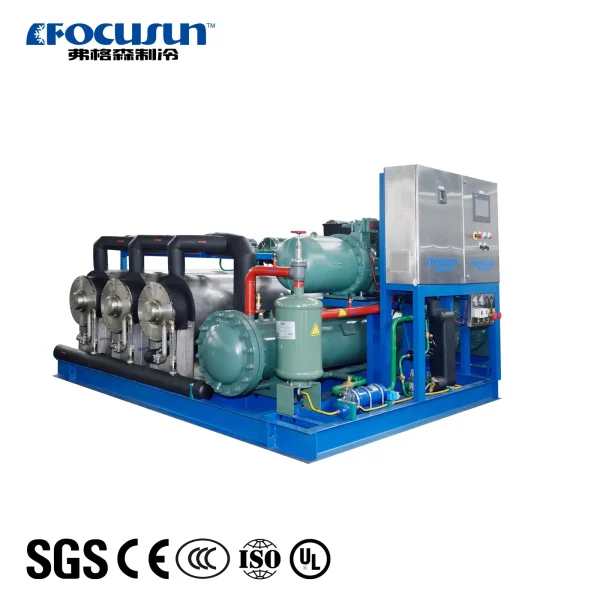
Ice Slurry Machine 5000 kg/h
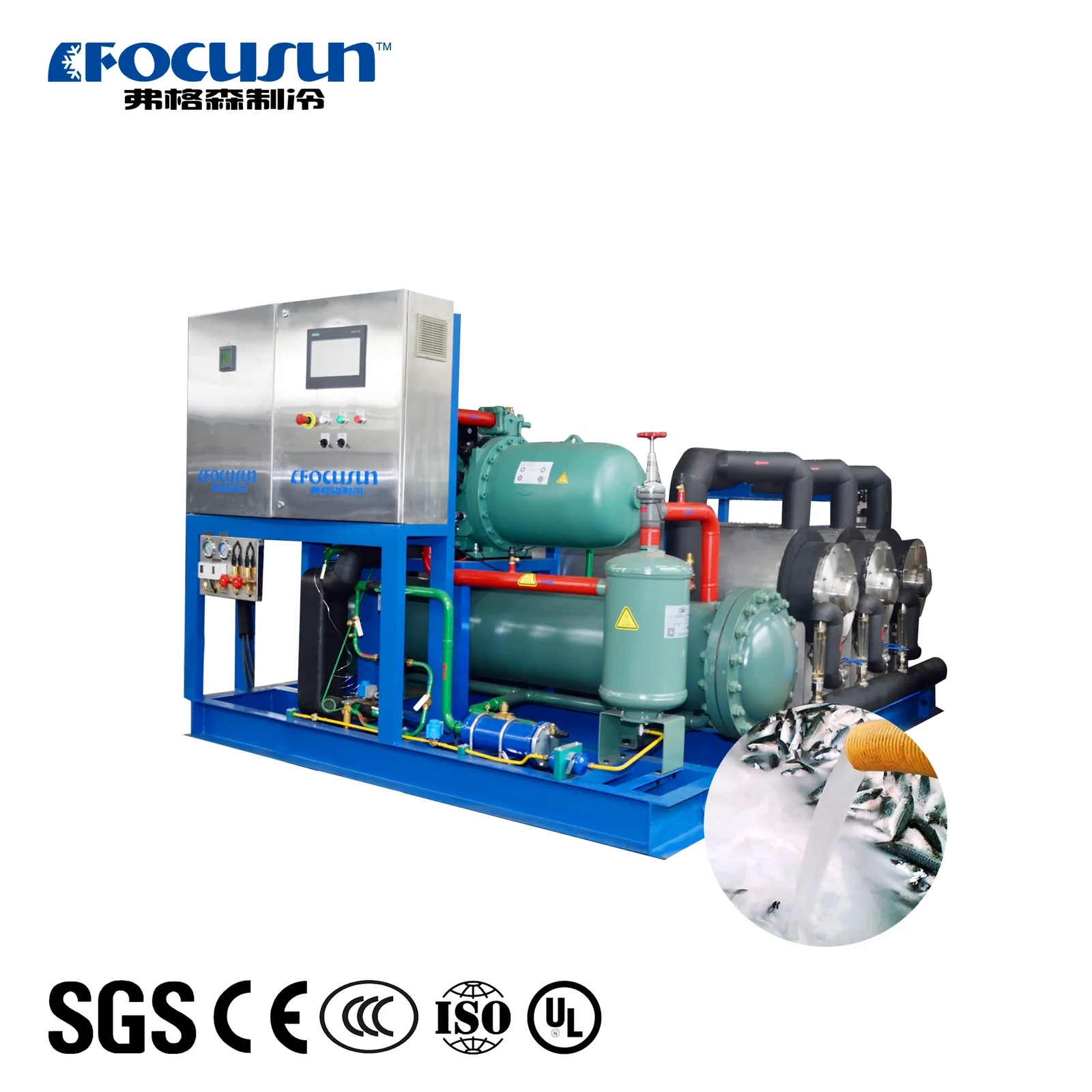
Refrigeration unit that makes cooling water that is colder than water. The trick is simple and effective: instead of relying on ice as a solid that has to be handled, the machine holds ice as a suspension of fine crystals in chilled water, pumpable like a liquid and pourable like ice. A slurry at minus one degree carries far more cooling capacity than the same volume of chilled water, and it delivers it by contact over the whole product surface at once — which is what makes it the fastest practical pre-cooling method for packed and unpacked produce alike.
How it works
Water is frozen into fine crystals inside a scraped-surface or flooded evaporator and held in suspension by circulation, giving a slurry that is typically a fifth to a third ice by weight. A pump delivers the slurry to the point of use: a bin of produce, a tote, a hydro-cooling tank, or directly into process water. As the slurry meets warm product the crystals melt, absorbing heat at a constant temperature near freezing, and the meltwater leaves with the cooling it took. The machine recirculates and re-freezes to hold the delivery temperature.
The advantage over solid ice is contact. Flake ice cools where it touches, which on a bin of produce is a few points; slurry flows around every piece and cools all of it at once. The advantage over chilled water is latent capacity — the same volume holds several times the cooling, which shortens the cooling cycle and reduces the water that ends up on the product and the floor.
Suitable for
Pre-cooling of freshly harvested fruit and vegetables in bins and totes; hydro-cooling circuits needing fast field-heat removal; process water that must stay near freezing through a washing or conveying step; operations replacing slow room cooling where field heat is the shelf-life limit; sites where pumpable cooling avoids the handling damage that solid ice causes on soft produce.
Not suitable for
Products that cannot be wetted or that must stay dry, where slurry contradicts the specification; operations without a recirculation and drainage arrangement, because slurry ends as water on the floor if it is not contained; sites without refrigeration service capability, which is a refrigeration machine and needs a technician; anyone wanting ice as a product rather than as cooling, where a flake or tube machine is the correct machine.
Material & compliance
Evaporator, slurry tank, pump and delivery circuit in SUS304 (EN 1.4301), with food-grade surfaces throughout and clean-out access at every low point where slurry settles. Water circuit filtered, and potable where slurry contacts food for consumption. Refrigeration circuit guarded and enclosed with pressure protection; refrigerant type declared at order because F-gas rules differ by market. Delivery points arranged so meltwater is collected rather than discharged onto the workroom floor.
Supplied with CE declaration of conformity and DoC on request; material certificate EN 10204 3.1 available for contact parts.
Selection notes
Ask for slurry output and ice fraction at your operating conditions, and ask how the fraction is held during delivery — a slurry that separates in the line delivers water first and ice last, and the product sees the difference. Check the delivery circuit’s insulation and flow velocity, because slurry that slows in an uninsulated line melts before it arrives. Check the refrigeration plant behind it: this machine is the delivery point, and the cooling comes from somewhere. Check how the meltwater and product water are contained and drained.
When you should not buy this machine: If your product must stay dry, slurry is the wrong physical form by definition — look at forced-air cooling. And if what you need is ice as a handled product rather than cooling capacity, buy a flake or tube ice machine instead; a slurry machine exists to deliver cold, not to stock ice.
Key specifications
| Parameter | Value |
| Slurry output | 2000-10000 kg/h by model (TYPICAL, confirm with factory) |
| Slurry temperature | About -1 to -2 °C (TYPICAL) |
| Ice fraction | 20-40 % by weight in suspension (TYPICAL) |
| Concentration | Pumpable slurry, delivered by pump |
| Application | Bin, tote or tank immersion; direct injection |
| Condenser | Air-cooled, water-cooled or remote by site |
| Refrigerant | R404A, R134a or R290 by market and regulation |
| Contact material | SUS304 (EN 1.4301) slurry-contact parts |
Specification values are industry-typical ranges for this machine class and are not verified against a specific factory datasheet. Replace them with measured factory data before publication.
FAQ
Why is slurry faster than flake ice?
Contact and capacity. Flake ice cools only where it touches, so a bin cools at a few contact points; slurry flows around every piece and cools all of it at once. The latent cooling in the suspension does the rest.
Does the product end up wet?
It can. Slurry is water with ice in it, and the meltwater has to go somewhere. Containment and drainage at the point of use are part of the installation, and products that must stay dry need a different cooling method entirely.
What is the ice fraction and why does it matter?
The share of the slurry that is ice by weight, typically a fifth to a third. It sets how much cooling each litre carries, and it has to hold through the delivery line — a slurry that arrives as plain water has lost the property the machine was bought for.
Related equipment
This unit is one stage of a complete processing line. For the full range of freezing equipment, or to compare this model against the Flake Ice Machine 3000 kg/24h, see the complete equipment catalogue. Capacity, material grade and utility requirements can be confirmed through a quote request.


Reviews
There are no reviews yet.