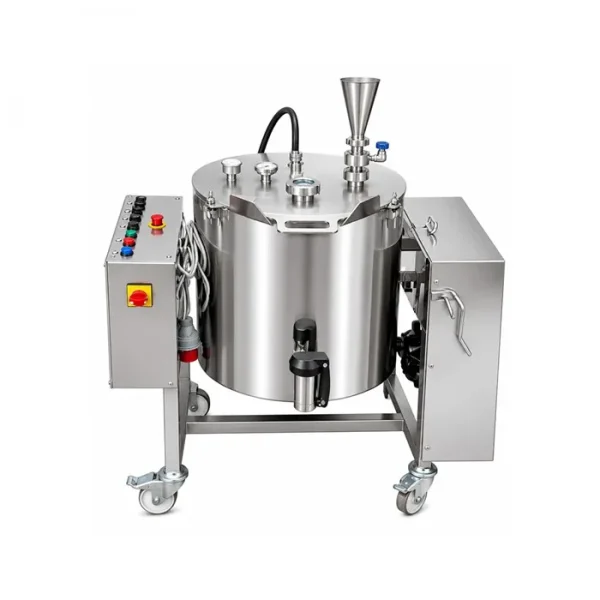
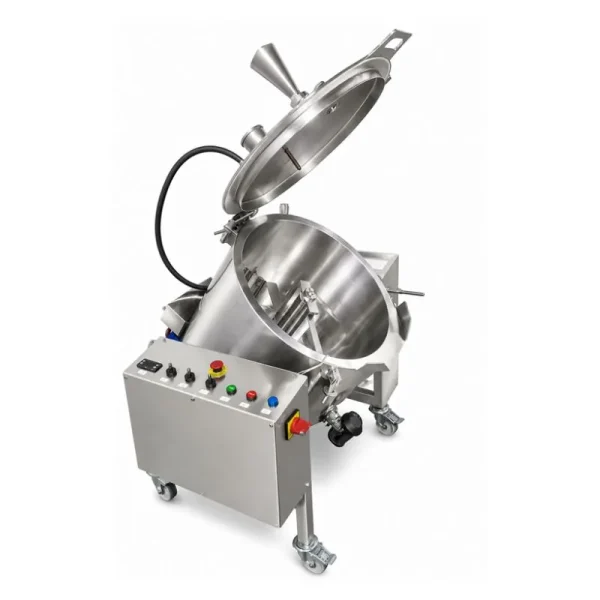
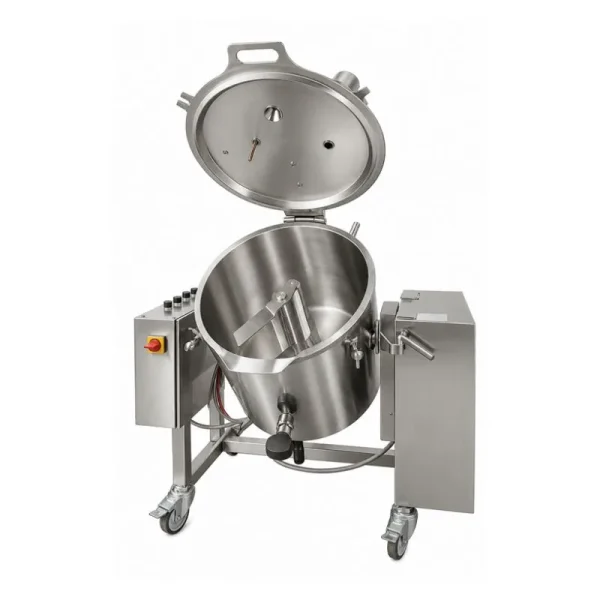
Vacuum Jam Cooking Machine 500 L/batch
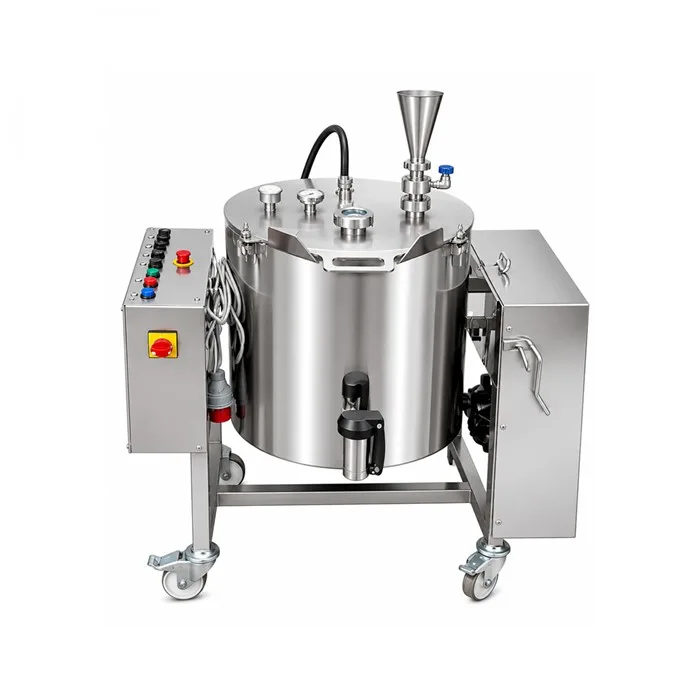
Cooking unit for the product where boiling is the enemy. Jam is fruit, sugar and water boiled down to a set Brix — and the longer it boils, the more colour and flavour it loses. Vacuum cooking sidesteps the trade-off: under vacuum, water boils at a lower temperature, so the batch concentrates at fifty to seventy degrees instead of a hundred and five, and the jam comes out the colour it went in as. For premium preserves, that is the whole reason the machine exists.
How it works
Fruit pulp, sugar and any other ingredients are charged into a jacketed vessel and heated while a vacuum pump draws the headspace down. As pressure falls, the boiling point of the water in the batch falls with it, and moisture leaves at a temperature that an atmospheric boiler would have to cook the fruit at to reach the same concentration. The jacket supplies the evaporation energy; the vacuum system removes the vapour; and a scraper or anchor agitator keeps the batch moving against the heated wall so it does not scorch or stick. When the batch reaches its target Brix, the vacuum is released and the product is discharged.
Two controls run the cycle: jacket temperature and vacuum level. Together they set the evaporation rate and the product temperature, and the recipe is written against those two rather than against a clock. The vacuum system itself — pump, condenser and its cooling water — is the part of the installation that most often gets undersized, because the vapour load at the start of the cycle is high and a marginal pump extends the whole batch.
Suitable for
Premium jam and fruit preserve production where colour and flavour retention is the product claim; fruit pastes and fillings that darken or taste cooked at atmospheric boiling temperatures; small and medium producers running batch recipes with different fruits and Brix targets; operations replacing open boiling pans, where labour, consistency and yield all improve; plants already running steam, because the jacket runs naturally on an existing steam supply.
Not suitable for
Products whose specification expects the cooked, caramelised character of open-pan boiling, where vacuum removes the very flavour being sold; operations without steam or another jacket heat source, since the evaporation energy has to come from somewhere; sites that cannot support a vacuum system’s cooling water and maintenance; high-volume continuous production, which is better served by a continuous evaporator rather than a batch vessel; anyone expecting vacuum cooking to change the recipe — it changes the temperature, not the formulation.
Material & compliance
Vessel, jacket, agitator, lid and discharge valve in SUS304 (EN 1.4301), with SUS316L (EN 1.4404) specified for acidic fruit service where chloride pitting is the concern. Internal surfaces polished and fully drainable; the agitator scrapes the wall so no product film remains to burn on. Vacuum vessel designed and built to the pressure vessel rules applicable in the market of installation, with relief device and inspection regime to match — this is the one machine on a fruit line where the pressure equipment certificate is the first document to ask for. Sight glass, sampling valve and temperature and vacuum instrumentation fitted as standard.
Supplied with CE declaration of conformity and DoC on request; material certificate EN 10204 3.1 available for contact parts.
Selection notes
Ask for the pressure vessel documentation and the design pressure and temperature, not as a formality but as the specification that governs the machine. Ask how the vacuum system is sized against the start-of-cycle vapour load, because that is where a marginal installation shows. Ask how Brix is measured and controlled during the cycle — in-line or by sample — and what the repeatability is between batches. Check the discharge arrangement against your filling operation and how the vessel is cleaned between fruit types. Check the agitator’s scraping action and how the blade is replaced, because it is the wear part that decides whether the batch burns.
When you should not buy this machine: If your product is sold on the cooked, open-pan character, vacuum cooking removes the flavour you are selling — an atmospheric kettle is the honest machine. And if you cannot support the pressure vessel inspection regime, do not buy a vacuum vessel at any price; it is the one machine on the line where skipping the paperwork is not an option.
Key specifications
| Parameter | Value |
| Batch volume | 200-1000 L by model (TYPICAL, confirm with factory) |
| Working vacuum | About -0.06 to -0.09 MPa (TYPICAL) |
| Cooking temperature | 50-70 °C under vacuum (TYPICAL) |
| Cycle time | 20-60 min by recipe and Brix target (TYPICAL) |
| Agitator | Scraper or anchor, by vessel design |
| Heating | Steam jacket or electric, with vacuum control |
| Contact material | SUS304 (EN 1.4301); SUS316L on acidic product |
| Power supply | 380V/3P/50Hz or 415V/3P/50Hz, customizable |
Specification values are industry-typical ranges for this machine class and are not verified against a specific factory datasheet. Replace them with measured factory data before publication.
FAQ
Why cook under vacuum instead of in an open pan?
Temperature. Vacuum lowers the boiling point of water, so the batch concentrates at fifty to seventy degrees rather than above a hundred. Colour and volatile flavour survive, and the jam comes out the colour it went in as.
Is a vacuum vessel risky?
It is a pressure vessel and is built, certified and inspected as one. That is a documentation and maintenance obligation rather than a hazard, provided the pressure equipment rules applicable in your market are followed — which is why the certificate is the first thing to ask for.
Can it run different fruits on the same vessel?
Yes, with cleaning between fruit types and recipe adjustment. The vessel is general-purpose; what changes between fruits is the jacket temperature, the vacuum level and the Brix target, all of which are recipe values rather than hardware.
Related equipment
This unit is one stage of a complete processing line. For the full range of cooking and blanching equipment, or to compare this model against the Jacketed Cooking Kettle 500 L, see the complete equipment catalogue. Capacity, material grade and utility requirements can be confirmed through a quote request.
Reviews
There are no reviews yet.