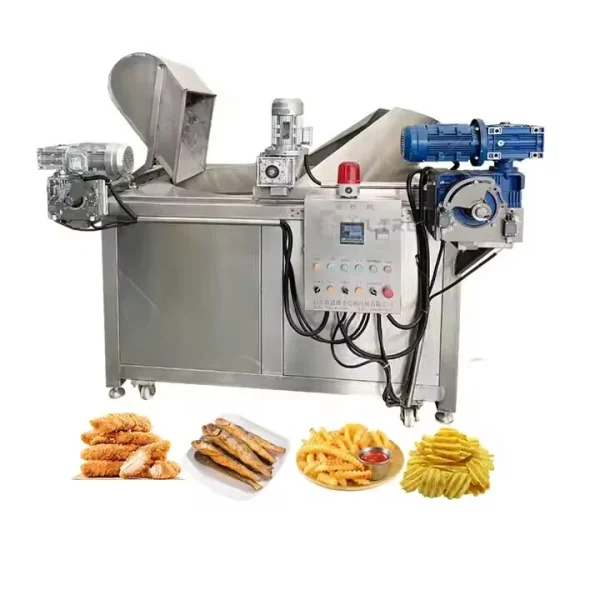
Continuous Frying Machine
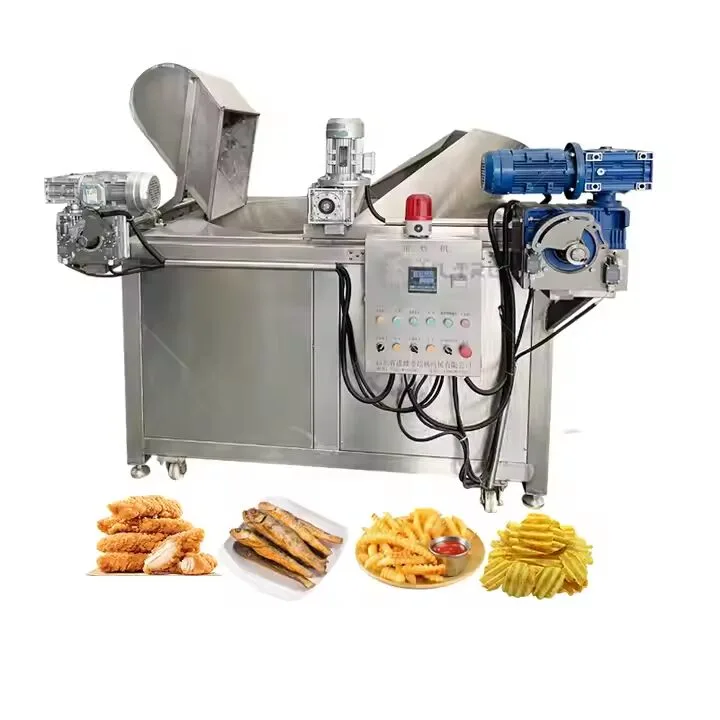
Continuous belt fryer that carries product through a temperature-controlled oil bath with continuous filtration, for chips, snacks and battered vegetable products.
How it works
Product is metered onto a submerged belt that carries it through the oil. A second hold-down belt keeps buoyant pieces below the surface. Oil is circulated through an external heat exchanger (electric elements, gas burner or thermal oil) and continuously filtered to remove fines. Residence time is set by belt speed, and oil temperature is controlled in zones so the product can be fried hotter at the infeed and cooler at discharge.
Fines removal matters: crumbs left in the oil carbonise, darken the oil and shorten its usable life.
Suitable for
Potato chips and crisps; French fries (usually as a par-fry step); battered or breaded vegetable products; root vegetable crisps; snack pellets.
Not suitable for
Product needing a very short fry at very high temperature where a batch kettle is simpler; low-volume production where oil turnover cost per kg is uneconomic; products with heavy loose batter that will foul the filter faster than it can be cleaned.
Material & compliance
Fryer tank, belts and hood in SUS304 (EN 1.4301); oil-contact welds ground smooth. Filtration package and oil discharge designed for cleaning without dismantling the tank.
Supplied with CE declaration of conformity and DoC on request; material certificate EN 10204 3.1 available for contact parts. Pressure vessels, where fitted, carry the relevant documentation.
Selection notes
Size on oil turnover, not just throughput — oil that sits too long degrades, and oil replaced too often is a direct cost. Ask what filtration is standard (usually a fines filter plus a continuous paper or screen filter) and what the oil life is at your throughput. Check how the tank drains and how long a full clean takes, because this is the biggest labour item on the machine.
When you should not buy this machine: If your volumes are small and intermittent, a continuous fryer’s oil volume and heat-up time will cost more than the product is worth — a batch fryer is the right answer. Also skip it if you cannot manage oil quality discipline: no filtration regime, no temperature logs and no turnover records will produce inconsistent product regardless of the machine.
Key specifications
| Parameter | Value |
| Capacity | 200-2000 kg/h (TYPICAL, confirm with factory) |
| Oil temperature | 160-190 °C (TYPICAL) |
| Oil volume | 300-1200 L by model (TYPICAL) |
| Heating source | Electric, gas or thermal oil (TYPICAL) |
| Contact material | SUS304 (EN 1.4301) |
| Power supply | 380V/3P/50Hz or 415V/3P/50Hz, customizable |
Specification values are industry-typical ranges for this machine class and are not verified against a specific factory datasheet. Replace them with measured factory data before publication.
FAQ
How is oil life extended in a continuous fryer?
Continuous fines filtration, correct temperature control, and keeping the oil volume appropriate to throughput. Most oil degradation on a continuous line traces back to carbonised fines rather than the fry process itself.
Can I use the same fryer for chips and battered products?
Usually not without a compromise. Battered products shed far more fines than chips, which loads the filter and darkens the oil faster. Dedicating the fryer to one product class keeps oil quality predictable.
What drives the heating choice between electric, gas and thermal oil?
Local utility cost and available infrastructure. Electric is simplest to install and control; gas usually has lower running cost where available; thermal oil suits very high capacity and gives gentle, uniform heating.
Related equipment
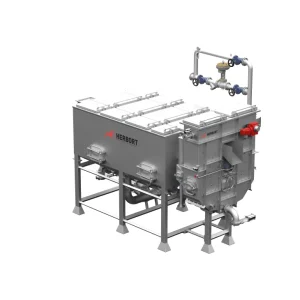
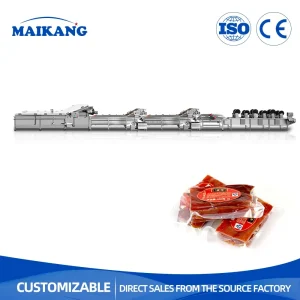
This unit is one stage of a complete processing line. For the full range of cooking and blanching equipment, or to compare this model against the continuous belt blancher, see the complete equipment catalogue. Capacity, material grade and utility requirements can be confirmed through a quote request.
Reviews
There are no reviews yet.