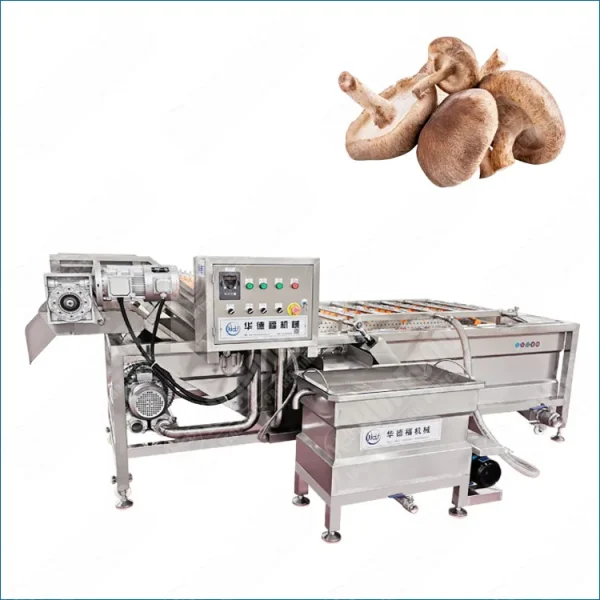
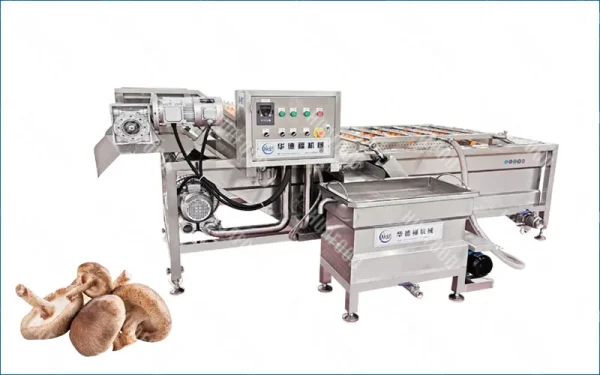
Mushroom Washing Machine 800 kg/h
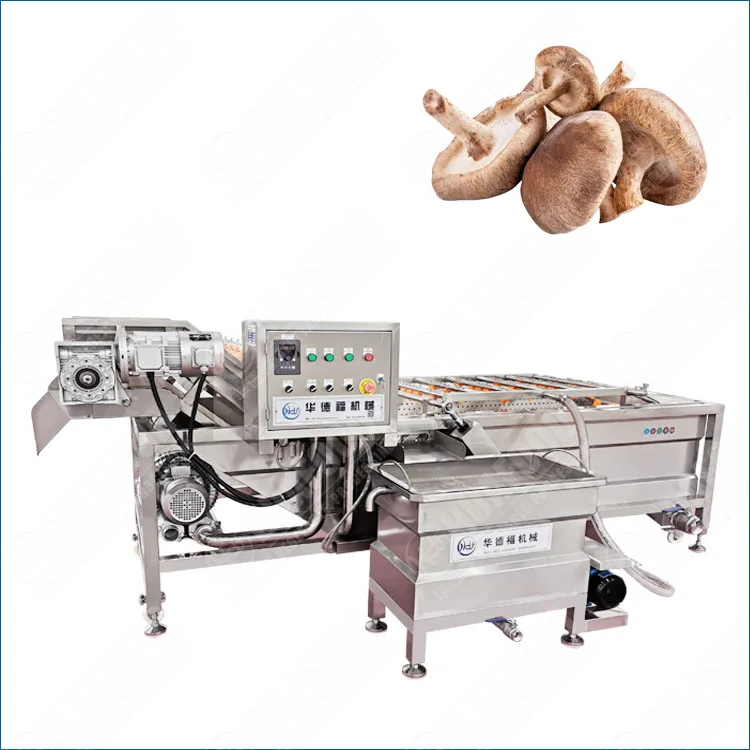
Mushrooms are mostly water already, and they behave like it. Wash them like potatoes and they drink, bruise and slime; leave them unwashed and the compost flecks ride through to the pack. A mushroom washer is therefore the gentlest machine in the washing hall: it works by soaking and soft spray, and its real specification is how little it does.
How it works
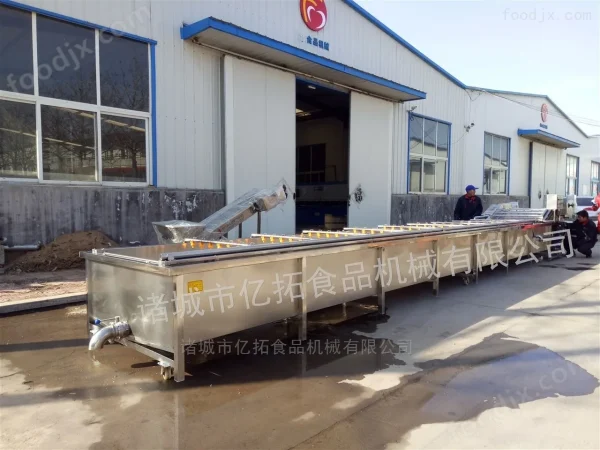
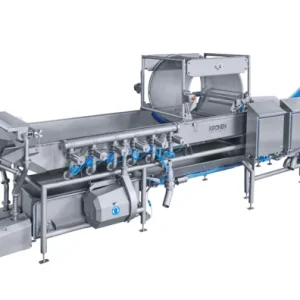
Product is fed onto a mesh conveyor that dips through a shallow bath. The immersion — a few seconds, controlled by belt speed — softens and lifts compost particles from gills and cap surfaces. On the rise out of the bath, low-pressure spray bars rinse the loosened particles off; pressure is kept low deliberately, because a jet that cuts compost out of a gill also cuts the gill. Some models add a soft brush roller for caps, and most end with an air-knife or vibration section to shed surface water before discharge. The bath itself is refreshed continuously, because compost particles accumulate fast and a dirty bath stains the caps brown instead of cleaning them.
Every setting is a trade against water uptake. Longer soak, cleaner mushroom, heavier mushroom — and a heavier mushroom that weeps in the pack.
Suitable for
Button, cremini and portobello washing ahead of slicing or packing; shiitake and oyster mushrooms on dedicated or mixed lines with gentle settings; fresh-cut mushroom operations where washed, sliced product must meet visual standards; growers moving from hand-wiping to machine washing as volume grows past what wiping can carry.
Not suitable for
Dried or preserved-mushroom processing, where the product is meant to stay dry and washing is done by the buyer; wild mushrooms with open, fragile caps at retail quality, which machine washing damages beyond tolerance; operations without a chilled chain behind the wash, because a washed mushroom spoils dramatically faster than a dry one — wash what you can move.
Material & compliance
Bath, conveyor and spray section in SUS304 (EN 1.4301), fully drainable and opening for daily strip-down, because mushroom wash water is organic-rich and a clean-at-night design is not optional in this machine class. Spray nozzles low-pressure type, removable for cleaning. Conveyor belt food-grade mesh with raised flights to control product depth. Air-knife section (where fitted) in stainless with filtered air.
Supplied with CE declaration of conformity and DoC on request; material certificate EN 10204 3.1 available for contact parts.
Selection notes
Ask what water uptake the machine adds on your mushroom type — it is the number that decides shelf life, and suppliers who measure it are suppliers worth having. Check bath refresh design: flow-through rate, filtration, and how the bath is emptied and cleaned at shift end. Check the spray pressure range and whether it is genuinely adjustable down. Check the discharge moisture against your slicer or packer’s tolerance, and whether the air-knife section is included or an extra.
When you should not buy this machine: If you sell through a supply chain that cannot keep washed mushrooms chilled and moving within a day, washing adds cost and risk without adding value — dry-brushing may serve better. And if your volume is under a few hundred kilograms a day, a well-organised washing table with a spinner is more honest economics.
Key specifications
| Parameter | Value |
| Capacity | 500-1500 kg/h by belt width (TYPICAL, confirm with factory) |
| Washing method | Shallow immersion + low-pressure spray rinse |
| Spray pressure | 0.5-1.5 bar, adjustable (TYPICAL) |
| Bath water | Continuous refresh with filtration |
| Dewatering | Air-knife or vibration section (TYPICAL) |
| Belt | Food-grade mesh, speed adjustable |
| Contact material | SUS304 (EN 1.4301) |
| Power supply | 380V/3P/50Hz or 415V/3P/50Hz, customizable |
Specification values are industry-typical ranges for this machine class and are not verified against a specific factory datasheet. Replace them with measured factory data before publication.
FAQ
Will washing reduce shelf life?
Some — a washed mushroom is a wet mushroom, and water is the enemy of shelf life. The machine’s air-knife or dewatering section, fast cooling after wash and same-day packing are what keep the penalty small. Ask for measured water uptake, not assurances.
Can shiitake and button mushrooms run on the same machine?
Yes, with different settings: shiitake takes less immersion time and lower spray. What matters is that the settings are genuinely adjustable and that operators change them — otherwise one product runs at the other’s settings and one of them suffers.
Is the compost wash water a disposal problem?
It is organic-rich and needs settling or screening before discharge, and local rules vary. Plan the drain and any treatment at purchase time; retrofitting effluent handling after installation always costs more.
Related equipment
This unit is one stage of a complete processing line. For the full range of washing and peeling equipment, or to compare this model against the Bubble Washing Machine 2000 kg/h, see the complete equipment catalogue. Capacity, material grade and utility requirements can be confirmed through a quote request.
Reviews
There are no reviews yet.