Vortex Washing Machine 2000 kg/h
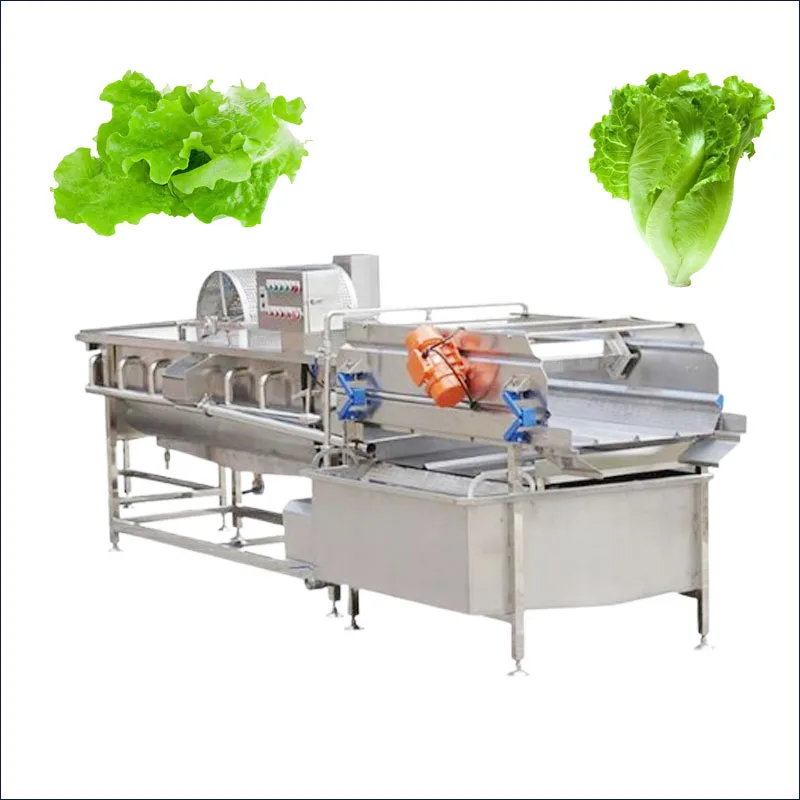
Once a vegetable is cut, every wash before it stops counting — cut surfaces weep juice, and the wash has to remove soil, starch and released tissue fluid without bruising pieces that no longer have skin. The vortex washer is the fresh-cut industry’s answer: instead of brushes or jets, it moves the water, and the water moves the product — a horizontal spiral flow that carries cut pieces round and round while dirt sinks, juice dilutes and floating debris overflows.
How it works
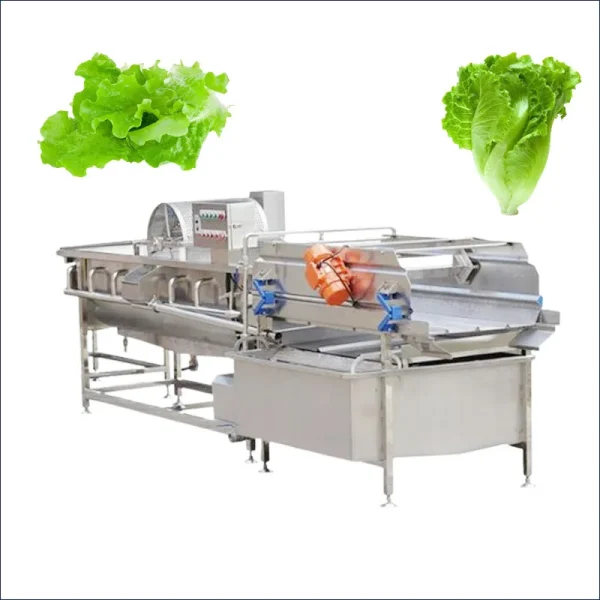
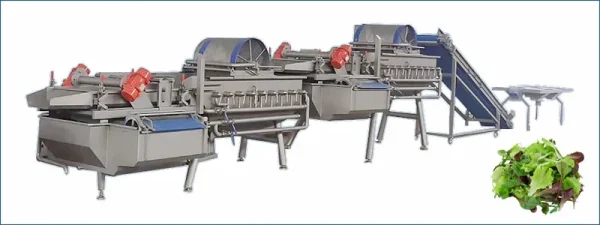
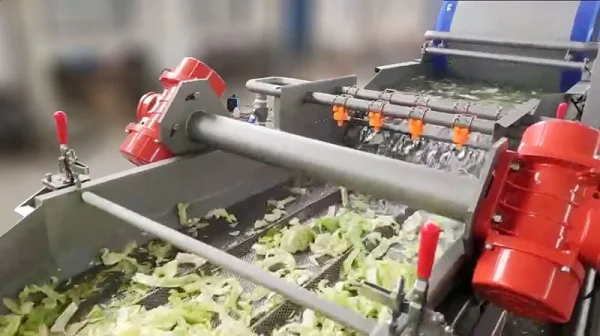
Cut product drops into a trough of circulating water. A propeller or pump drives the water into a horizontal vortex — a spiral current that runs the length of the trough and curls back on itself. Product pieces ride the flow, tumbling gently against water rather than against each other or any surface. The physics does the sorting: heavier debris — grit, soil, stones — sinks to a sediment zone below and leaves through a valve; lighter debris — leaf fragments, insects — floats and leaves over an overflow weir. Washed product exits at the far end onto a dewatering screen or elevator. The water circuit passes through filtration and recirculates, with fresh top-up, because the vortex is only as clean as the water driving it.
Suitable for
Fresh-cut lettuce, cabbage and shredded vegetable lines as the wash after cutting; diced and sliced root vegetables before blanching or packing; baby-leaf and cut salad operations where mechanical gentleness is a shelf-life variable; any line where the wash must also be a sorter — vortex machines separate stone, sand and leaf debris while they clean.
Not suitable for
Whole uncut vegetables with heavy soil, which need a soak or brush washer first; very light products that will not ride the flow, and very dense ones that sink faster than the vortex lifts — both exist and both need different machines; operations without water treatment capacity, because the vortex concentrates everything it removes into its water loop.
Material & compliance
Trough, propeller housing, overflow and discharge in SUS304 (EN 1.4301), fully drainable with sloped tank floor and openable inspection panels — the sediment zone is cleaned daily and the design should admit it. Propeller drive guarded; water circuit filtered with accessible filter housings. Hygienic design throughout: no dead legs, continuous welds, drainable low points.
Supplied with CE declaration of conformity and DoC on request; material certificate EN 10204 3.1 available for contact parts.
Selection notes
Ask what the machine removes on your product and see it demonstrated with dirty product, not clean — the vortex’s value is wash and sort in one, and the demo should show both. Check the sediment discharge arrangement and how the daily clean-out works. Check water consumption and filtration sizing against your soil load. Check the product exit arrangement against your dewatering or spin-dry step — the vortex leaves product wet, and what comes next is part of the washing decision.
When you should not buy this machine: If your product is whole and dirty, this machine is stage two of a wash — buy the first stage too or the vortex loads its filter in an hour. And if your product is delicate berries, test before buying; a strong vortex is still a current, and some berries bruise in any current.
Key specifications
| Parameter | Value |
| Capacity | 1000-4000 kg/h by trough size (TYPICAL, confirm with factory) |
| Washing method | Horizontal vortex flow, propeller or pump driven |
| Debris separation | Sediment valve + floating overflow weir |
| Water circuit | Recirculated with filtration, fresh top-up |
| Product exit | Flume or elevator to dewatering |
| Contact material | SUS304 (EN 1.4301) |
| Power supply | 380V/3P/50Hz or 415V/3P/50Hz, customizable |
Specification values are industry-typical ranges for this machine class and are not verified against a specific factory datasheet. Replace them with measured factory data before publication.
FAQ
Why is vortex washing the fresh-cut standard?
Because cut product needs gentleness and cleanliness at once. Brushes damage cut surfaces; sprays alone miss the suspended juice and tissue fluid. The vortex washes by water movement, dilutes released juice continuously, and sorts debris by density — three jobs in one gentle pass.
How is it different from a bubble washer?
Flow direction and purpose. A bubble washer lifts and tumbles whole product in place; a vortex washer transports product horizontally through a directed current. For whole vegetables the bubble machine shines; for cut product the vortex’s continuous transport and juice dilution fit better.
Does it remove pesticides?
Partly — vortex washing removes surface residues along with soil, but chemical residue reduction is a chemistry question that water movement alone only partially answers. Machines that add ozone or UV exist for that specific claim.
Related equipment
This unit is one stage of a complete processing line. For the full range of washing and peeling equipment, or to compare this model against the Bubble Washing Machine 2000 kg/h, see the complete equipment catalogue. Capacity, material grade and utility requirements can be confirmed through a quote request.
Reviews
There are no reviews yet.