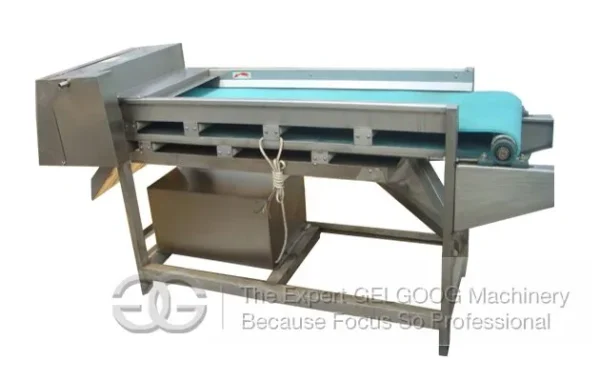
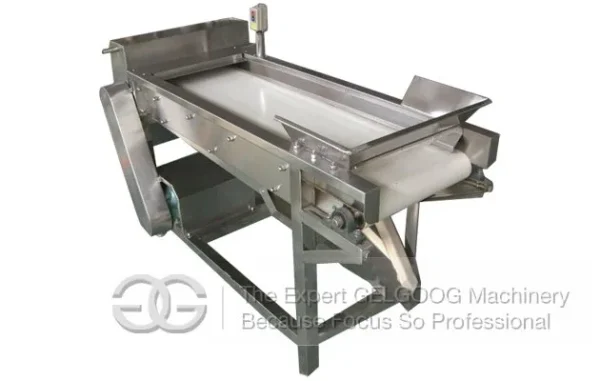
Mushroom Slicing Machine 800 kg/h
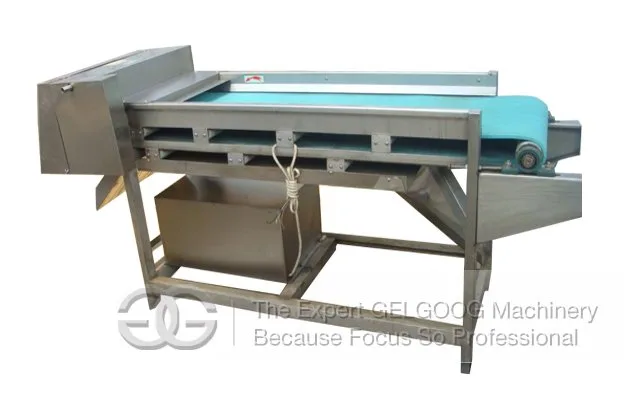
A mushroom is mostly water held together by good manners. Slice it with a spinning hard knife and it tears; slice it by hand and the labour cost outruns the mushroom. The mushroom slicing machine solves this with an old idea done precisely: carry the mushroom on a soft belt into a bank of parallel stationary blades, so each slice is pressed, not struck, and the laminations come off whole. Every canned, frozen and dried mushroom in commerce started on a machine of this type.
How it works
Mushrooms are dewatered or dried of surface water, then laid on a food-grade belt that presses them against a set of evenly spaced circular or straight knives. The gap between blades sets slice thickness — typically 2 to 8 mm — and the belt speed against feed rate sets throughput. Because the blade is stationary and the product moves, the cut is a press-shear that keeps lamella structure intact; the slices leave the blade bank onto a discharge conveyor with surface water and broken bits screened off. Blade sharpness and belt tension are the two daily adjustments; a dull blade shows immediately as ragged edges and pinned slices.
Suitable for
Canning lines, where uniform slice thickness is a label claim and a fill-weight issue; frozen mushroom lines, where slices blanch and IQF-freeze more evenly than wholes; drying operations, because a slice dries in hours where a whole mushroom takes a day; fresh-cut suppliers slicing for retail punnets and food service.
Not suitable for
High-end whole-mushroom products — no slicer improves a mushroom meant to be sold whole; mushrooms too soft or slimy from poor storage, which smear rather than slice and jam the blade bank; operations wanting mixed shapes from one machine — slicing machines slice; dicing and strip cuts belong to different cutter heads or machines.
Material & compliance
Frame, belt deck, blade bank and covers in SUS304 (EN 1.4301); belts food-grade and washdown-safe; blades stainless tool steel with food-safe hardness, designed for removal and regrind. All product zones open or hinged for sanitation, because mushroom residue is a Fabre’s paint of protein and moisture that dries into every seam. Motors and switches rated for wet washdown.
Supplied with CE declaration of conformity and DoC on request; material certificate EN 10204 3.1 available for contact parts.
Selection notes
Ask what thickness range the blade bank ships with and what a spare set costs — blades are consumables and the second set is always needed before the first year ends. Ask how blade change is done; a blade bank that strips with four bolts is a working machine, one that needs a whole teardown is a maintenance story. Check the belt tracking and tensioning, and whether the infeed accepts mixed cap sizes without an operator aligning every mushroom. Ask for a cutting trial with your own mushrooms — cap moisture varies by farm and season, and the trial is the only honest answer.
When you should not buy this machine: If your volume is under a hundred kilos a day, a bench slicer or disciplined hand work is cheaper and just as good. And if your real product is mushroom powder, buy a crusher — slicing to a spec nobody downstream reads is wasted precision.
Key specifications
| Parameter | Value |
| Capacity | 500-1500 kg/h by model (TYPICAL, confirm with factory) |
| Slice thickness | 2-8 mm by blade set (TYPICAL) |
| Blades | 20-60 pcs stainless tool steel, removable bank |
| Belt | Food-grade PU, washdown, tensioned |
| Contact material | SUS304 (EN 1.4301) |
| Motor | 1.5-3 kW class |
| Power supply | 380V/3P/50Hz, customizable |
Specification values are industry-typical ranges for this machine class and are not verified against a specific factory datasheet. Replace them with measured factory data before publication.
FAQ
Why do slices come out ragged?
Blade sharpness first, belt tension second, mushroom condition third. Ragged edges with a fresh blade mean the belt is slipping or the mushrooms are too soft; check storage and the infeed moisture before blaming the machine.
Can it slice oyster mushrooms and shiitake, not just button?
Yes, within reason — oyster mushrooms want gentler belt pressure, shiitake are firmer and slice well. Ask for a trial on your species; the family is broad and cap structure varies more than buyers expect.
How often do blades need changing?
Under daily two-shift use, regrind intervals of one to two weeks are typical. Keep a spare set sharp and rotating — running to dull costs more in downgraded slices than a second blade set ever will.
Related equipment
This unit is one stage of a complete processing line. For the full range of cutting and slicing equipment, or to compare this model against the Vegetable Slicing Machine 1200 kg/h, see the complete equipment catalogue. Capacity, material grade and utility requirements can be confirmed through a quote request.

Reviews
There are no reviews yet.