Peanut Peeling Machine 300 kg/h
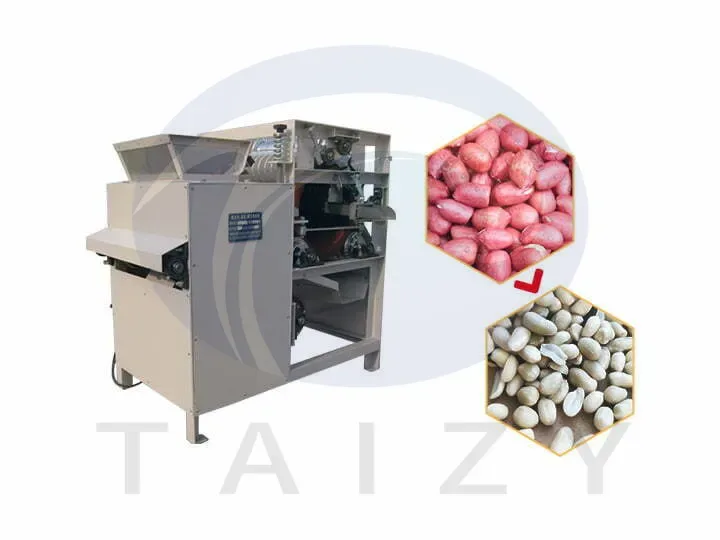
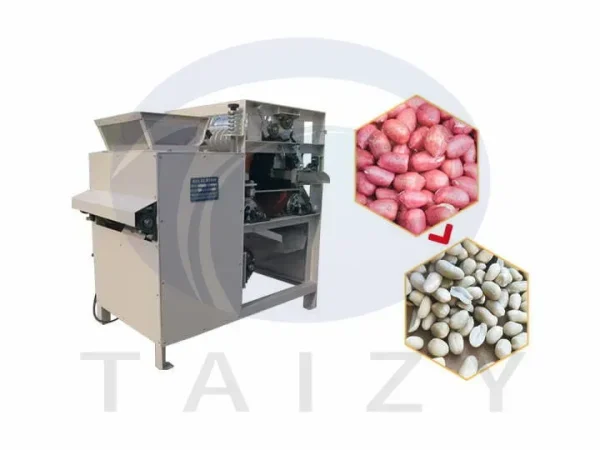
The red skin on a peanut is 3% of the kernel’s weight and most of what customers complain about. Coated peanuts, peanut candy, white-kernel butter — all of them start with skin removal, and skin does not come off willingly at ambient temperature. The peanut peeling machine’s trick is thermal: heat the kernel just enough for the skin to loosen, then rub the skin off mechanically while the kernel stays whole. Get the heat right and the skin falls; get it wrong and you roast the peanut by accident.
How it works
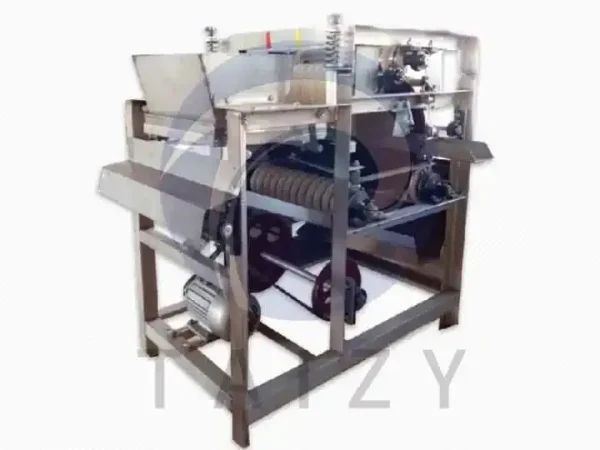
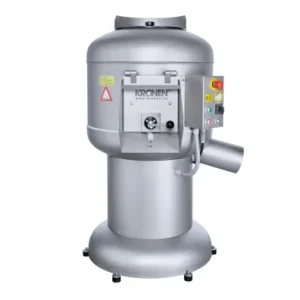
Kernels pass a short dry-heating or roasting section — hot air, or in some designs a heated hopper — that dries and loosens the testa. The warmed kernels drop between counter-rotating rubber rollers or into a cone-and-rib rubbing chamber where friction strips the loosened skin without breaking the kernel. A fan and cyclone or suction duct pulls the separated skin away immediately, because skin left in the product re-adheres as it cools. Output is a white kernel with its germ intact, cool enough for coating or packing. Wet-peeling variants exist — kernels are blanched in hot water and skinned in brushes — but dry peeling dominates for confectionery lines that want no added moisture.
Suitable for
Coated-peanut and snack lines, where skin would burn and speckle the coating; peanut butter and paste producers chasing a whiter paste and longer shelf life; confectionery and bakery suppliers selling white kernels as a product; fried-peanut lines, where skins scorch in the fryer and blacken the oil.
Not suitable for
Raw-kernel trade — skin-on is the grade, and peeling it adds cost for nothing; very small volumes, where a bench blancher and rubbing tray remain honest economics; buyers expecting 100% removal without any kernel heating at all — the process is thermal by definition, and the mild colour change on the kernel surface is part of the deal; operations without skin extraction, because the machine without its dust loop fills the room with red fluff.
Material & compliance
Heating section, rubbing chamber and chutes in SUS304 (EN 1.4301); rubbing surfaces food-grade rubber or stainless ribbing sized for gentle duty. Temperature control on the heating section with a display, because the loosing temperature is the process. Skin extraction duct, fan and collection bag or cyclone included in any serious quotation.
Supplied with CE declaration of conformity and DoC on request; material certificate EN 10204 3.1 available for contact parts.
Selection notes
Ask for the peeling rate and the half-kernel rate together — aggressive rubbing peels brilliantly and halves the kernel, and the pair of numbers is the machine’s real grade. Ask what heating method is fitted and what surface temperature the kernel sees; your downstream process may care. Check the skin-extraction spec and the collection arrangement — skin removal is a dust problem wearing a peeling costume. Check roller or rubber wear parts pricing; they are consumables and the second set arrives within the year.
When you should not buy this machine: If your product sells on red-skin character — whole roasted peanuts in shell or skin-on snacks — this machine subtracts value. And if your kernels are small, broken or of mixed origin, peeling them will not make them uniform; buy sorting first and peeling second.
Key specifications
| Parameter | Value |
| Capacity | 200-500 kg/h by model (TYPICAL, confirm with factory) |
| Peeling rate | 95%+ at correct heat (TYPICAL) |
| Half-kernel rate | Machine-dependent, ask for the figure |
| Heating | Dry hot-air / electric short roast (TYPICAL) |
| Skin extraction | Fan + cyclone / collection bag |
| Contact material | SUS304 (EN 1.4301), food-grade rubber rollers |
| Power supply | 380V/3P/50Hz, 2-6 kW class |
Specification values are industry-typical ranges for this machine class and are not verified against a specific factory datasheet. Replace them with measured factory data before publication.
FAQ
Dry peeling or wet peeling?
Dry for confectionery and coating — no added moisture, kernel goes straight to the next step. Wet peeling suits some paste lines but adds a drying need. Most snack lines buy dry; ask which the factory’s rate guarantee is quoted for.
Does peeling hurt the kernel’s germination if I sell seed peanuts?
Yes — do not peel seed stock. This machine is for processing-grade kernels, and seed lots should never see the heating section.
How hot do the kernels get?
Warm, not roasted — typically a surface-loosening heat well below frying colour. Ask the factory for the kernel exit temperature and confirm your coating or packing process tolerates it, or add a short cooling conveyor.
Related equipment
This unit is one stage of a complete processing line. For the full range of washing and peeling equipment, or to compare this model against the Brush Roller Peeling Machine 800 kg/h, see the complete equipment catalogue. Capacity, material grade and utility requirements can be confirmed through a quote request.
Reviews
There are no reviews yet.