Blast Freezing Room 5 t/batch
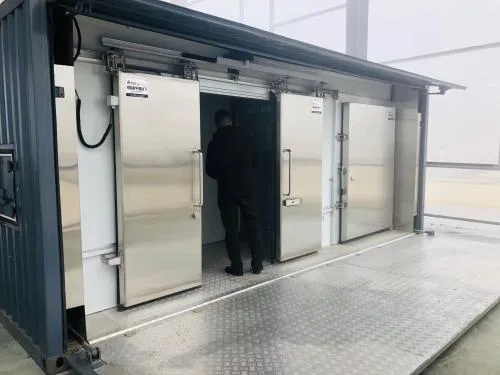
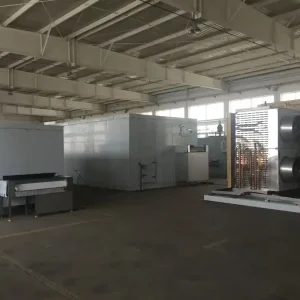
Continuous freezers earn their keep on single products at steady rate. Most mid-size processors do not run that way: crops arrive in lots, products change weekly, and the freezing load spikes after harvest peaks. A blast freezing room is the batch answer — an insulated enclosure with rack trolleys and high-velocity air that pulls pallets or carts of product through the freezing zone in hours, whatever the product, whatever the schedule. It is the least elegant freezer in the catalogue and often the most profitable per yuan invested.
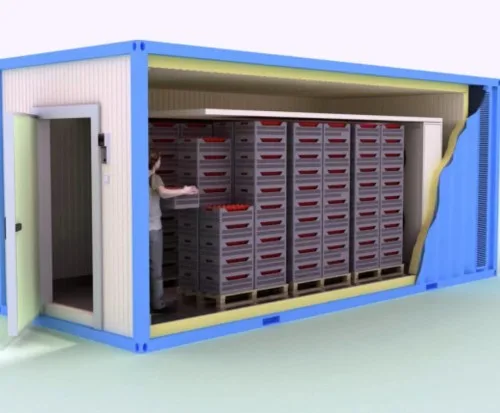
How it works
Loaded trolleys or racks roll into the insulated room; doors seal and the refrigeration plant floods the space with high-velocity air at -30 °C class, forced across product at speeds that strip the boundary layer and drive heat out fast. Airflow is the engineering — evaporator fans, duct baffles and rack spacing are arranged so air sweeps every face of every tray, because freezing rate depends on air contact, not room temperature alone. Product center temperature falls through the freezing zone over hours, and the controller holds cycle settings per product; sensors verify core temperature before release. Doors open, trolleys roll out to cold storage, and the next batch loads — the cycle repeating around your production rhythm, not a conveyor’s.
Suitable for
Mixed-product plants freezing different crops across a season in one enclosure; packers freezing bagged or bulk produce in the pack format it ships in; seasonal peaks that outrun a continuous line’s capacity; processors of irregular lots — trial batches, contract lots, by-product freezing; cold stores adding a freezing capability without building a tunnel line.
Not suitable for
IQF specification on loose berries or diced product — blast rooms freeze in bulk or packs, and clumping is inherent, not a defect to argue; single-product continuous duty at high tonnage, where a tunnel or spiral pays back its extra capital in labour; buyers without the buffer cold storage to hold frozen batches; and sites whose floor cannot take trolley loads or whose doors cannot take the traffic.
Material & compliance
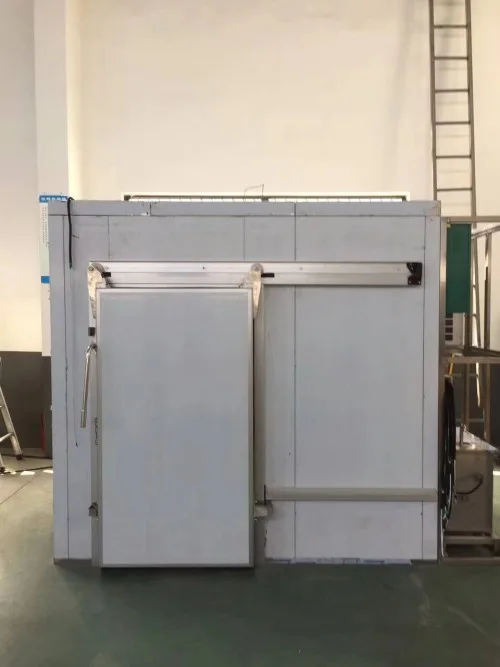
Enclosure panels insulated food-grade with SUS304 (EN 1.4301) or food-safe coated interiors; evaporators, racks and trolleys food-grade construction; door seals and traffic layout for hygiene; temperature recording for HACCP with core-probe verification per cycle.
Supplied with CE declaration of conformity and DoC on request; refrigeration plant per applicable pressure and safety codes.
Selection notes
Start from your batch, not your tonnage: room volume must take your real trolley geometry with airflow clearances, and the honest spec is your worst-shaped load. Ask for the freezing curve — hours from load to -18 °C core at your product and pack — because cycle time sets daily capacity and the label rate rarely matches your pack size. Confirm airflow uniformity across rack positions; front rows freeze while back rows linger in badly designed rooms, and the difference shows in audit samples. Check refrigerant and plant compliance for your market, and price the electricity — blast rooms are simple but power-hungry, and the running cost is the number your accountant asks about.
When you should not buy this machine: If your product is a single loose-cut vegetable at continuous volume, the IQF line freezes better per tonne and pays for itself — a blast room serving as an IQF substitute ships clumps. And if you only need to hold frozen stock, cold storage freezes nothing; buy the store, and rent freezing capacity for the peaks until volume justifies the room.
Key specifications
| Parameter | Value |
| Batch capacity | 2000-8000 kg per cycle by product and pack (TYPICAL, confirm with factory) |
| Air temperature | -30 °C class at evaporator (TYPICAL) |
| Cycle time | 3-8 h to -18 °C core by product (TYPICAL) |
| Airflow | High-velocity evaporator fans with ducted distribution |
| Panel / interior | Insulated food-grade panels, SUS304 or food-safe interior |
| Power supply | 380V/3P/50Hz, refrigeration plant sized per room |
Specification values are industry-typical ranges for this machine class and are not verified against a specific factory datasheet. Replace them with measured factory data before publication.
FAQ
How does it differ from a cold storage room?
Temperature and airspeed. Cold storage holds at -18 °C with gentle air; a blast room pulls to -30 °C class and drives air across product at high velocity to freeze fast. Freezing speed decides ice-crystal size and quality — a store that freezes slowly does the job of a store, not a freezer.
Can we freeze in retail bags and cartons?
Yes — that is the blast room’s advantage over IQF lines. Pack thickness is the enemy: every extra centimetre of insulation between product and air stretches cycle time. Freeze in the thinnest pack that survives handling, then overwrap or case after freezing if the format needs it.
How many cycles a day?
One to three depending on product and cycle time. The honest planning number comes from your freezing curve — load, pull-down, freeze to core, unload — plus the labour around it. Schedule the room around your production rhythm; that flexibility is precisely why you chose batch.
Related equipment
This unit is one stage of a complete processing line. For the full range of freezing equipment, or to compare this model against the Blast Freezer 1000 kg/h, see the complete equipment catalogue. Capacity, material grade and utility requirements can be confirmed through a quote request.
Reviews
There are no reviews yet.