


Lotus Root Slicing Machine 800 kg/h
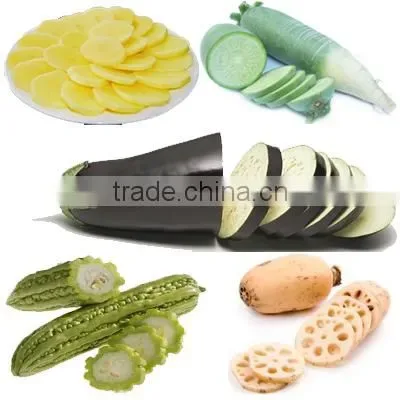
Lotus root is a slicing problem disguised as a vegetable. It is long, it curves, its cross-section carries air holes that tear if cut badly, and its value in the pack is a clean ring with the hole pattern intact. A lotus root slicer holds curved, tapered segments steady and shears them into round slices of set thickness — quickly enough for a blanching or frying line, gently enough that the slices look hand-cut.
How it works
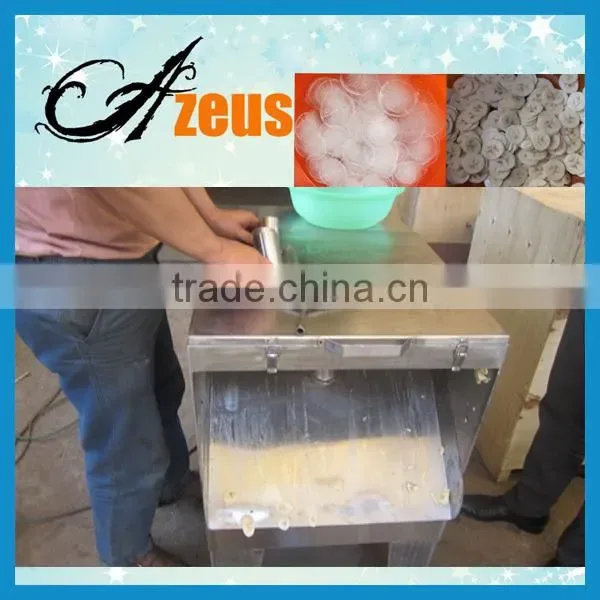
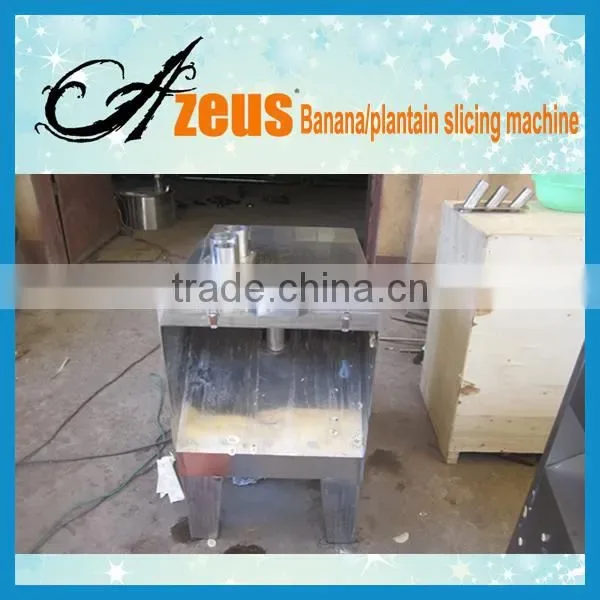
Peeled segments feed into a guide channel sized to the segment range. A reciprocating or circular blade set cuts transverse slices; the feed mechanism advances the segment by exactly one slice thickness per stroke, which is how thickness is controlled — mechanically, by the feed pitch. Guides support the segment along its curve rather than clamping it, so tapered pieces stay centred and the slice comes out round instead of wedge-shaped. Slices wash forward on a water flume or belt to the discharge, since cut surfaces release starch that must leave the cutting zone. Thickness is changed by feed pitch or blade-set swap depending on the model.
Suitable for
Fresh-pack lotus root slices for retail and foodservice; blanching and frying lines needing uniform slice thickness for even cooking; dried lotus root slice production feeding a dryer; mixed root slicing — potato, sweet potato, taro — on the same machine within the segment size range.
Not suitable for
Unpeeled, unwashed segments with stringy fibre and grit, which dull blades fast and ruin the cut; segments outside the guide channel’s size range — very small or very curved pieces need manual trimming first; operations expecting dicing or shredding from the same head, which is a different machine class with different tooling.
Material & compliance
Frame, channel and discharge in SUS304 (EN 1.4301); blades in stainless blade steel, removable as matched sets with defined sharpening or replacement intervals. The cutting zone opens fully for wash-down — lotus root starch dries hard and packs into every gap. Blade station fully guarded with interlocked access; feed channel geometry keeps hands clear by design.
Supplied with CE declaration of conformity and DoC on request; material certificate EN 10204 3.1 available for contact parts.
Selection notes
Ask for a cut test with your segments, including the curved and tapered ones — slice roundness on non-straight pieces is where this machine class separates. Check how thickness is changed and what the real range is. Check blade access and the sharpening regime, since starch plus fibre is a hard combination on edges. Check the starch-flume arrangement, because starch left in the cutting zone packs within an hour and starts stressing the blade.
When you should not buy this machine: If your slices go straight into a paste or starch process, slice geometry does not matter and a cheaper crusher does the job. And if your intake segment sizes vary wildly by season, either trim to a range upstream or accept wedge slices — the guide channel cannot hold what it was not sized for.
Key specifications
| Parameter | Value |
| Capacity | 500-1500 kg/h by model (TYPICAL, confirm with factory) |
| Slice thickness | 2-12 mm by feed pitch/blade set (TYPICAL) |
| Cut type | Transverse round slice, guide-channel feed |
| Segment range | 40-100 mm diameter by channel set (TYPICAL) |
| Blades | Stainless matched sets, removable |
| Starch control | Water flume or wet belt discharge |
| Contact material | SUS304 (EN 1.4301) |
| Power supply | 380V/3P/50Hz or 415V/3P/50Hz, customizable |
Specification values are industry-typical ranges for this machine class and are not verified against a specific factory datasheet. Replace them with measured factory data before publication.
FAQ
Does it keep the hole pattern intact?
Yes when the blade is sharp and the segment is supported — the holes are air channels that tear under crushing but shear cleanly under a true cut. Blade condition is the deciding variable, which is why the sharpening regime matters more here than on most slicers.
Can it slice potatoes and sweet potatoes?
Yes, within the channel size range — straight roots slice more easily than curved lotus segments. Thickness settings apply across products.
How much does peeling quality matter upstream?
A lot. Fibre and grit from unpeeled segments reach the blade edge and the slice face both. Well-peeled, well-washed segments are the cheapest way to good slices.
Related equipment
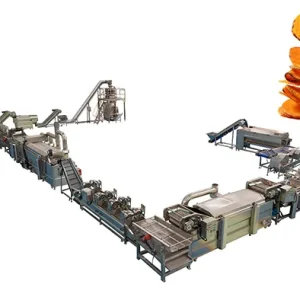
This unit is one stage of a complete processing line. For the full range of cutting and slicing equipment, or to compare this model against the Vegetable Slicing Machine 1200 kg/h, see the complete equipment catalogue. Capacity, material grade and utility requirements can be confirmed through a quote request.
Reviews
There are no reviews yet.