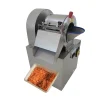
Vegetable Shredding Machine
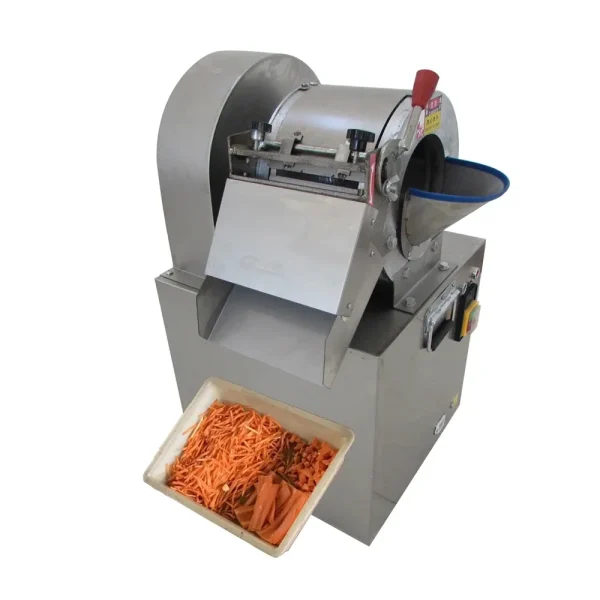
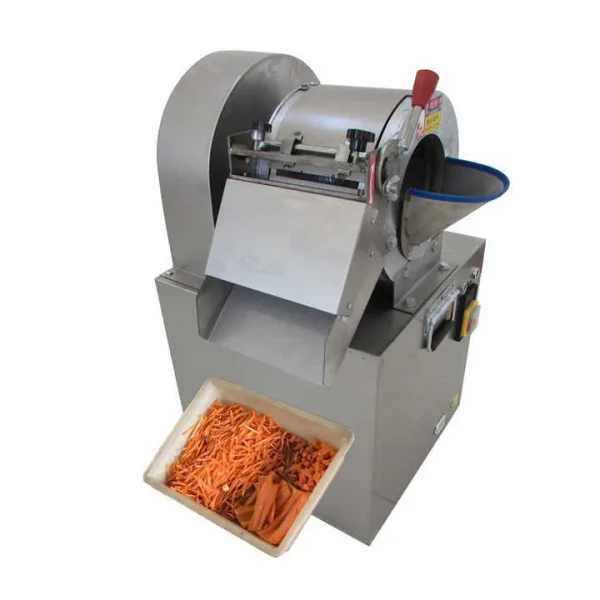
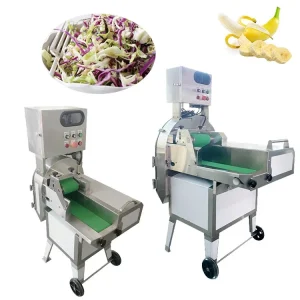
Rotary shredder that reduces cabbage, carrots and firm vegetables to uniform shreds and julienne for salads, pickling, coleslaw and dehydration lines.
How it works
Product is fed by hand or conveyor into a hopper above a horizontal cutting disc. The disc carries a set of knives arranged radially; as it turns, each knife takes a slice of the thickness set by its height above the disc, and a comb or guide below separates the slice into shreds of the width cut by the knife spacing. Product is pressed down by a feed pusher or simply by weight, and the shreds discharge through a chute below.
Cut geometry is fixed by the disc: slice thickness comes from the knife height, shred width from the knife spacing, and both change by swapping the disc rather than by adjusting a setting.
Suitable for
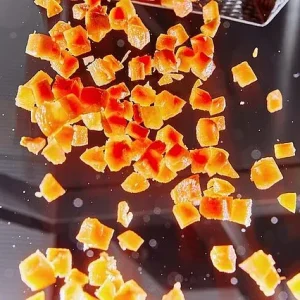
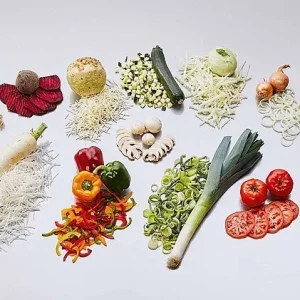
Cabbage and Chinese cabbage for coleslaw and pickling; carrot, celeriac and radish julienne; onions for dehydration; firm vegetables for soup mixes and ready meals; product where a long, thin cut is wanted rather than a dice.
Not suitable for
Soft or overripe product that crushes at the feed; leafy greens needing a cross-cut, which a belt cutter does better; very large root crops that will not pass the feed throat; product needing a dice or a shaped cut.
Material & compliance
Cutting disc, knives, hopper and chute in SUS304 (EN 1.4301); knives in hardened stainless or tool steel. Disc and knives removable without tools for cleaning and sharpening; feed hopper interlocked.
Supplied with CE declaration of conformity and DoC on request; material certificate EN 10204 3.1 available for contact parts.
Selection notes
Specify the cut geometry you actually sell — thickness and width are set by the disc, and a machine shipped with one disc gives you one cut. Ask how many discs are included and what a spare costs. Check the feed throat against your whole-product size; if you must pre-cut everything, the machine is not saving you the labour it claims.
When you should not buy this machine: If you need several cut sizes per shift, disc changeover will dominate your day — look at quick-change cassettes or a second machine. Also skip it for soft product: a rotary disc crushes rather than slices anything that cannot hold its shape under feed pressure.
Key specifications
| Parameter | Value |
| Capacity | 300-2000 kg/h (TYPICAL, confirm with factory) |
| Cut size | 1.5-8 mm by blade set (TYPICAL) |
| Motor power | 0.75-2.2 kW (TYPICAL) |
| Feed opening | By model, sized to whole or halved product (TYPICAL) |
| Contact material | SUS304 (EN 1.4301) |
| Power supply | 380V/3P/50Hz or 415V/3P/50Hz, customizable |
Specification values are industry-typical ranges for this machine class and are not verified against a specific factory datasheet. Replace them with measured factory data before publication.
FAQ
Can I change shred width without changing the disc?
Usually not. Width is set by knife spacing on the disc. Some machines offer interchangeable knife sets on one disc body, which is cheaper than a whole disc — confirm what you are buying.
Why do shreds come out ragged or crushed?
Dull knives, or product too soft for the feed method. Sharpen the knives first; if the problem persists, the product is not suited to a rotary disc and a belt cutter will give a cleaner cut.
Is it suitable for dehydration lines?
Yes, and shred size matters there: uniform shreds dry at a uniform rate. Oversized pieces stay wet after the dryer, so match the shred to the drying curve rather than to the pack appearance alone.
Related equipment
This unit is one stage of a complete processing line. For the full range of cutting and slicing equipment, or to compare this model against the Vegetable Strip Cutter 1000 kg/h, see the complete equipment catalogue. Capacity, material grade and utility requirements can be confirmed through a quote request.
Reviews
There are no reviews yet.