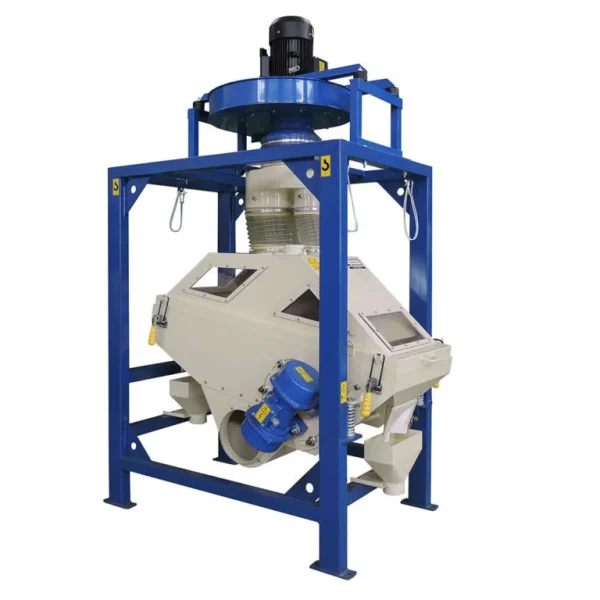

Air Aspiration Separator
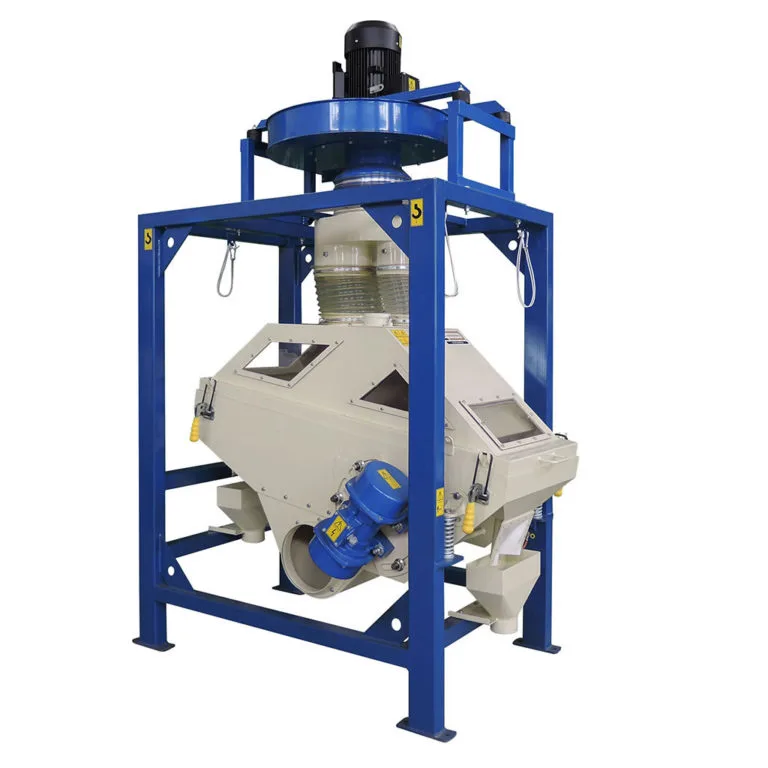
Aspiration separator that removes light foreign material from a product stream by exploiting the difference in terminal velocity between product and trash.
How it works
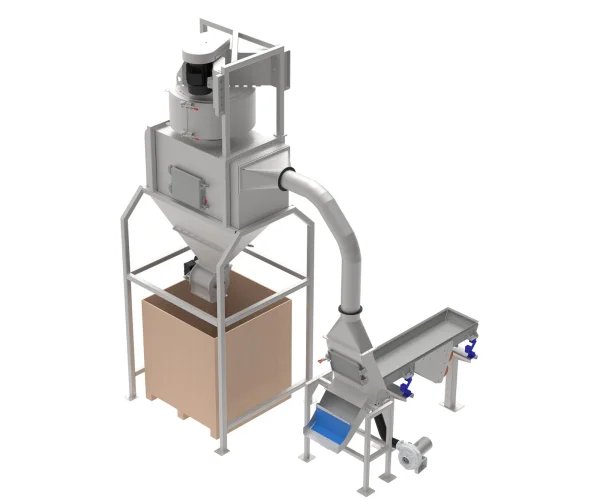
Product is metered into a vertical or inclined channel through which air is drawn at a controlled velocity. Pieces whose terminal velocity is below the air speed — leaf, husk, skin, empty seed, chaff, light debris — are carried upward and out to a cyclone or settling chamber. Pieces heavier than the air can lift fall through and discharge as the clean fraction. Air velocity is the setting that decides the cut point.
The separation is by density and drag, not by size. That is what makes it useful where a screen cannot help: a leaf and a pea may be the same size and completely different in the air stream.
Suitable for
Removing leaf and stalk from peas, beans and berry harvests; taking husk and skin out of cut product; cleaning grain-like product such as sweetcorn before further processing; removing light debris after peeling or de-stoning; any stream where the trash is lighter than the product.
Not suitable for
Trash of the same density as the product, which no air stream can separate; heavy contamination such as stones, glass or metal, which needs a destoner or a metal detector; wet or sticky product that agglomerates and changes its drag; product that is itself light enough to be carried away.
Material & compliance
Channel, expansion chamber, cyclone and discharge chutes in SUS304 (EN 1.4301); air path designed for inspection and washdown. Air is filtered where it contacts food; exhaust passes through a cyclone or filter before discharge to the room.
Supplied with CE declaration of conformity and DoC on request; material certificate EN 10204 3.1 available for contact parts.
Selection notes
Give the factory a sample of your product and your trash, because the cut point sits between the two terminal velocities and cannot be set from a description. Ask how air volume is adjusted and whether the setting is repeatable after cleaning. Check dust handling: aspiration generates dust, and the exhaust arrangement is what keeps it out of the room and out of the operator’s breathing zone.
When you should not buy this machine: If your contamination is dense — stones, glass, metal — air will not move it and you need a destoner, a gravity table or detection equipment. Also skip it if the product and the trash are close in density: you will either blow away good product or leave the trash in.
Key specifications
| Parameter | Value |
| Capacity | 500-8000 kg/h by channel width (TYPICAL, confirm with factory) |
| Air volume | Model and product dependent (TYPICAL) |
| Separation principle | Terminal velocity difference in an air stream (TYPICAL) |
| Fan power | 1.5-5.5 kW (TYPICAL) |
| Contact material | SUS304 (EN 1.4301) |
| Power supply | 380V/3P/50Hz or 415V/3P/50Hz, customizable |
Specification values are industry-typical ranges for this machine class and are not verified against a specific factory datasheet. Replace them with measured factory data before publication.
FAQ
How do I set the air speed?
By trial with your own product. Raise the air until trash is carried over, then back off until good product stops being lost. That window is your operating range, and it is narrow when densities are close.
Does it remove stones?
No. Stones are denser than product and fall through with it. Use a destoner or a gravity separator for dense contamination.
Where does the light material go?
To a cyclone or settling chamber that drops it out of the air stream. The exhaust should be filtered before it is discharged, both for housekeeping and for operator air quality.
Related equipment
This unit is one stage of a complete processing line. For the full range of sorting and grading equipment, or to compare this model against the Vibrating Screen Grader 2000 kg/h, see the complete equipment catalogue. Capacity, material grade and utility requirements can be confirmed through a quote request.
Reviews
There are no reviews yet.