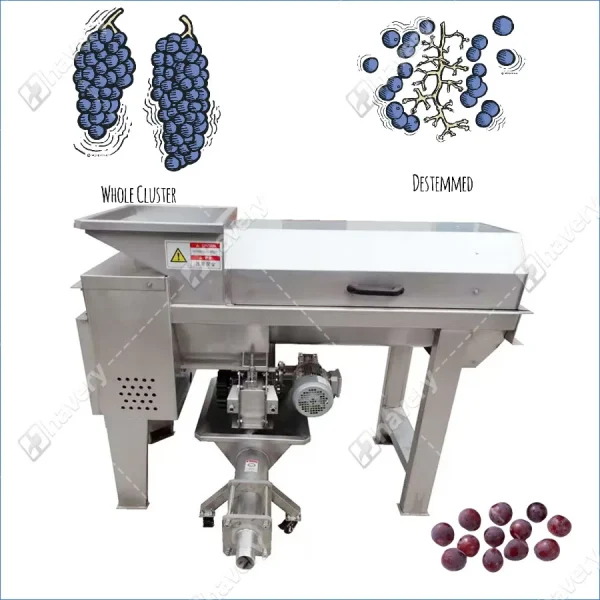
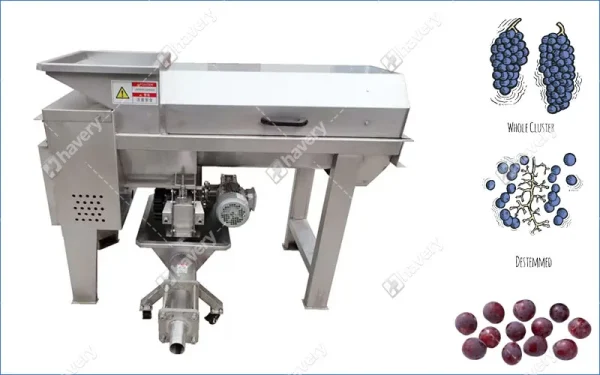
Grape Destemming Machine 2000 kg/h
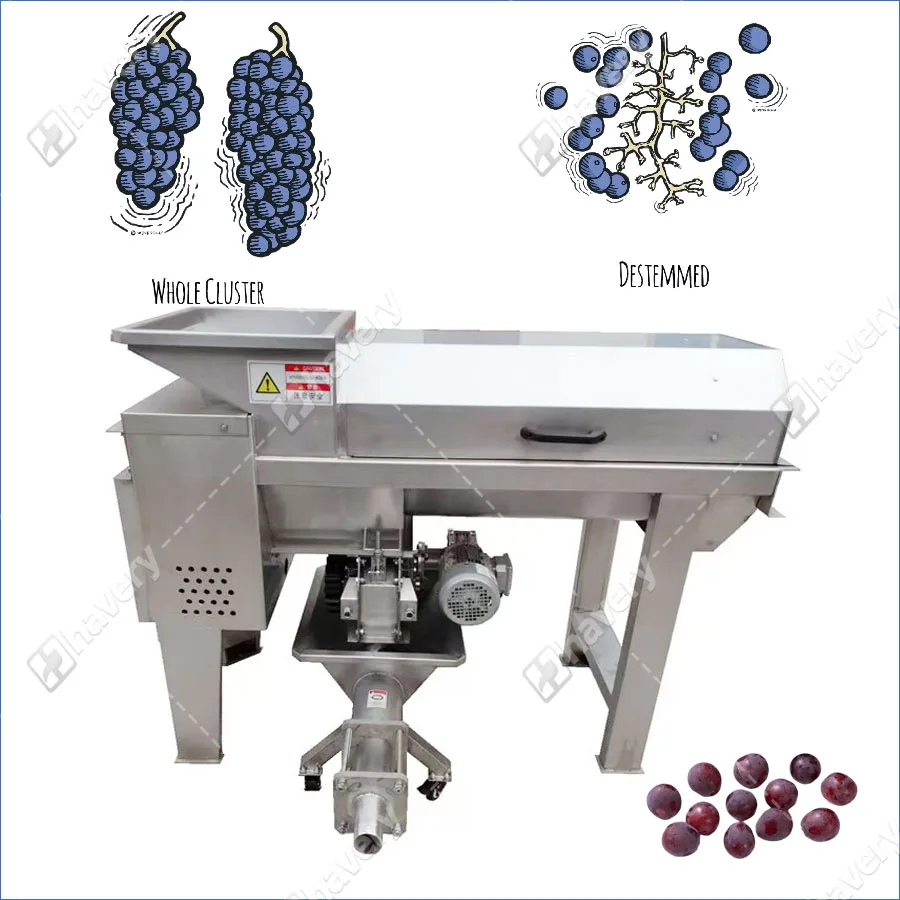
Separating unit that removes stems from harvested grape clusters before crushing. Whether you destem at all, and how gently you do it, is a wine-making decision as much as an equipment one — the machine is the tool that lets you apply it consistently at scale.
How it works
Clusters are fed into a horizontal or slightly inclined cage. Inside, a rotating shaft carries beater arms or paddles that throw the clusters against the cage wall; berries pass through the perforations, while stems are retained and worked along the cage to a discharge at the far end. A separate auger removes the stems.
Intensity is set by shaft speed and by the clearance between the beaters and the cage. Higher speed removes stems more completely but damages more berries and releases juice that then oxidises before pressing. Most machines therefore offer a speed control rather than a fixed setting, and the operator tunes it against the condition of the fruit arriving that day.
Suitable for
Wineries and juice plants receiving machine-harvested or hand-harvested clusters; red and white vinification where whole-berry fermentation or a low-phenolic must is wanted; table grape packing lines that need stems off without skin damage; berry and soft fruit processing where the stem fraction has to leave the process as a dry stream.
Not suitable for
Product where whole-cluster fermentation is deliberately used, in which case the machine sits idle; very small or very fragile berries that break under any beater setting; fruit arriving with a large amount of leaf and woody material, which overloads the cage and jams the stem discharge; anyone without a route for the stem stream — it is wet, bulky and needs somewhere to go.
Material & compliance
Cage, beater shaft and hopper in SUS304 (EN 1.4301); perforated cage edges deburred so they do not cut berries. The machine must open for cleaning, because sugar residue left overnight is a microbial problem as much as a hygiene one.
Supplied with CE declaration of conformity and DoC on request; material certificate EN 10204 3.1 available for contact parts.
Selection notes
Ask for the stem-removal completeness and the berry breakage rate at the same speed setting — quoted separately they mean nothing. Check that the cage can be changed or cleaned without tools, because it will be cleaned every day of the harvest. Check the stem discharge route before you buy: a destemmer with nowhere to put its stems stops the line.
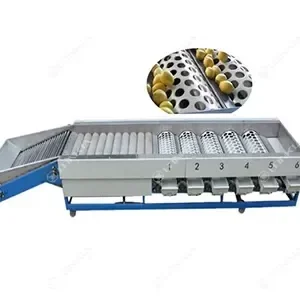
When you should not buy this machine: If you make wine from whole clusters, or if your volumes are small enough that hand destemming and a crusher are sufficient, this is capital sitting still for eleven months of the year. Also skip it if your fruit arrives with heavy leaf load — put a sorting step in front of it first.
Key specifications
| Parameter | Value |
| Capacity | 1000-3000 kg/h by cage size (TYPICAL, confirm with factory) |
| Stem discharge | Separate stream, typically by auger |
| Berry damage | Adjustable; low-intensity setting available (TYPICAL) |
| Cage / beater speed | Variable by model (TYPICAL) |
| Juice loss at destemming | Low, but measurable (TYPICAL) |
| Contact material | SUS304 (EN 1.4301) |
| Power supply | 380V/3P/50Hz or 415V/3P/50Hz, customizable |
Specification values are industry-typical ranges for this machine class and are not verified against a specific factory datasheet. Replace them with measured factory data before publication.
FAQ
Does destemming change the wine?
Yes. Stems contribute tannin and a vegetal character; removing them gives a cleaner, fruit-forward must. Whole-cluster fermentation is a deliberate choice for some styles, and those producers run the fruit straight to the fermenter.
How do I set the speed?
Against the fruit, not against the clock. Start low, check the stem stream for attached berries and the berry stream for skin damage, then raise the speed until one of the two becomes unacceptable. That point moves as the fruit condition changes through the harvest.
What happens to the stems?
They leave wet and bulky, typically 3-7 % of the intake by weight. Most plants compost them or spread them; the handling problem is volume and moisture, not disposal cost.
Related equipment
This unit is one stage of a complete processing line. For the full range of sorting and grading equipment, or to compare this model against the Vegetable Destoner Machine 3000 kg/h, see the complete equipment catalogue. Capacity, material grade and utility requirements can be confirmed through a quote request.
Reviews
There are no reviews yet.