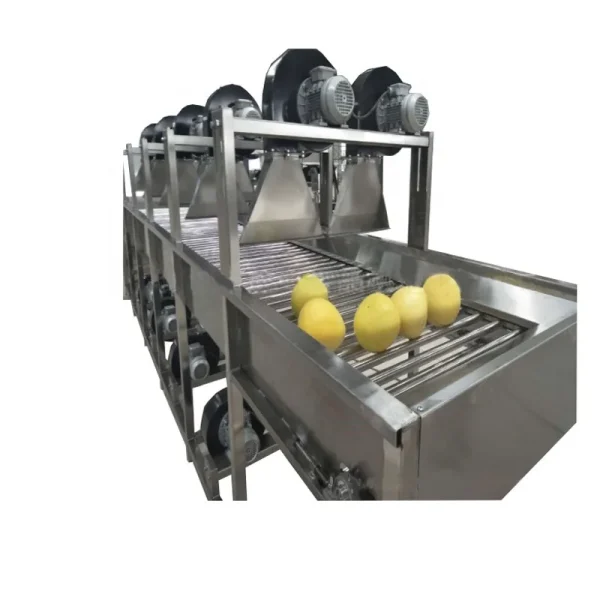

Fruit Waxing Machine 3000 kg/h

Coating unit installed after washing and grading that applies a controlled film of food-grade wax over the fruit surface, restoring the protective layer washing removes and slowing moisture loss through storage and transport.
How it works
Washed and dried fruit is carried over a set of rotating brushes. Wax emulsion is metered onto the brushes or sprayed onto the fruit ahead of them, and the brushes spread it into a thin, even film as the fruit rotates and travels. Excess is wiped off, and the coated fruit passes through a warm-air drying section that sets the film. Application rate is controlled by pump output and by line speed; uniformity comes from the brush bed and from having the fruit dry before it enters.
The coating does two jobs: it reduces water loss, which is weight you are paid for, and it improves appearance, which is what the retail buyer sees. Both depend on an even film rather than a heavy one.
Suitable for
Apples and pears after washing and grading; citrus destined for export, where coating is standard practice; stone fruit and other firm fruit where storage life is the constraint; packhouses losing saleable weight to moisture loss in cold storage; lines supplying retail, where surface finish is part of the specification.
Not suitable for
Fruit sold immediately or locally, where coating adds cost without benefit; product where the destination market restricts the coating material; soft or delicate fruit that the brush bed damages; organic programmes that prohibit the coating; wet fruit, because wax applied over water films unevenly and looks worse than no coating.
Material & compliance
Frame, brush bed, drip trays and drying section in SUS304 (EN 1.4301). Wax circuit with metering pump, filter and return; drip trays arranged for recovery and cleaning; drying section with controlled warm air; coating material and any food-contact elastomers to FDA 21 CFR 175 where required.
Supplied with CE declaration of conformity and DoC on request; material certificate EN 10204 3.1 available for contact parts.
Selection notes
Establish which coating your destination market allows before you size anything — the material approval, not the machine, is usually the binding constraint. Ask for the application rate measured in litres per tonne at your line speed, and check that the fruit is genuinely dry before the brush bed, since water is the usual cause of an uneven finish. Confirm the coating can be traced and documented: buyers increasingly ask what was applied at what rate.
When you should not buy this machine: If your fruit is sold within days of packing, coating does not pay for itself. Also skip it where the destination market or your certification scheme restricts coating materials — you would be buying a process you cannot use.
Key specifications
| Parameter | Value |
| Capacity | 1000-10000 kg/h by brush bed width (TYPICAL, confirm with factory) |
| Application rate | 0.5-3.0 L/t by fruit size (TYPICAL) |
| Coating type | Carnauba, shellac or composite food-grade wax (TYPICAL) |
| Brush rows | 2-6 by model (TYPICAL) |
| Drying section | Warm air, ambient by model (TYPICAL) |
| Contact material | SUS304 (EN 1.4301) |
| Power supply | 380V/3P/50Hz or 415V/3P/50Hz, customizable |
Specification values are industry-typical ranges for this machine class and are not verified against a specific factory datasheet. Replace them with measured factory data before publication.
FAQ
Why wax fruit after washing?
Because washing removes the natural surface wax. Replacing it slows moisture loss — which is saleable weight — and gives the finish that retail buyers expect.
How much wax goes on each fruit?
Enough to cover, not enough to see. Over-application is visible as a blotchy or greasy surface and it costs money; the rate is measured in litres per tonne of fruit.
Does coating affect storage atmosphere?
It reduces gas exchange through the skin, which is part of how it slows water loss. In controlled-atmosphere storage the coating and the atmosphere specification need to be considered together.
Related equipment
This unit is one stage of a complete processing line. For the full range of sorting and grading equipment, or to compare this model against the Roller Size Grading Machine 3000 kg/h, see the complete equipment catalogue. Capacity, material grade and utility requirements can be confirmed through a quote request.
Reviews
There are no reviews yet.