

Fruit Wedging Machine 800 kg/h
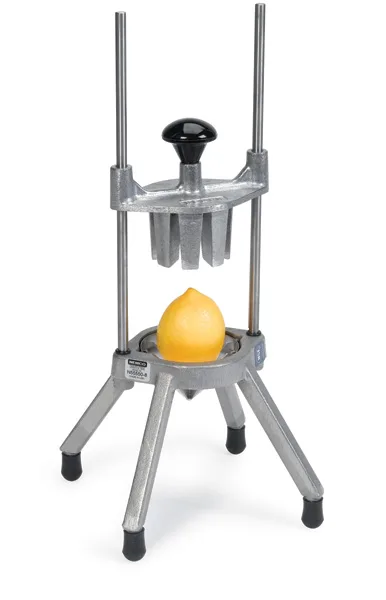
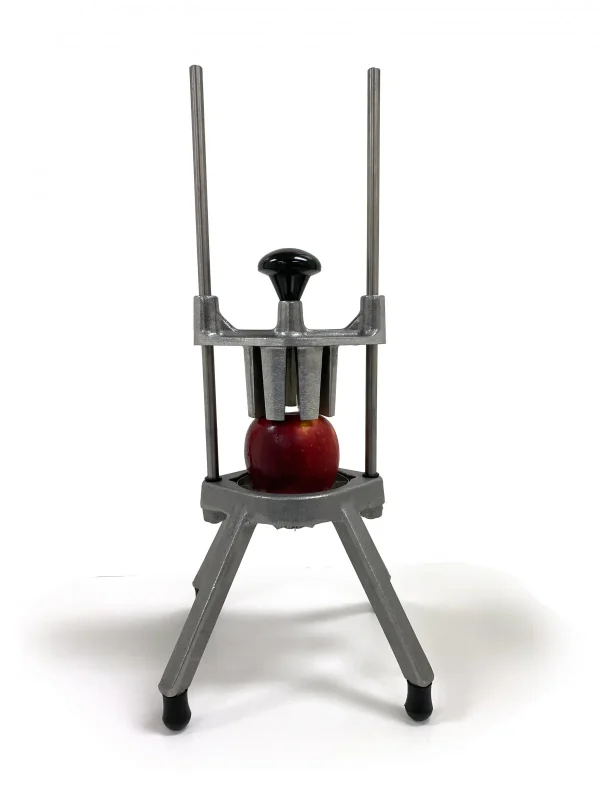
Cutting unit that takes whole fruit, centres it, and divides it into radial wedges in one stroke. It sits between sizing and downstream processing, and it is the machine that decides whether your wedges look uniform enough to be sold as a cut product.
How it works
Fruit is fed individually — by hand on small machines, by an orienting feeder on larger ones — into a cup or a set of centring fingers. A blade head carrying a number of radial blades descends and pushes the fruit through the blade set in a single stroke, dividing it around its axis. The core can be removed in the same stroke by a coring tube, or left in depending on the product.
The important part is the centring, not the blades. If the fruit is off-centre, the wedges come out uneven: some mostly skin, some mostly core. Machines handle this either with a mechanical centring device that finds the fruit axis, or by accepting a wider tolerance and sorting the output. Blade heads are interchangeable, so the same machine produces 4, 6, 8 or 10 wedges from the same fruit.
Suitable for
Apples and pears for fresh-cut packs, for drying or for canning; citrus where segments or wedges are wanted rather than slices; firm-fleshed stone fruit after stoning; product where the visual appearance of the cut face is a specification, such as dried apple rings or fruit for yoghurt and bakery toppings.
Not suitable for
Soft or overripe fruit, which collapses under the stroke instead of being cut; irregular shapes that cannot be centred, where the blade misses or the wedges vary too widely; very small fruit below the cup range, where the machine will not hold the piece; product where a flat slice is required — that is a slicer, not a wedger.
Material & compliance
Frame, product cups and guides in SUS304 (EN 1.4301); blades in hardened stainless blade steel, typically a martensitic grade, and supplied as a consumable set. Guarding and interlocks on the blade head; the cutting zone must be reachable for blade change and cleaning without defeating the guard.
Supplied with CE declaration of conformity and DoC on request; material certificate EN 10204 3.1 available for contact parts.
Selection notes
Ask what happens to off-centre fruit, because that is where the yield loss hides — a machine with a good centring device costs more and wastes less. Check blade changeover time and whether blade heads are stocked in the cut count you need. Check the cup range against your actual fruit diameter distribution; a wedger sized for dessert apples will struggle with small processing-grade fruit.
When you should not buy this machine: If your fruit is already peeled and cored and you only need to divide it, a simple slicer does the job for less money. And if your input size variation is wide and you cannot size-grade first, buy the grader before the wedger — no wedger compensates for an ungraded feed.
Key specifications
| Parameter | Value |
| Capacity | 500-1200 kg/h by feed method (TYPICAL, confirm with factory) |
| Cuts per fruit | 4 / 6 / 8 / 10 by interchangeable blade head |
| Fruit diameter | 50-110 mm (TYPICAL) |
| Core removal | Optional coring head in the same stroke |
| Blade material | SUS420 or equivalent stainless blade steel |
| Contact material | SUS304 (EN 1.4301) |
| Power supply | 380V/3P/50Hz or 415V/3P/50Hz, customizable |
Specification values are industry-typical ranges for this machine class and are not verified against a specific factory datasheet. Replace them with measured factory data before publication.
FAQ
Why are my wedges uneven if the blades are sharp?
Because the fruit was not centred. Wedging is a radial cut; if the fruit axis is off, the blade set divides it unevenly. Sharpen or replace the blades and the problem will remain until the centring is fixed.
Can one machine do both wedges and slices?
Not usually in the same stroke. Some machines accept both a radial head and a slicing head, but the feed and the centring are different, so treat a changeover as a different setup rather than a switch.
How often do blades need replacing?
As a consumable, not as a spare part. Blade life depends on fruit acidity, throughput and how much grit arrives with the fruit. Buy a spare set at the start; the first set will not last a full season on a hard-running line.
Related equipment
This unit is one stage of a complete processing line. For the full range of cutting and slicing equipment, or to compare this model against the Fruit Slicing Machine 1000 kg/h, see the complete equipment catalogue. Capacity, material grade and utility requirements can be confirmed through a quote request.
Reviews
There are no reviews yet.