Pineapple Peeling and Coring Machine
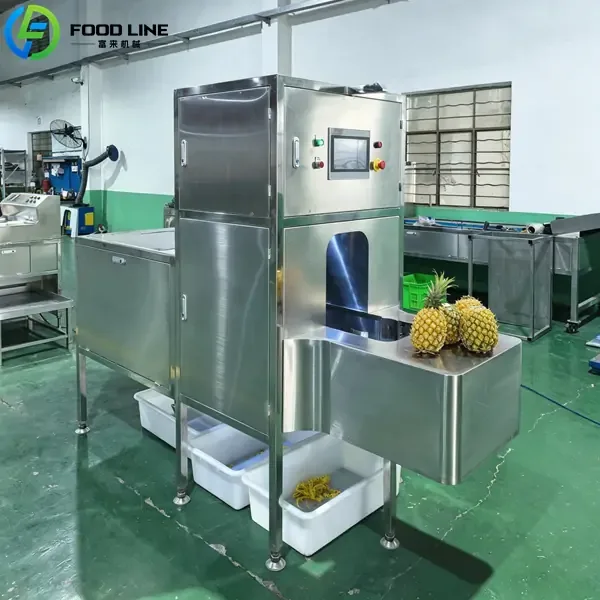
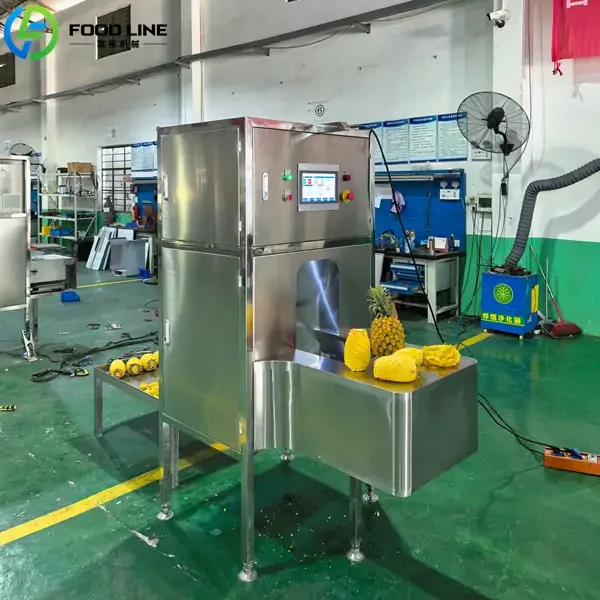
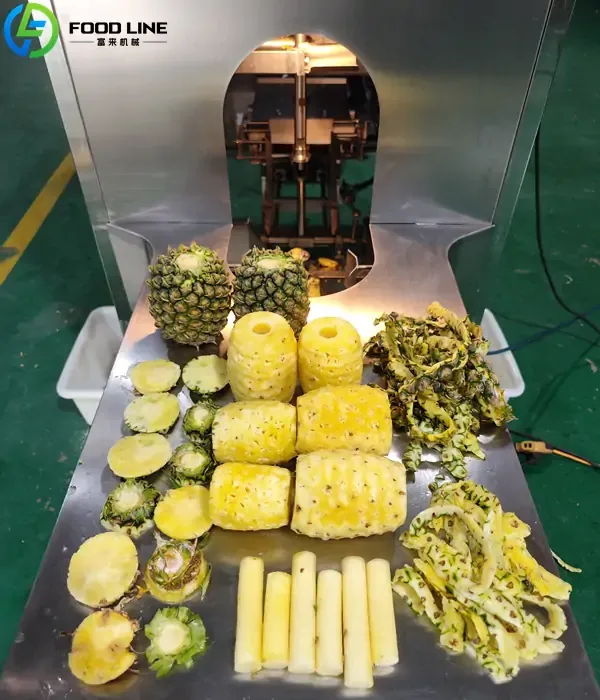
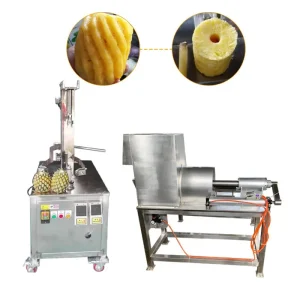
Automatic machine that removes the crown, peels the skin and cores the central axis of a pineapple in one pass, leaving a clean cylinder ready for slicing, dicing or juice extraction.
How it works
Fruit is placed by hand onto a locating spike or cup on an indexing carousel or chain. The first station cuts off the crown, the second drives a tubular knife down the axis to remove the core, and a cylindrical peeling blade follows the fruit profile to remove skin and eyes. Peel and core are discharged separately from the edible cylinder, which is released at the end of the cycle.
Because the peeling blade follows the fruit contour, yield depends on how well each fruit is centred on the spike.
Suitable for
Pineapple for slices, chunks, juice or drying; similar firm cylindrical fruit such as melon with a change of tooling; fresh-cut operations and canning lines; plants replacing manual peeling, which is slow and inconsistent.
Not suitable for
Soft or overripe fruit that will not hold on the spike; fruit outside the diameter range of the peeling head; products where the eyes must be removed in a spiral groove rather than by cylindrical peeling; low-volume operations where hand peeling is cheaper.
Material & compliance
Peeling and coring knives, spike and product-contact parts in SUS304 (EN 1.4301); SUS316L (EN 1.4404) on request because pineapple juice is acidic. Knife assemblies removable without tools; guards interlocked.
Supplied with CE declaration of conformity and DoC on request; material certificate EN 10204 3.1 available for contact parts.
Selection notes
Buy against your diameter range, not your average fruit — an off-centre fruit loses a crescent of flesh the full length of the cylinder. Ask how many peeling-head sizes ship with the machine and whether they cover your small and large grades. Check the cycle rate against your labour: one operator can feed only so many pieces per minute, and the machine is usually faster than the person.
When you should not buy this machine: If you are running mixed calibre without grading, yield loss will exceed what you save on labour — grade first. Also skip it if your output is chunks for juice only; a crusher and press route is simpler and recovers more juice from irregular fruit.
Key specifications
| Parameter | Value |
| Capacity | 300-1200 pcs/h by model (TYPICAL, confirm with factory) |
| Fruit diameter range | 90-160 mm (TYPICAL) |
| Functions | Crown removal, peeling, coring (TYPICAL) |
| Motor power | 1.5-3.0 kW (TYPICAL) |
| Contact material | SUS304 (EN 1.4301); SUS316L on request |
| Power supply | 380V/3P/50Hz or 415V/3P/50Hz, customizable |
Specification values are industry-typical ranges for this machine class and are not verified against a specific factory datasheet. Replace them with measured factory data before publication.
FAQ
How much yield loss should I expect?
Peeling removes skin plus a margin around the eyes, and coring removes the central axis. Loss depends mainly on fruit calibre consistency and centring. Ask the factory for a measured yield on your grade of fruit.
Can it handle other fruit?
Melon and similar firm cylindrical fruit with a tool change on some designs. It will not handle soft fruit or irregular shapes. Confirm which change parts exist before assuming a second use.
Do I need to grade pineapples before peeling?
Yes, if you care about yield. A peeling head sized for the average fruit over-peels small fruit and under-peels large fruit, and both outcomes cost more than the grading step.
Related equipment
This unit is one stage of a complete processing line. For the full range of cutting and slicing equipment, or to compare this model against the Fruit Coring Machine 800 kg/h, see the complete equipment catalogue. Capacity, material grade and utility requirements can be confirmed through a quote request.
Reviews
There are no reviews yet.