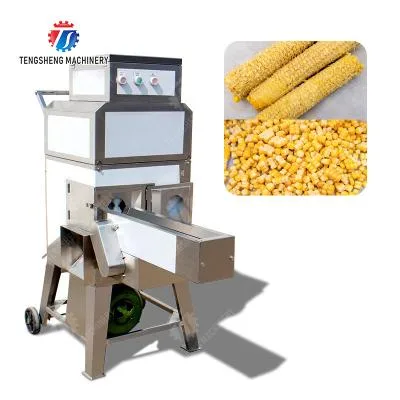
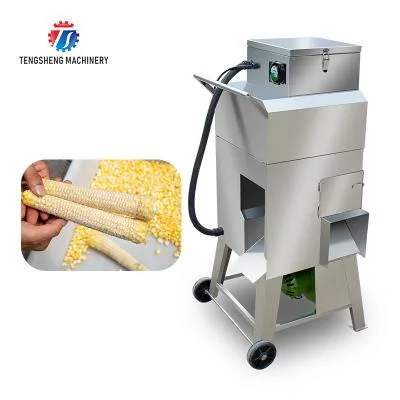
Corn Threshing Machine 1500 ears/h
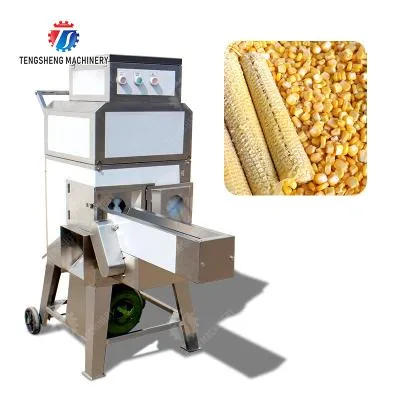
Cutting unit that takes kernels off the cob. Sweet corn processing starts here — every kernel product, whether frozen, canned or cut for ingredients, begins with getting kernels off cobs cleanly at line speed, and the quality bar is whole kernels, not shreds.
How it works
The ear is fed into a channel where a rotating drum of cutting blades runs against a matched bed or idler. The blade drum’s geometry is set to the ear diameter: the knives cut through the kernel base and lift the whole kernel away, while the cob travels on and discharges as a bare stream. Kernel depth and cob diameter vary with variety and maturity, so the drum-to-bed gap is set per product class.
The cut matters more than the speed. A blade set too deep shaves cob material into the product; too shallow, it slices kernels and leaves meat on the cob. Whole-kernel recovery is the specification the machine is bought on, and it is checked by looking at the cob discharge — a clean cob means the setting is right.
Suitable for
Frozen sweet corn lines feeding washing, blanching and IQF; canned corn operations ahead of the filling line; fresh-cut corn kernel products; ingredient lines supplying corn for salads, mixes and prepared foods; operations replacing hand cutting or whole-corn stripping, which damages kernels and caps throughput.
Not suitable for
Field corn or feed corn dried on the cob — those go through impact shelling, a different machine for a different product; ungraded ear sizes without setting changes; immature or over-mature ears outside the cut window; anyone without a route for the cobs, which leave wet and bulky — they are saleable as feed or fibre, but they need somewhere to go.
Material & compliance
Frame, channel and discharge chutes in SUS304 (EN 1.4301); blades in hardened stainless, removable and replaceable as a set — blade condition is the single biggest driver of kernel quality. Guards enclosing the drum with interlocked access for blade change; the machine opens fully for wash-down, because corn juice and silk residue build up fast.
Supplied with CE declaration of conformity and DoC on request; material certificate EN 10204 3.1 available for contact parts.
Selection notes
Ask for whole-kernel recovery on your variety and maturity window, and check the cob discharge for kernel meat — that is where yield is hiding. Check how the drum-bed setting changes between ear sizes and how long it takes. Check blade supply and changeover time; blades are consumables and a worn set ruins quality before it ruins throughput. Check the cob handling route in the same purchase, not after.
When you should not buy this machine: If your volume is farm-gate scale, hand cutters and a bench machine are cheaper. And if your ears arrive ungraded with a wide diameter spread, fix the grading first — one drum setting cannot cut both, and the machine will be blamed for what the grader mixed.
Key specifications
| Parameter | Value |
| Capacity | 1000-3000 ears/h by model (TYPICAL, confirm with factory) |
| Threshing method | Rotating knife drum against matched bed |
| Kernel integrity | Whole-kernel cut; low embryo damage (TYPICAL) |
| Cob discharge | Separate stream by conveyor or chute |
| Ear size range | Graded classes, by drum and bed setting (TYPICAL) |
| Contact material | SUS304 (EN 1.4301) |
| Power supply | 380V/3P/50Hz or 415V/3P/50Hz, customizable |
Specification values are industry-typical ranges for this machine class and are not verified against a specific factory datasheet. Replace them with measured factory data before publication.
FAQ
Why are whole kernels the specification?
Because cut or shredded kernels leak starch, cloud the blanching water and read as a defect in the pack. Whole-kernel recovery is both a yield and a quality number, and it is the number to compare between machines.
What happens to the cobs?
They discharge as a separate wet stream, typically 20-30 % of ear weight. Most plants sell them as feed, fibre or biomass; the requirement is a handling route, because they will not wait in the room.
How often do blades need changing?
As a consumable set, against throughput and any grit arriving with the ears. Quality degrades before the blades look worn, so the change interval is set by kernel inspection, not by eye on the blade.
Related equipment
This unit is one stage of a complete processing line. For the full range of cutting and slicing equipment, or to compare this model against the Vegetable Strip Cutter 1000 kg/h, see the complete equipment catalogue. Capacity, material grade and utility requirements can be confirmed through a quote request.
Reviews
There are no reviews yet.