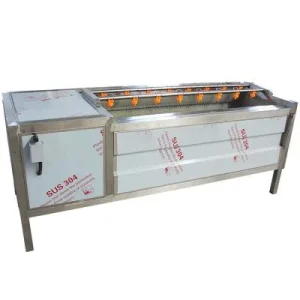
Apple Peeling Coring Machine 1800 pcs/h
Combined unit that peels and cores the apple in one station. It is the classic fruit-processing machine, and the design has barely changed in principle for a century: spindle in the fruit’s base, blade against the skin, coring tube down the axis. What has changed is the speed, the yield and how little flesh the blade takes with the skin.
How it works
The apple is speared onto a rotating spindle mounted at its base — or held in centring cups on fully automatic models with singulating feed. The spindle turns the fruit against a profile-following peeling blade, which tracks the fruit’s shape from shoulder to base and strips the skin in a continuous ribbon. In the same station, a coring tube descends through the fruit’s axis and lifts out the core and seeds; on some models the same cycle cuts the fruit into segments.
Everything depends on the fruit being on-axis. An apple mounted off-centre peels unevenly and the coring tube leaves core material behind. Grading before the machine is not optional: spindle and cup sizes are set per diameter class, and the machine converts a graded feed into a uniform peeled product at speed.
Suitable for
Apple processing lines feeding slices, wedges, dicing or drying; fresh-cut operations where whole peeled, cored fruit is the input; cannery and bakery ingredient lines; pear and quince lines with changeover tooling; operations replacing hand peeling where yield and consistency both matter — a good machine loses less flesh than a fast hand peeler.
Not suitable for
Very soft or bruised fruit, which tears on the spindle; ungraded fruit, which is the root cause of both poor peeling and core residues; fruit sold with skin on, which this machine removes by definition; very small volumes, where a bench peeler and hand coring are adequate; anyone without a route for the peel and core streams, which are wet and continuous.
Material & compliance
Frame, spindles, cups and guards in SUS304 (EN 1.4301); peeling blade and coring tube in stainless blade steel, removable for sharpening as consumable sets. The blade station is fully guarded with interlocked access; the machine opens for daily cleaning, because apple juice and peel residue accumulate at the spindle and tray.
Supplied with CE declaration of conformity and DoC on request; material certificate EN 10204 3.1 available for contact parts.
Selection notes
Ask for the peeling loss and the coring completeness on your apple class — off-axis losses are the hidden yield leak, and the supplier’s answer to “what happens with an off-grade apple” tells you about the machine’s real behaviour. Check changeover between diameter classes: spindle, cup and blade settings change together. Check blade and coring-tube supply, and whether the machine takes segmenting tooling if your product range might grow that way.
When you should not buy this machine: If your apples go straight to pulp or juice, peeling and coring are steps you are paying for and then undoing — a pulper or mill handles whole fruit cheaper. And if your fruit supply is genuinely mixed and ungraded, buy the grader first; every loss figure the supplier quotes assumes a graded feed.
Key specifications
| Parameter | Value |
| Capacity | 1000-3000 pcs/h by model and feed method (TYPICAL, confirm with factory) |
| Operation | Peel and core in one spindle station |
| Fruit diameter | Graded classes, 55-100 mm (TYPICAL) |
| Peeling loss | 5-12 % by fruit shape and blade setting (TYPICAL) |
| Coring | Tube cutter through the core, optional segmenting |
| Contact material | SUS304 (EN 1.4301) |
| Power supply | 380V/3P/50Hz or 415V/3P/50Hz, customizable |
Specification values are industry-typical ranges for this machine class and are not verified against a specific factory datasheet. Replace them with measured factory data before publication.
FAQ
Why does an ungraded feed cause core residue?
Because the coring tube is set on the fruit’s diameter class. A smaller apple mounted on a large spindle sits off-axis, and the tube misses the core line. Grading is what makes the machine’s yield figures real.
Does it also segment the fruit?
Some models take segmenting tooling in the same cycle — peel, core and cut into segments in one pass. If wedges or segments are on your product roadmap, check that option before buying, because retrofitting varies by design.
What happens to the peel and cores?
They leave as separate continuous streams. Peel is clean enough for pectin or feed use on many lines; cores go to feed or waste. Both need a collection route planned at installation, not discovered after.
Related equipment
This unit is one stage of a complete processing line. For the full range of washing and peeling equipment, or to compare this model against the Fruit Pitting Machine 1200 kg/h, see the complete equipment catalogue. Capacity, material grade and utility requirements can be confirmed through a quote request.
Reviews
There are no reviews yet.