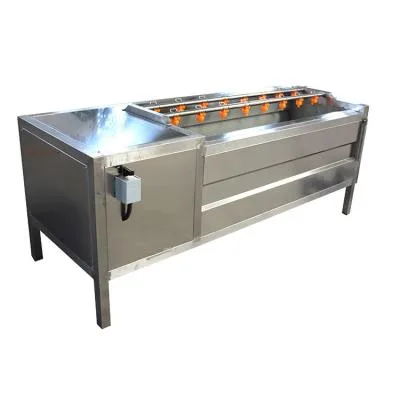
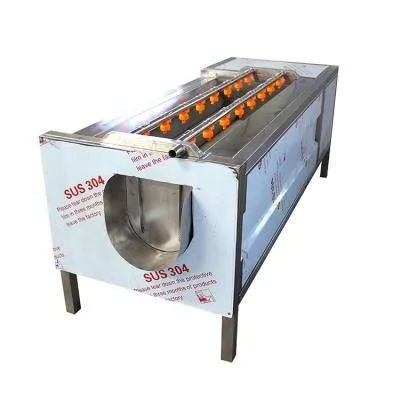
Potato Washing Machine 2000 kg/h
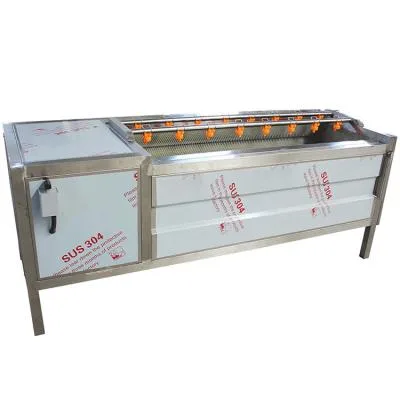
Washing unit for the dirtiest job on a root-crop line. Potatoes arrive carrying their own weight in soil after a bad harvest, and every machine downstream — peeler, cutter, freezer — inherits whatever the washer misses. This is the step that decides whether the rest of the line runs or clogs.
How it works
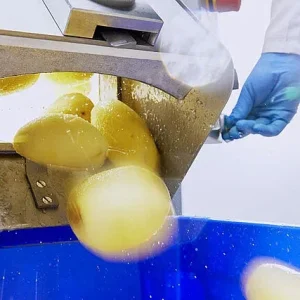
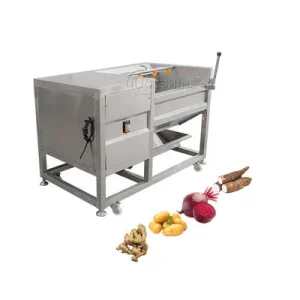
Product is fed into a washing drum or onto a bed of rotating brush rollers. Water spray bars above the bed wash soil off while the brushes scrub the surface; the product travels through the brush bed by roller rotation and by a slight fall along its length. Loose soil falls into a hopper below, where it settles or is carried out by a screw conveyor, and the water is filtered and recirculated to the spray bars with a fresh-water top-up.
The brushes do the work the water cannot. Stiff brushes scrub dried-on soil from firm crops; soft brushes finish delicate or early-season product. Brush speed, spray flow and residence time are the three settings, and they are set against how dirty the crop arrived, which changes from field to field.
Suitable for
Potato packing houses and processing lines ahead of peeling; carrots, beets and celeriac with comparable soil loads; lines where wash water must be recirculated because of drain or water-supply limits; operations feeding peelers, cutters or steam peelers that block on unclean input; packing operations where the brushed surface is the finished appearance.
Not suitable for
Soft or bruised product, where brush pressure turns bruises into open damage; delicate crops sold with bloom or skin intact, where a flotation washer is gentler; product with stones mixed in — a destoner ahead of the washer is cheaper than a broken brush bed; anyone without drainage capacity, because this machine moves a large volume of very dirty water.
Material & compliance
Trough, brush shafts and hoppers in SUS304 (EN 1.4301); brushes on stainless shafts with sealed food-grade bearings, because soil-laden water finds every unsealed bearing in a season. Settling tank and filter accessible for daily clean-out.
Supplied with CE declaration of conformity and DoC on request; material certificate EN 10204 3.1 available for contact parts.
Selection notes
Ask what the machine does with the soil it removes, because the settling and discharge arrangement is half the engineering. Check brush speed is adjustable — a fixed-speed bed that suits potatoes will damage early carrots. Check bearing sealing and wash-down access; on this machine class, bearings and nozzles are what fail. Ask for water consumption per tonne, both wash and rinse.
When you should not buy this machine: If your crop arrives pre-washed from a grower cooperative, you are buying a machine for a problem someone else has solved. And if stones are a recurring reality in your intake, buy the destoner first — every washer supplier will tell you the same, usually after the brush bed has been damaged.
Key specifications
| Parameter | Value |
| Capacity | 1000-3000 kg/h by brush bed length (TYPICAL, confirm with factory) |
| Washing method | Rotary drum or brush roller bed with spray bars |
| Water circuit | Recirculated with settling tank; fresh top-up |
| Soil removal | Settling tank or screw conveyor out (TYPICAL) |
| Brush type | Soft or stiff by crop and peel condition |
| Contact material | SUS304 (EN 1.4301) |
| Power supply | 380V/3P/50Hz or 415V/3P/50Hz, customizable |
Specification values are industry-typical ranges for this machine class and are not verified against a specific factory datasheet. Replace them with measured factory data before publication.
FAQ
Does a potato washer also peel?
No. Washing removes soil, not skin. A brush washer polishes the surface and improves appearance, which on some markets is enough; for actual peeling, a peeling step follows.
How is the water kept clean?
It is not kept clean — it is kept working. Wash water recirculates through a settling tank that captures the heavy soil, with fresh water topping up the rinse section. The tank is cleaned on a schedule, and that schedule is the real water-quality control.
Why did my brushes deform after one season?
Usually stiff brushes on soft crops, or brushes run dry. Brush pressure and spray flow are matched; running the bed without adequate spray overheats and deforms the bristles.
Related equipment
This unit is one stage of a complete processing line. For the full range of washing and peeling equipment, or to compare this model against the Brush Roller Peeling Machine 800 kg/h, see the complete equipment catalogue. Capacity, material grade and utility requirements can be confirmed through a quote request.
Reviews
There are no reviews yet.