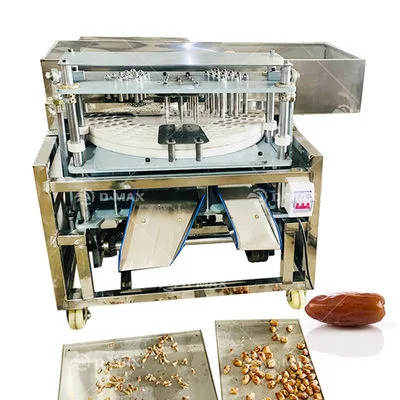
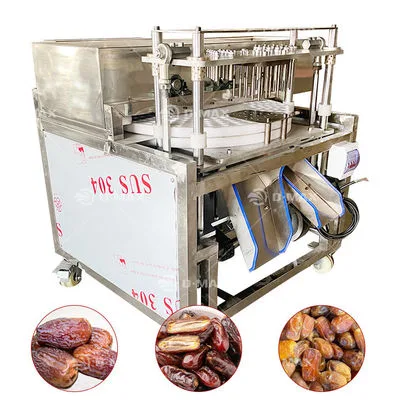
Fruit Pitting Machine
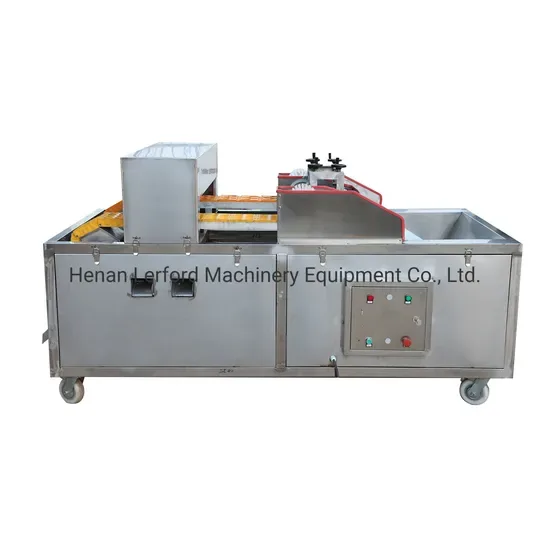
Automatic pitting machine that removes stones from cherries, olives, dates, plums and similar drupes while leaving the fruit largely intact.
How it works
Fruit is singulated onto a chain or rotating drum of cups or pockets, each holding one piece. A punch descends through the fruit axis and drives the stone out through a hole in the cup, while the flesh is held by the cup walls. Pitted fruit is ejected, and stones fall away separately. Some designs split the fruit instead of punching it, which suits products destined for halves rather than whole.
Singulation is the constraint: a pitter can only pit what it can place one at a time, and feed rate above the singulation capacity shows up as unpitted fruit rather than as a jam.
Suitable for
Cherries for freezing, canning or drying; olives before stuffing or curing; dates for pitting and filling; plums, apricots and small peaches in the right size band; product where the stone must go but the shape must stay.
Not suitable for
Fruit outside the size band of the cups; soft or overripe fruit that deforms before the punch; product where a whole stuffed fruit is needed with minimal damage; mixed calibre without grading first.
Material & compliance
Punches, cups and product-contact parts in SUS304 (EN 1.4301); food-grade polymers for cup inserts where softer contact is needed. Cup sets interchangeable for different fruit sizes; guards interlocked.
Supplied with CE declaration of conformity and DoC on request; material certificate EN 10204 3.1 available for contact parts.
Selection notes
Buy for your size range and get the matching cup sets — a cup sized for the average fruit mis-holds both ends, and mis-held fruit either loses flesh or keeps its stone. Ask how many cup sizes ship with the machine and what spares cost. Check whether the machine punches or splits, since those are different products downstream.
When you should not buy this machine: If your fruit is ungraded, grade it first — a pitter cannot handle a wide calibre spread, and the result is both yield loss and stones in the product. Also skip a punch-type pitter if your product is halves for drying or canning; a splitter gives a cleaner cut face.
Key specifications
| Parameter | Value |
| Capacity | 300-3000 kg/h by model (TYPICAL, confirm with factory) |
| Fruit size range | 10-40 mm by model (TYPICAL) |
| Pitting principle | Punch and cup, or knife split (TYPICAL) |
| Motor power | 1.1-2.2 kW (TYPICAL) |
| Contact material | SUS304 (EN 1.4301) |
| Power supply | 380V/3P/50Hz or 415V/3P/50Hz, customizable |
Specification values are industry-typical ranges for this machine class and are not verified against a specific factory datasheet. Replace them with measured factory data before publication.
FAQ
Can one machine pit cherries and olives?
Often yes with a cup and punch change, because both are small drupes. The size ranges differ, so confirm which cup sets cover both before buying.
Why do some stones stay in the fruit?
Usually singulation: two pieces in one cup, or a piece not seated before the punch descends. Slow the feed rather than increasing punch force, which damages flesh.
How much flesh loss should I expect?
It depends on fruit size consistency and cup fit. Well-graded fruit in correctly sized cups loses little; ungraded fruit loses noticeably more. Test on your own fruit rather than working from a percentage claim.
Related equipment
This unit is one stage of a complete processing line. For the full range of cutting and slicing equipment, or to compare this model against the Fruit Coring Machine 800 kg/h, see the complete equipment catalogue. Capacity, material grade and utility requirements can be confirmed through a quote request.
Reviews
There are no reviews yet.