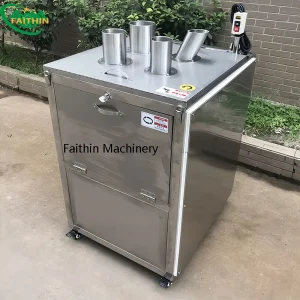
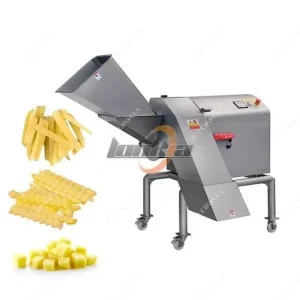
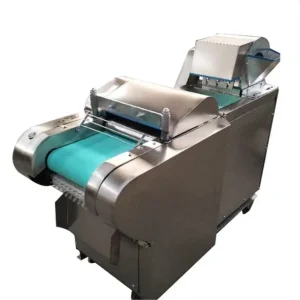
Tomato Dicing Machine 2000 kg/h
Dicing a tomato is dicing a water balloon. The flesh is firm only by comparison, the skin is elastic, and every cut releases juice that carries seed and gel. A tomato dicer therefore cuts in stages — slice, strip, cube — with the fruit guided, not pressed, and with juice drainage designed in from the hopper down. It is the machine behind canned diced tomatoes and frozen dice alike.
How it works
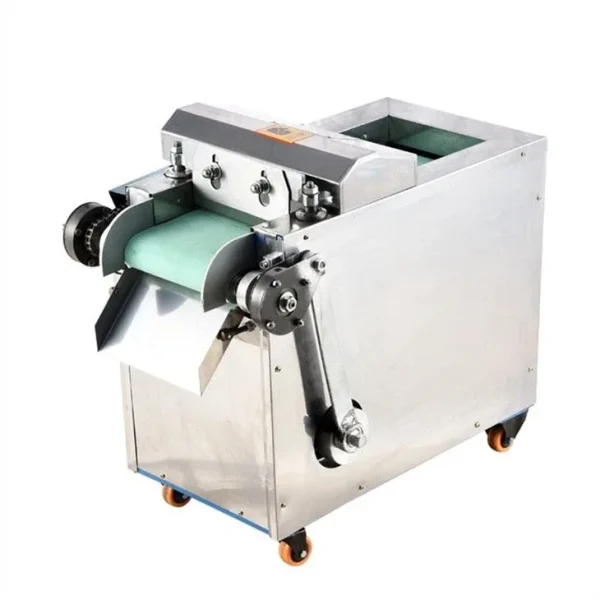
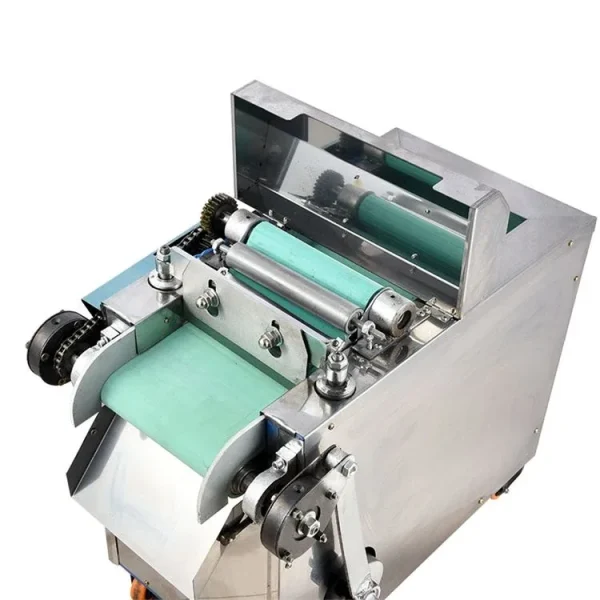
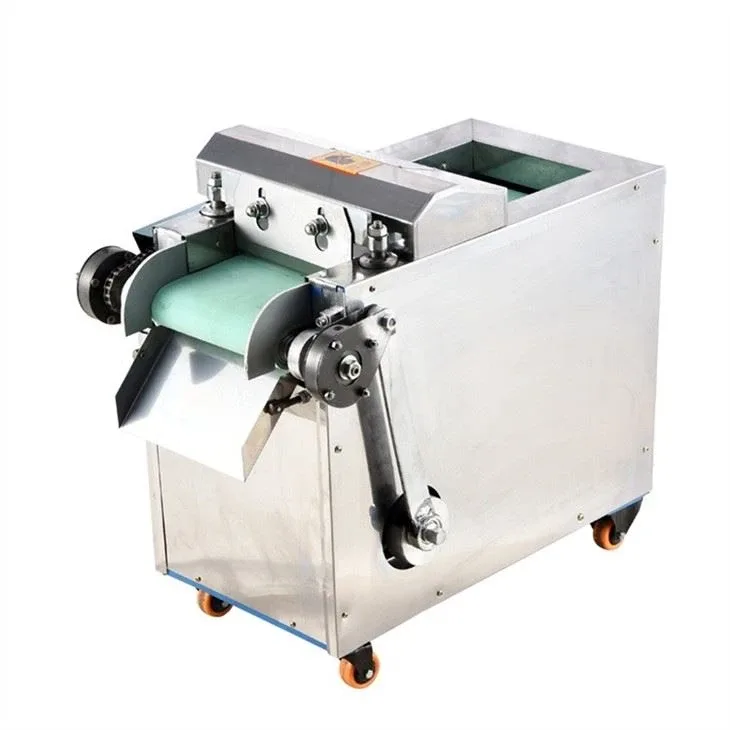
Fruit is singulated and fed into the cutting head, where the sequence runs: first a slicing section cuts the fruit into slabs of the target dice thickness; a stripping section then cuts the slabs into strips; a final crosscut knife set shears the strips into cubes. At each stage the fruit is held by shaped guides rather than clamped, because compression of a ripe tomato costs more than it gains. The juice, seed and gel released at every station drain by gravity into channels and leave through a separate outlet — this stream is often collected separately for sauce lines, and its handling is part of the machine’s design rather than an afterthought. Dice size changes with a knife-set changeover; the range is set by the head’s tooling.
Suitable for
Canned diced tomato production at industrial scale; salsa and fresh-pack operations needing uniform cube size for filling consistency; frozen dice lines feeding IQF freezers, where size uniformity is a freezing-quality parameter; soft fruit dicing — peach, pear — on changeable tooling; combined lines where the drained juice stream feeds a separate sauce or puree process.
Not suitable for
Overripe or very soft fruit outside the firmness window the guides are set for — it macerates instead of dicing, and a pulse mill is the honest route; product with stems or calyx not removed upstream, where the calyx ends up in the dice; operations expecting one machine to dice both tomato and hard vegetable like carrot without a changeover — the knife geometry differs more than sales material suggests.
Material & compliance
Frame, hoppers, guides and discharge in SUS304 (EN 1.4301); knives in stainless blade steel, removable as matched sets. The machine opens fully for wash-down — tomato juice dries to a varnish that fouls hygiene inspections, and cleanability is a first-order purchase criterion here. Juice drainage channels sloped and accessible. Knife station fully guarded with interlocked access.
Supplied with CE declaration of conformity and DoC on request; material certificate EN 10204 3.1 available for contact parts.
Selection notes
Ask for dice uniformity figures and, more importantly, for a cut test with tomatoes of your firmness range — dice quality is a fruit-firmness conversation, and a demo on greenhouse tomatoes says little about processing-tomato performance. Check the juice drainage arrangement and whether the juice outlet suits your collection or disposal plan. Check knife-set changeover time and the cost of sets for each dice size you sell. Check wash-down access honestly by opening the machine yourself.
When you should not buy this machine: If your product is sauce or juice, you do not need dice — a crusher and finisher is a smaller, cheaper machine. And if your intake firmness varies wildly by season, either invest in firmness sorting upstream or accept that dice uniformity will vary; the dicer cannot fix what the intake delivers.
Key specifications
| Parameter | Value |
| Capacity | 1000-4000 kg/h by model (TYPICAL, confirm with factory) |
| Dice size | 6-25 mm by knife set (TYPICAL) |
| Cut sequence | Slice → strip → crosscut cube |
| Juice drainage | Gravity channels, separate outlet |
| Knife sets | Removable matched sets, stainless blade steel |
| Feed | Automatic singulation |
| Contact material | SUS304 (EN 1.4301) |
| Power supply | 380V/3P/50Hz or 415V/3P/50Hz, customizable |
Specification values are industry-typical ranges for this machine class and are not verified against a specific factory datasheet. Replace them with measured factory data before publication.
FAQ
Does the juice loss reduce yield?
The juice is not lost — it is separated, and most lines collect it for sauce or puree. What matters is that your process plan includes the juice stream; a dicer bought without a plan for its juice wastes 8-12 % of the fruit’s value (TYPICAL).
Can it dice peach or pear?
On the right tooling, yes — soft fruit dicing is a common second use. The guides and knife geometry are changed for the fruit’s shape and firmness, and the supplier’s cut test should include the second product before you commit.
How does it handle firmness variation across a season?
Poorly, by itself. Dicers perform within a firmness window, and sorting or conditioning upstream keeps the fruit inside it. This is an intake-management question more than a machine question — ask the supplier how their best customers handle the shoulder season.
Related equipment
This unit is one stage of a complete processing line. For the full range of cutting and slicing equipment, or to compare this model against the Vegetable Dicing Machine 1500 kg/h, see the complete equipment catalogue. Capacity, material grade and utility requirements can be confirmed through a quote request.
Reviews
There are no reviews yet.