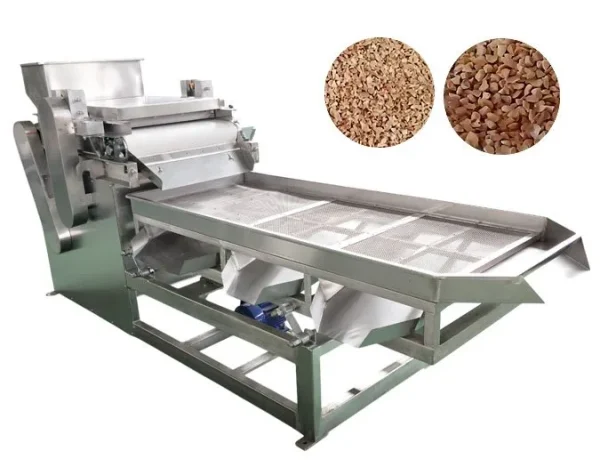
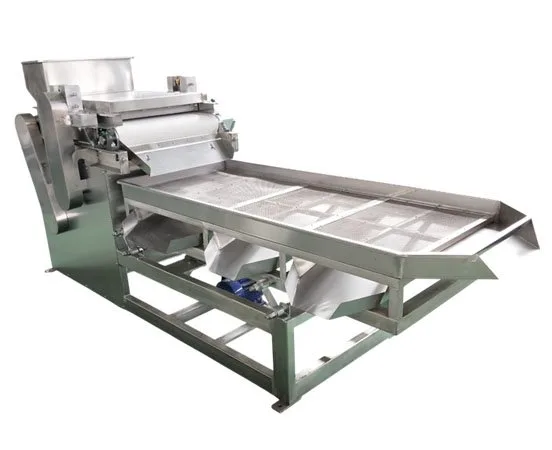
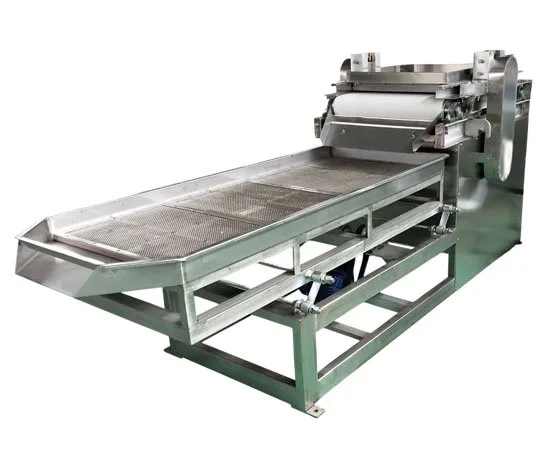
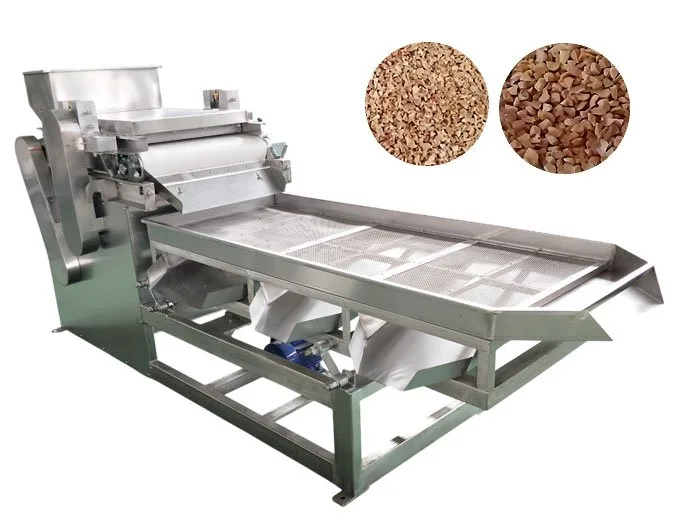
Nut Chopping Machine 300 kg/h
Nut granules are a product with a specification, not a waste product with a price cut. The bakery buying 4-6 mm almond dice does so because a sprinkle looks and bakes a certain way; the ice-cream plant buying 2-4 mm peanut grit does so because a coarse bite is a complaint. A nut chopping machine makes that specification repeatable: cut between rollers, not hammer blows, so the kernel fractures along chosen lines and the fines fraction stays a fraction.
How it works
Blanched, peeled and size-graded kernels feed between a grooved feed roller and a cutting roller or blade drum set at controlled clearance. The kernel is gripped and sheared into strips, then a second pass — often at 90 degrees, in two-stage machines — dices the strips into granules. A sizing screen below separates on-spec granules from fines and overs; overs recirculate, fines are drawn off to a collection bag because a dusty chop reads as stale on the shelf. Gap, roller speed and screen are the three adjustments that define the product; feed rate is the discipline that keeps the cut clean instead of crushed.
Suitable for
Bakery and confectionery suppliers selling nut dice and grit to specification; ice-cream and dessert plants inlining chopped nuts into variegates and coatings; peanut brittle and candy lines that chop their own; repackers building mixed-nut retail products where granule uniformity is the visible quality.
Not suitable for
Nut meal and flour production, which wants hammer milling and a different machine class entirely; whole and half kernel trade — chopping is a one-way street; oily, unblanched or wet kernels, which smear instead of cut and foul the roller gap; operations without upstream sizing, because mixed kernel sizes entering a set gap is how fines are manufactured.
Material & compliance
Frame, hoppers, rollers and contact chutes in SUS304 (EN 1.4301); rollers food-safe hardened steel with grooves re-cuttable; screens stainless and quick-change. Dust-tight guarding over the cutting zone with extraction provision — chopped nut dust is both a hygiene and a combustible-dust consideration at scale. Tool-free screen and roller access for the daily clean.
Supplied with CE declaration of conformity and DoC on request; material certificate EN 10204 3.1 available for contact parts.
Selection notes
Ask for the granule distribution curve, not a single number — the spec you will be held to is a range, and the machine’s screen decides it. Ask how the two-stage cut is arranged and whether single-stage output is acceptable for coarser specs. Check the fines handling: suction or bag, and where it goes. Check roll and screen changeover time — a supplier serving several granule specs changes them daily. Insist on a chopping trial with your kernel at your target spec, and take the distribution curve home.
When you should not buy this machine: If your buyer takes any-ground nut meal, buy a mill and stop paying for precision nobody reads. And if your kernels arrive unblanched and mixed-size, fix the two steps upstream — this machine will faithfully chop whatever mess you feed it.
Key specifications
| Parameter | Value |
| Capacity | 200-500 kg/h by model (TYPICAL, confirm with factory) |
| Granule size | 2-8 mm by screen and gap (TYPICAL) |
| Cutting | Grooved roller / blade drum, 1-2 stages |
| Fines handling | Suction to collection, adjustable |
| Screens | Quick-change stainless, multiple sizes |
| Contact material | SUS304 (EN 1.4301) |
| Power supply | 380V/3P/50Hz, 1.5-4 kW class |
Specification values are industry-typical ranges for this machine class and are not verified against a specific factory datasheet. Replace them with measured factory data before publication.
FAQ
Chopping or grinding — which machine do I need?
Specification language decides: dice, grit, granule with a size range — chopping. Meal, flour, butter-prep — grinding. If your customer’s spec sheet gives millimetres, they want a chopper.
Why do my granules have too many fines?
Kernel condition and gap setting first, screen second. Oily or warm kernels smear and raise fines; an over-tight gap crushes. Ask the factory to demonstrate at your spec and record the settings — they are the recipe.
Can one machine serve almond dice and peanut grit?
Yes, with screen and gap changeover and clean-out between products. Ask how long changeover takes on the quoted model; multi-spec suppliers live or die by it.
Related equipment
This unit is one stage of a complete processing line. For the full range of cutting and slicing equipment, or to compare this model against the Vegetable Dicing Machine 1500 kg/h, see the complete equipment catalogue. Capacity, material grade and utility requirements can be confirmed through a quote request.
Reviews
There are no reviews yet.