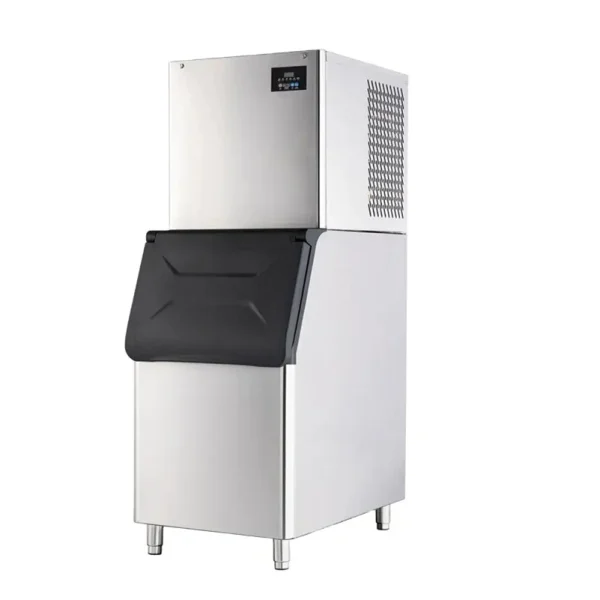
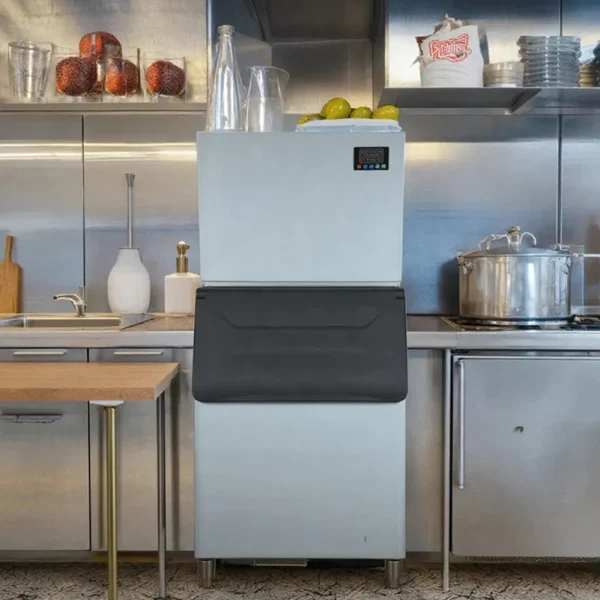
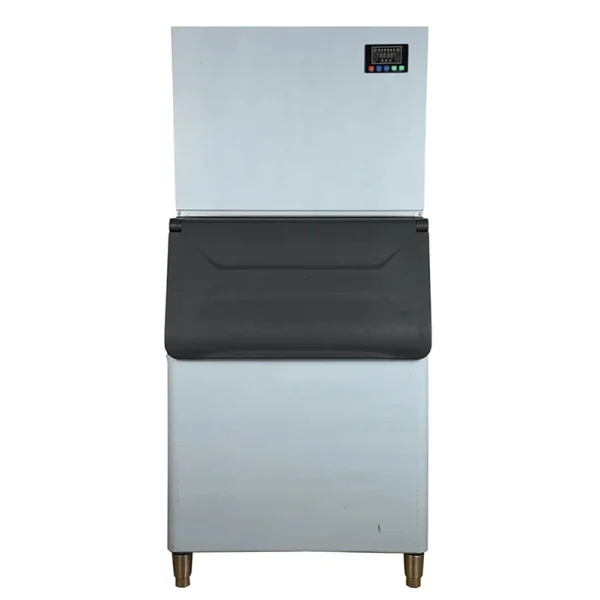

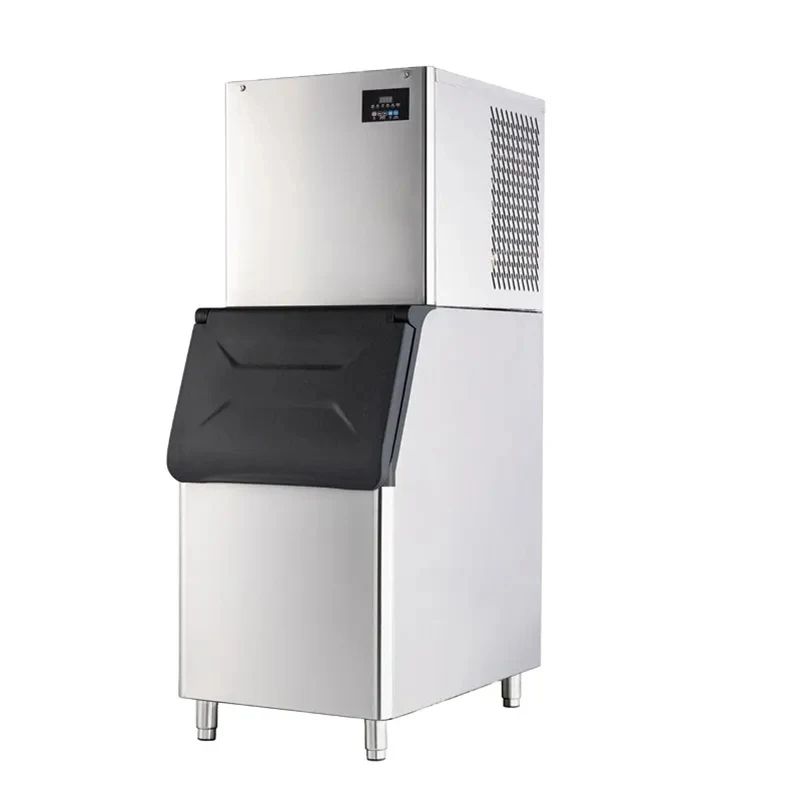
Ice Cube Machine 2 t/day
Plants underestimate ice until they run out of it. Produce lines need it for hydro-cooling and chill water; packing sheds need it under and over product in crates; central kitchens need food-contact ice for blanch-shock and dough work; display and retail need cubes that hold shape in the bag. Buying ice by the truck means paying someone else’s logistics and hygiene risk every day, and running out mid-shift stops a line. A dedicated ice cube machine closes that loop on site: potable water becomes solid, clear, food-grade cubes on a repeating cycle, stored in a bin and scooped or augured to the point of use as the shift demands.
How it works
Potable water feeds a plate or cup system where it freezes in layers — commercial cube machines run water over vertically inverted plates, freezing a sheet, then cutting or harvesting the sheet into cubes by a warm-gas sweep that releases them into the bin below. Cycle time, water quality and harvest temperature set both output and cube clarity; machines sized for food plants run on potable feed with filtration, and the bin, auger and discharge chutes that move ice onward are designed for food contact rather than drink-service only. Output accumulates in the insulated bin and the machine modulates or stops on bin level, so a day’s production lands without an operator watching the cycle.
Suitable for
Produce packing lines feeding hydro-coolers, chill tanks and top-icing stations; central kitchens and ready-meal plants consuming food-contact ice for blanch-shock, dough chilling and cold transport; fruit and vegetable processors topping crates for cold-chain distribution; retail and distribution centres bagging display ice from their own production; any site whose ice demand is steady enough that truck delivery is a daily logistics tax.
Not suitable for
Large-scale cooling loads better served by flake or tube ice — cubes are dense and slow-melting, which is right for food contact and display but wrong for fast thermal pull-down, where the flake machine’s surface area wins; sites with poor potable water or no filtration, because cube quality is water quality; and buyers expecting a small drink-service cabinet to survive plant duty — the difference between a bar machine and an industrial ice plant is measured in harvest cycles per day, and the industrial frame costs more because it is built for them.
Material & compliance
Water plate, bin interior, auger and discharge contacts in SUS304 (EN 1.4301); potable-water-rated piping and pump; insulated bin with food-grade liner; controls with bin-level modulation, harvest-fault alarms and water-treatment compatibility.
Supplied with CE declaration of conformity and DoC on request; material certificate EN 10204 3.1 available for contact parts; machines intended for food-contact ice documented against potable-water practice.
Selection notes
Size the machine on your worst day, not your average — ice demand on a hot packing day can double the annual mean, and a machine that trails demand stops a line that a bigger bin would have carried. Ask whether the quoted tonnage is 24-hour production or harvest-window reality, and what ambient and water temperatures the figure assumes. Check the bin size against your shift pattern: production without storage is a machine running to waste. Confirm the water-treatment story for your local hardness — scale on the plates is what slowly kills output. And ask about auger or chute delivery to your points of use, because the metre from bin to crate is where most plants improvise badly.
When you should not buy this machine: If your ice need is cooling tonnage rather than food-contact or display ice, buy the flake machine — per ton of cooling, flakes beat cubes on surface area and price. And if demand is a few bags a week, delivered ice is cheaper than any machine you will own; the payback starts at roughly a truck a month.
Key specifications
| Parameter | Value |
| Production | 1-5 t/24 h by model (TYPICAL, confirm with factory) |
| Cube size | 22-35 mm food-grade cubes (TYPICAL) |
| Cycle | Plate freeze + warm-gas harvest, automatic |
| Bin | Insulated storage, 300-2000 kg by model |
| Feed | Potable water with filtration |
| Contact material | SUS304 (EN 1.4301) |
| Power supply | 380V/3P/50Hz, 3-15 kW class |
Specification values are industry-typical ranges for this machine class and are not verified against a specific factory datasheet. Replace them with measured factory data before publication.
FAQ
Why cubes instead of the flake ice we already have?
Different jobs: flakes cool fast and pack tight, which is right for thermal work in a tank or under crates; cubes are dense, slow-melting and presentable, which is right for food contact, bagged ice and display. Many plants run both and let each do what it is best at.
Is the ice food-contact safe?
On a machine built for it, yes — potable feed, food-grade contact surfaces and covered storage. The hygiene risk in practice is the scoop and the floor, not the machine: covered bins and proper dosing keep it that way.
How much does water quality matter?
A lot — hard water scales the freezing plates and clouds the cubes, and output drifts down season by season. Filtration and, on hard sites, treatment belong in the quotation, not in the year-two service call.
Related equipment
This unit is one stage of a complete processing line. For the full range of freezing equipment, or to compare this model against the Flake Ice Machine 3000 kg/24h, see the complete equipment catalogue. Capacity, material grade and utility requirements can be confirmed through a quote request.


Reviews
There are no reviews yet.