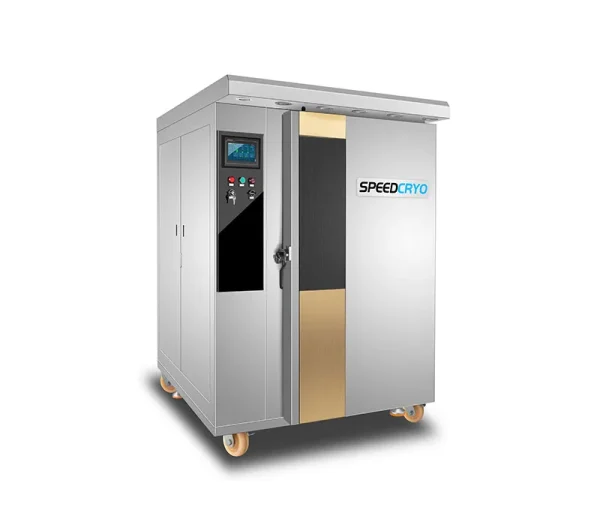
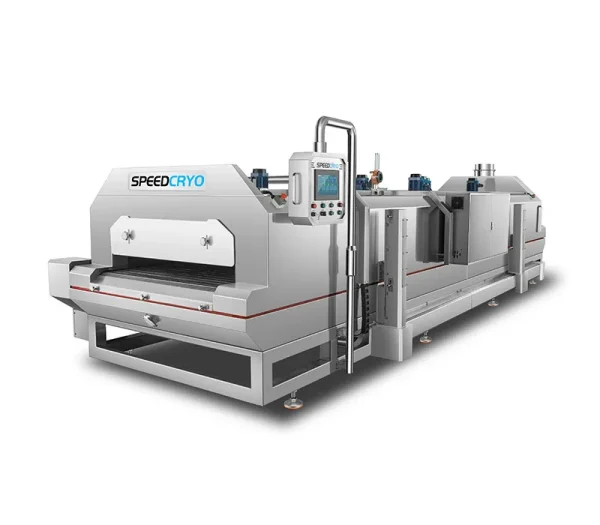
Cryogenic Cabinet Freezer 150 kg/h
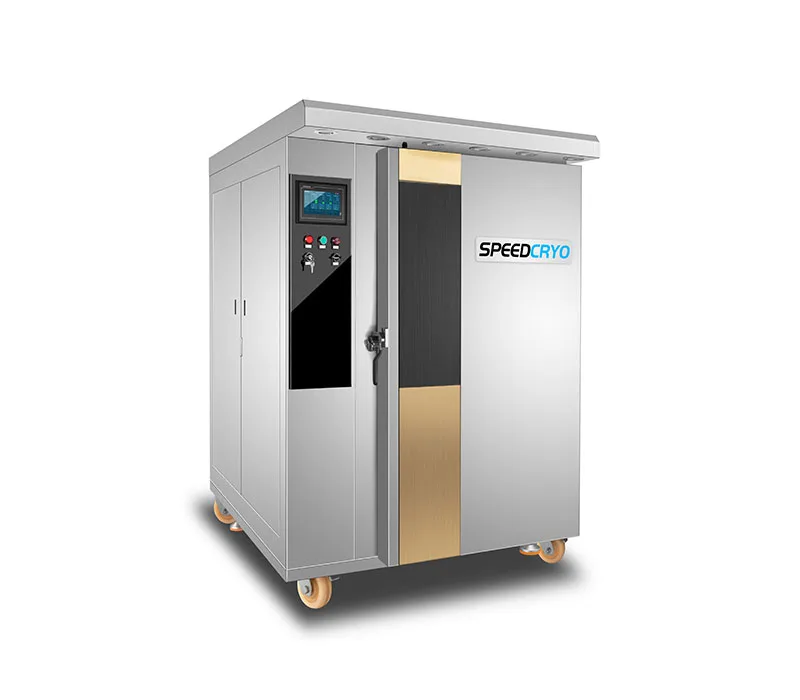
Some products should never meet mechanical freezing at all. Soft berries, diced mango, filled doughs, premium ready-meal components — slow cold air spends half an hour pulling heat through them while ice crystals grow and cell walls burst, and the thawed product leaks the value you froze it to protect. A cryogenic cabinet freezer skips the fight: liquid nitrogen or liquid CO₂ sprays directly into the cabinet, gas at -60 °C and colder washes the trays, and the same product crosses to -18 °C core in minutes. You buy the cold by the litre instead of building it with compressors, which is why this machine appears wherever a line freezes premium product by the tray and the freezer bill is priced per kilo, not per kilowatt.
How it works
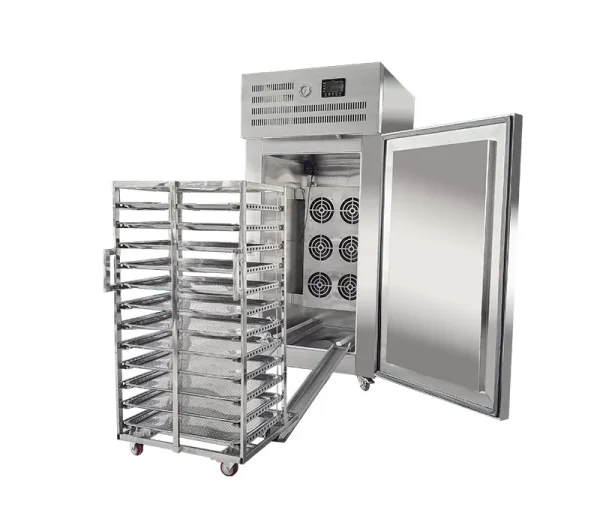
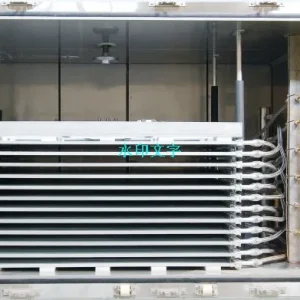
Product in trays or pans loads onto trolleys that roll into an insulated cabinet. When the cycle starts, a cryogenic liquid — LN2 at -196 °C or CO2 at -78 °C — feeds a spray manifold inside the cabinet roof; it flashes to gas on contact with the air, and circulation fans drive the resulting cryogenic gas across the product in a controlled pattern. Because the gas arrives far colder than any mechanical coil can hold, the product surface crusts within the first minutes, locking shape and moisture; the controller then meters injection to pull the core down the rest of the way at a pace that avoids shell cracking. A core probe or cycle timer ends the run, the exhaust routes residual gas out through a vent stack, and the trolley rolls out ready for glazing or packing. Injection rate, fan speed and cycle end are all set per recipe on the controller.
Suitable for
Soft-fruit processors freezing whole berries and diced fruit that must keep shape and drip-loss numbers; ready-meal and central-kitchen plants crust-freezing filled components before chilled distribution; pastry and dough producers hardening filled products fast enough to set laminations; seasonal packers whose freezing volume spikes for weeks at a time and cannot justify permanent refrigeration plant; test kitchens and pilot lines running freezing trials where recipe iterations are measured in batches, not tons; any plant that wants tunnel-grade freezing speed in a footprint a cabinet owns.
Not suitable for
High-volume continuous freezing — a cabinet’s trolley rhythm tops out well below a tunnel, and at more than a few hundred kilos an hour the cryogenic bill per kilo makes a mechanical IQF line cheaper within a season; loose-flowing product that needs true IQF separation, since trays limit airflow contact; plants with no local cryogenic supply — the economics only work where LN2 or CO2 is delivered reliably at contract prices; and buyers who cannot ventilate the exhaust, because oxygen displacement is a real hazard that the install must engineer out, not ignore.
Material & compliance
Cabinet shell and interior in SUS304 (EN 1.4301) with high-density insulation rated for cryogenic service; spray manifold, valves and piping in cryogenic-rated stainless; controls with recipe storage, core-probe input and gas-leak detection interlock as standard, because the safety system is part of the machine, not an option. Exhaust stack sized for the cabinet’s gas load and routed above roofline where the site requires it.
Supplied with CE declaration of conformity and DoC on request; material certificate EN 10204 3.1 available for contact parts; pressure components delivered with their own test paperwork.
Selection notes
Price the gas before the machine — ask your local cryogenic supplier for a delivered price per kilo of product frozen, using the consumption figures the cabinet maker quotes, because the running cost decides whether this technology fits your product at all. Ask what the capacity assumes: tray size, load depth and crust-freeze versus full-freeze cycles give very different kilos per hour. Check the safety package — gas detection, alarm, ventilation interlock and operator training — as a single list, in writing. Check whether the controller logs cycle data if your certification needs it. And confirm the service story: a cryogenic cabinet is mechanically simple but its valves and sensors are specialised, and the supplier’s response time is your freezing uptime.
When you should not buy this machine: If your freezing runs all day, every day, at more than a few hundred kilos an hour, gas cost will dwarf the mechanical line you did not build — this is a premium-product, seasonal-volume, or fast-payback tool, not a general freezer. And if your site cannot get a cryogenic supply contract or pass a ventilation review, no feature on the cabinet fixes that.
Key specifications
| Parameter | Value |
| Capacity | 100-300 kg/h by cabinet size and cycle (TYPICAL, confirm with factory) |
| Cryogen | LN2 (-196 °C) or LCO2 (-78 °C), site supply |
| Cycle time | 15-30 min to -18 °C core on trayed product (TYPICAL) |
| Cabinet | 2-8 trolley positions, insulated to cryogenic service |
| Controls | Recipe storage, core probe, gas-leak interlock |
| Contact material | SUS304 (EN 1.4301) |
| Power supply | 380V/3P/50Hz, fans and controls only |
Specification values are industry-typical ranges for this machine class and are not verified against a specific factory datasheet. Replace them with measured factory data before publication.
FAQ
How does the gas cost compare with mechanical freezing?
Per kilo, cryogenic freezing usually costs more to run but almost nothing to install, so the answer depends on volume and utilization: seasonal spikes, premium products and multi-recipe lines favor gas, while constant high tonnage favors compressors. Model both over a year with your real gas price before deciding — the crossover point is normally somewhere near a few tons a day.
Will the liquid gas touch the product?
No — the liquid sprays into the cabinet air and vaporizes before contacting food; the product sees only the cold gas. Spray position, fan pattern and interlocks keep it that way, which is also why tray loading per the recipe matters.
Can it work as a chiller instead of a freezer?
Yes, at low injection rates the same cabinet holds chill cycles down to +3 °C or a set crust temperature, and many plants use one cabinet for chill in the week and freeze on peaks. The controller recipes make the switch an operator choice, not a hardware one.
Related equipment
This unit is one stage of a complete processing line. For the full range of freezing equipment, or to compare this model against the Liquid Nitrogen Freezer 300 kg/h, see the complete equipment catalogue. Capacity, material grade and utility requirements can be confirmed through a quote request.
Reviews
There are no reviews yet.