Vegetable Strip Cutter
Centrifugal strip cutter that turns potatoes, carrots and firm root vegetables into uniform strips and julienne for frying, freezing or dehydration lines.
How it works
Whole or halved product is fed into a rotating impeller. Centrifugal force presses the product against a stationary blade assembly: a leading slab knife first forms a flat face, then a set of parallel knives cuts the slab into strips. The strip cross-section is fixed by the blade assembly, so changing cut size means changing the blade set rather than adjusting a setting. Some designs use hydraulic feed instead of a rotary impeller, which suits larger or irregular product.
Discharge is continuous, and strips fall directly onto a take-away conveyor, flume or fryer infeed.
Suitable for
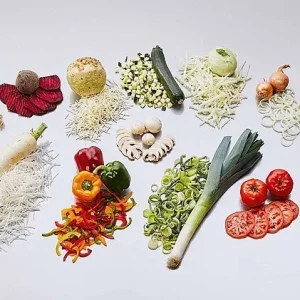
Potatoes for French fries; carrot, parsnip and celeriac julienne; firm root vegetables for dehydration or soup mixes; product with a regular cross-section and consistent firmness.
Not suitable for
Soft or overripe product that collapses under feed pressure; leafy greens; very large irregular tubers that will not pass the feed throat; product needing a curved or decorative cut.
Material & compliance
Product-contact surfaces and blade holders SUS304 (EN 1.4301); knives in hardened stainless or tool steel with food-grade handling. Cutting chamber designed for tool-free opening so the assembly can be washed down between batches.
Supplied with CE declaration of conformity and DoC on request; material certificate EN 10204 3.1 available for contact parts.
Selection notes
Confirm whether the cut size is fixed or adjustable — on centrifugal heads the blade assembly determines strip size, and changing it later may mean buying a new blade disk rather than turning a knob. Ask about feed throat diameter relative to your largest whole tuber; undersized throats force you to pre-halve, adding a manual step. Check knife sharpening interval and whether spare blade sets are included.
When you should not buy this machine: Do not buy a strip cutter if you need several cut sizes on the same shift — blade-set changeover is the bottleneck, and a machine with quick-change cassettes is worth the premium. Also skip it if your product is irregular in size: a centrifugal head needs reasonably uniform feed to hold strip length.
Key specifications
| Parameter | Value |
| Capacity | 300-2500 kg/h (TYPICAL, confirm with factory) |
| Cut size | 4-25 mm, set by blade assembly (TYPICAL) |
| Cutting principle | Centrifugal or hydraulic feed |
| Motor power | 1.1-1.5 kW (TYPICAL) |
| Contact material | SUS304 (EN 1.4301) |
| Power supply | 380V/3P/50Hz or 415V/3P/50Hz, customizable |
Specification values are industry-typical ranges for this machine class and are not verified against a specific factory datasheet. Replace them with measured factory data before publication.
FAQ
Can I change strip size on the same machine?
On centrifugal heads the blade assembly sets the cross-section, so changing size means swapping blades. Some hydraulic designs allow adjustment within a range. Confirm which type you are buying before ordering.
Why do my strips come out short or tapered?
Usually irregular feed size or a dull slab knife. Short strips mean the product is not held squarely against the knife face; tapered strips usually indicate a worn leading knife.
How often do the knives need sharpening?
Depends on product abrasiveness and hours run. Root crops with adhered soil wear blades fast — a pre-wash stage ahead of the cutter is the cheapest way to extend blade life.
Related equipment
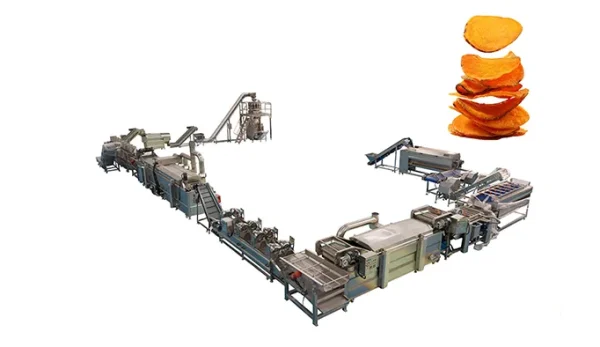
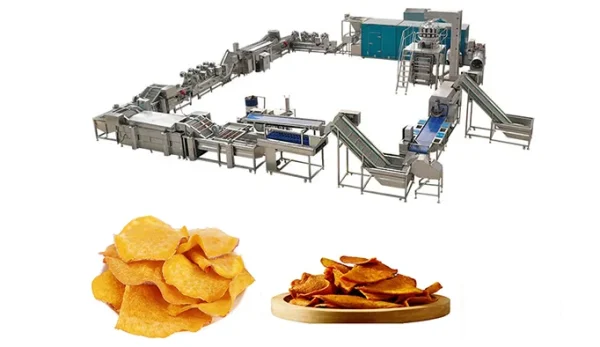
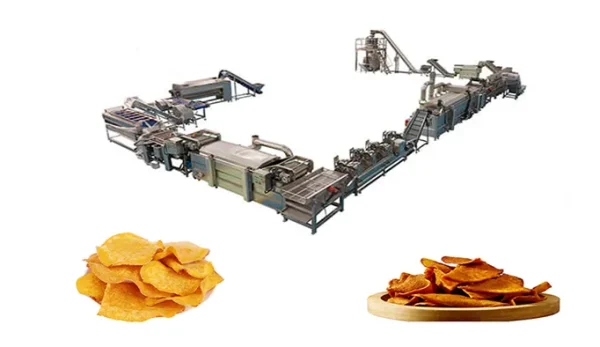
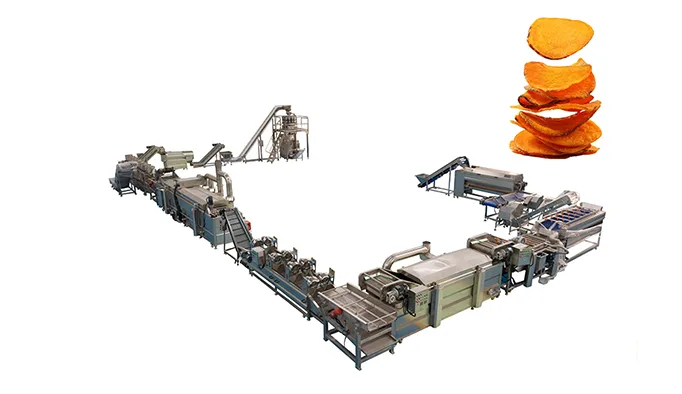
This unit is one stage of a complete processing line. For the full range of cutting and slicing equipment, or to compare this model against the vegetable slicing machine, see the complete equipment catalogue. Capacity, material grade and utility requirements can be confirmed through a quote request.
Reviews
There are no reviews yet.