Air Bubble Washing Machine 3000 kg/h
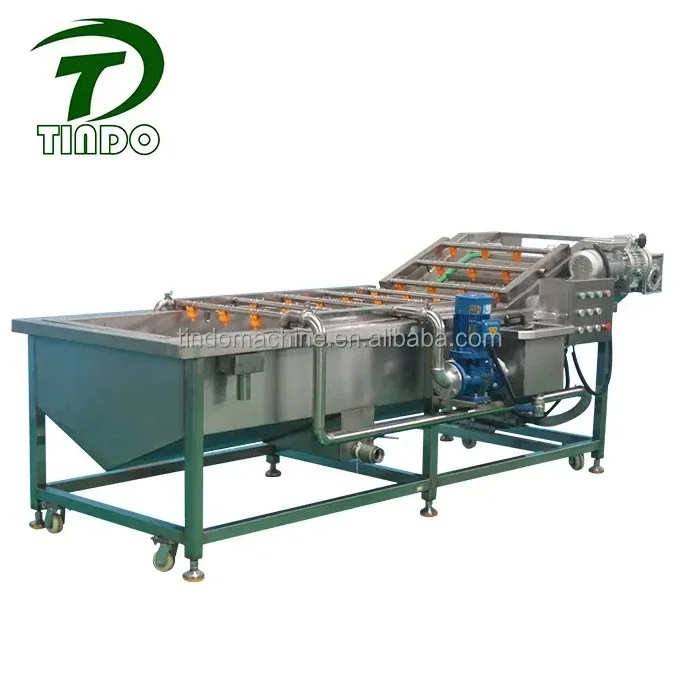
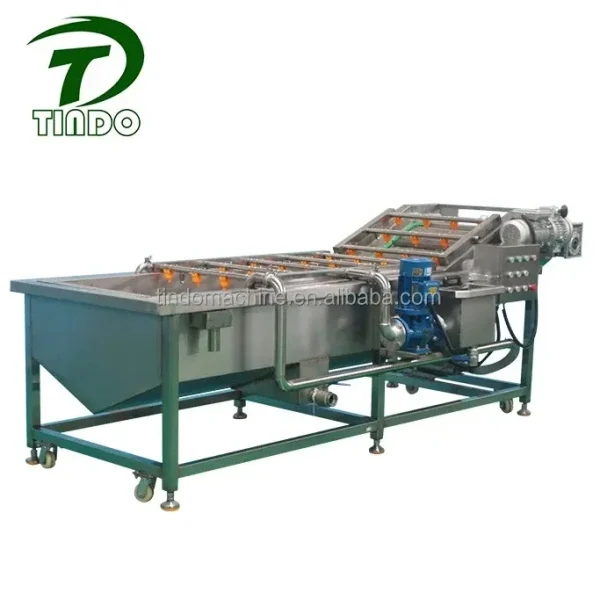
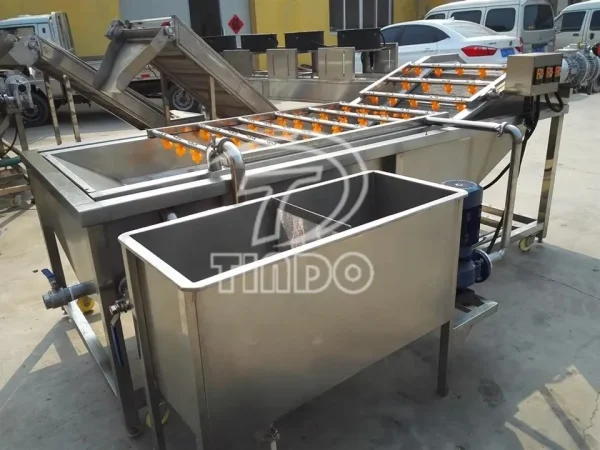
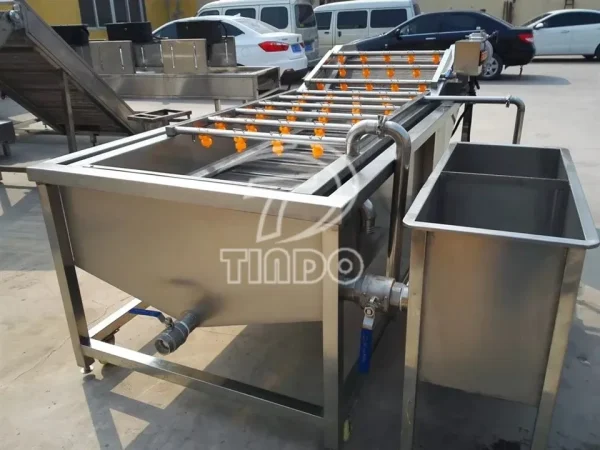
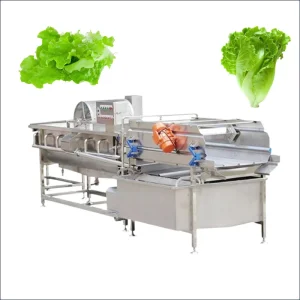
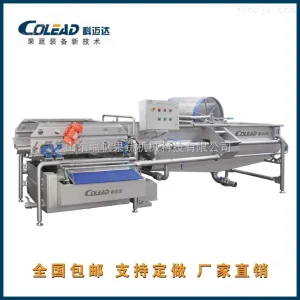
Washing unit built on turbulence instead of contact. Where a brush washer scrubs, an air-bubble washer lifts: submerged diffusers release air along the tank, the water boils, and the product tumbles gently through it. The point of the design is that soil is knocked loose by water movement and by fruit rubbing fruit, not by anything mechanical pressing on the product — which is what makes it the standard first wash on delicate produce.
How it works
The tank holds a working depth of water with a diffuser grid along its length. Product enters at the inlet end and immediately joins the turbulent zone: air bubbles rising through the water column create circulation, lifting lighter product and tumbling it forward. Soil, field debris and heavier contaminants are knocked off the product surface and either sink to the tank bottom or are carried to the overflow. A screw, mesh belt or drag conveyor moves the product to the discharge against the flow direction, where it transfers to a dewatering section or the next process step.
Air volume and water depth are the two operating settings, and they are set against the product. Leafy greens need enough agitation to float the leaves open without bruising them; berries need less; root crops take the most because they carry the heaviest soil load. Water is recirculated through filtration with fresh top-up at the inlet, because the wash water is doing the whole job and a dirty bath simply redistributes soil.
Suitable for
Leafy vegetables, berries and other produce that bruises under brush pressure; mixed loads where size and firmness vary and contact washing would damage the softer pieces; first-stage washing ahead of spray or brush finishing; operations where the washing water has to be recirculated, because the bath is compact relative to a spray section; plants processing cut or semi-prepared product where an agitated bath separates pieces and removes released starch or tissue fluid.
Not suitable for
Loose soil in heavy clods, where the bath loads its own filter and the turbulence is too gentle — a drum washer or spray bar does more work; product that must stay unbruised at any cost and cannot be tumbled at all, which needs a gentler method; operations without drainage and filtration provision, because the bath concentrates waste in one volume of water; anyone expecting the machine to remove chemical or pesticide residue on its own, which is a chemistry question, not a washing question.
Material & compliance
Tank, diffuser grid, conveyor and discharge chutes in SUS304 (EN 1.4301); tank bottom sloped with clean-out access, because soil settles where the diffusers cannot reach it. Diffusers in food-grade material and removable for descaling, since hard water blocks the bubble pattern and the machine loses its function quietly. Overflow and filtration arranged so debris leaves the system continuously rather than recirculating with the product.
Supplied with CE declaration of conformity and DoC on request; material certificate EN 10204 3.1 available for contact parts.
Selection notes
Ask what turbulence the tank actually produces on your product, not on demo potatoes — agitation that is right for a carrot will bruise a strawberry, and this machine class is sold on how well its air pattern suits the produce. Check the diffuser arrangement and how the diffusers are cleaned or descaled, because a partially blocked grid turns the machine into a soak tank without anyone noticing. Check water volume and filtration capacity against your soil load. Check the discharge transfer to dewatering; a wash that leaves the product swimming is only half the job.
When you should not buy this machine: If your soil load is heavy clay or clods, a spray or drum washer is the better buy — bubbles lift, they do not dislodge. And if your product is very delicate berries at a high margin, test the machine with your fruit in your water before committing; turbulence that reads gentle in a brochure is not always gentle in a full tank.
Key specifications
| Parameter | Value |
| Capacity | 1000-5000 kg/h by tank width and product (TYPICAL, confirm with factory) |
| Washing method | Turbulent air-bubble bath with surge flow |
| Air diffusers | Submerged diffuser grid along the tank |
| Water circuit | Recirculated with filtration; top-up at inlet |
| Conveyor | Screw, mesh belt or drag by design |
| Drying section | Optional air-knife or dewatering screen (TYPICAL) |
| Contact material | SUS304 (EN 1.4301) |
| Power supply | 380V/3P/50Hz or 415V/3P/50Hz, customizable |
Specification values are industry-typical ranges for this machine class and are not verified against a specific factory datasheet. Replace them with measured factory data before publication.
FAQ
How is this different from a brush washer?
Contact. A brush washer scrubs the surface mechanically and gives a polished finish; an air-bubble washer agitates the product in water and leaves the surface as it found it, minus the dirt. Where surface finish matters, a brush washer is chosen; where gentleness matters, this one is.
Why does the water turn dirty so fast?
Because it is collecting everything the wash removes, continuously. That is the design working as intended — the question is whether the filtration keeps up. A tank whose filter is undersized runs on recirculated soil, and the product leaves as dirty as it arrived.
Does it also dewater?
No, not by itself. The washing tank transfers to a dewatering section — a screen, an air knife, or a centrifugal unit — and most suppliers quote them together. Check what the quoted machine includes before assuming the washed product is dry enough for the next step.
Related equipment
This unit is one stage of a complete processing line. For the full range of washing and peeling equipment, or to compare this model against the Immersion Washing Machine 2000 kg/h, see the complete equipment catalogue. Capacity, material grade and utility requirements can be confirmed through a quote request.
Reviews
There are no reviews yet.