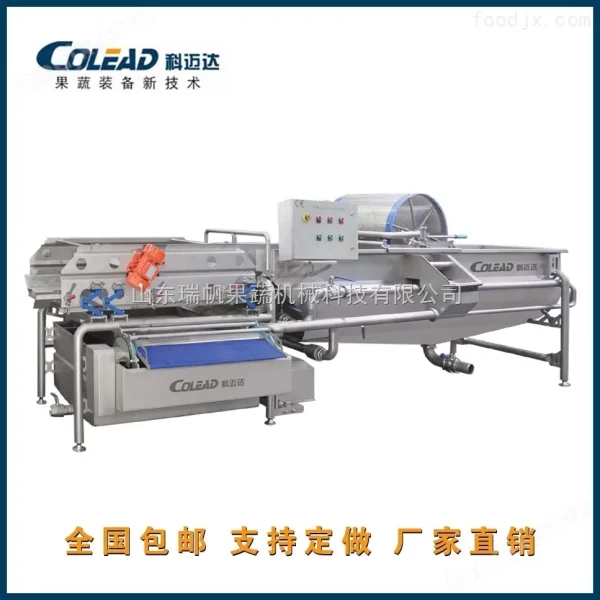
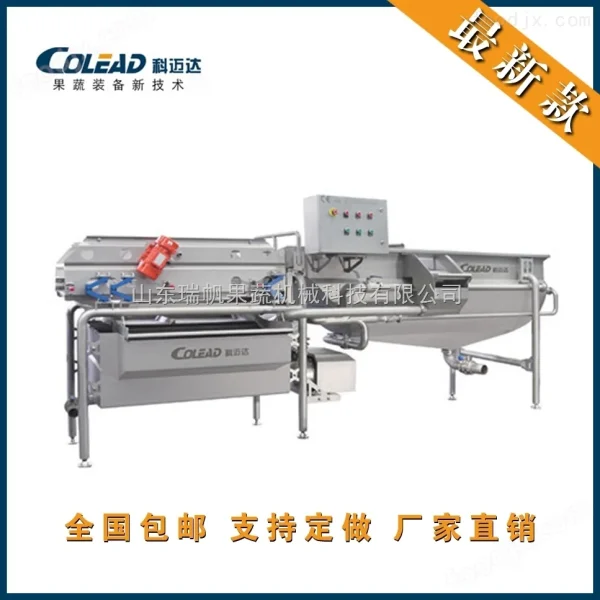
Immersion Washing Machine 2000 kg/h
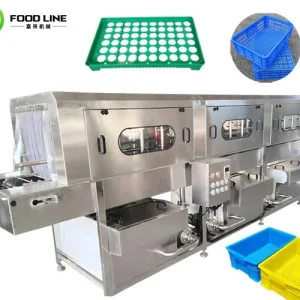
Soak washer that holds product submerged and moving through a tank of circulating water, loosening attached soil and drawing down field heat before the product reaches mechanical washing.
How it works
Product is fed into a tank of water and carried through on a slow belt or a paddle system that keeps it submerged and moving. Soaking softens and loosens dried-on soil, sand and clay that a spray alone would drive into the surface rather than remove. Water is circulated and, in most designs, filtered and recirculated, with a controlled overflow carrying away floating debris and a drain point at the bottom for settled grit. Product leaves the tank over a drain section and goes on to spray or bubble washing.
The tank is a soil-removal step, not a cleaning step. Its job is to make the soil easy to remove downstream, and the water in it gets dirty by design.
Suitable for
Root vegetables arriving with heavy field soil — carrot, potato, beetroot, turnip; product where dry soil must be softened before it can be washed off; lines drawing down field heat before further processing; product with soil held in crevices or around stems; any plant where the spray washer is currently being asked to remove soil it was never designed for.
Not suitable for
Product damaged by prolonged immersion — leafy product held too long, or berries that split; lines where water is scarce or disposal is constrained, because a soak tank uses water heavily; plants without grit removal, since settled sand accumulates and is then carried out with the product; anyone expecting the soak to deliver a clean product without a spray or rinse stage after it.
Material & compliance
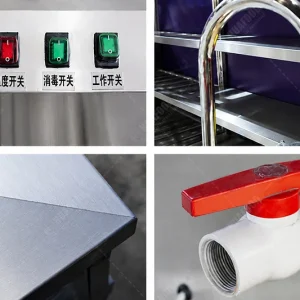
Tank, belt, paddles and frame in SUS304 (EN 1.4301). Tank arranged for full draindown and for grit settlement with a cleanout; overflow and drain screened; circulation pump and filter accessible; belt designed to lift out for tank cleaning.
Supplied with CE declaration of conformity and DoC on request; material certificate EN 10204 3.1 available for contact parts.
Selection notes
Size the tank to the soil load and the soak time your soil actually needs, not to a throughput number — a tank that is too short gives you product that is still dirty at the outlet. Ask how grit is removed and how often, because settled sand in the tank bottom is the most common source of recontamination. Check the water balance honestly: recirculation saves water but concentrates load, and the overflow rate is what keeps it under control.
When you should not buy this machine: If your product arrives clean or lightly soiled, a spray washer does the job with less water and less floor space. Also skip it where water disposal is the constraint — a soak line’s cost is often in the water, not the tank.
Key specifications
| Parameter | Value |
| Capacity | 500-10000 kg/h by tank size (TYPICAL, confirm with factory) |
| Tank volume | 1-8 m³ by model (TYPICAL) |
| Soak time | 2-15 min by product (TYPICAL) |
| Water circulation | Filtered and recirculated by model (TYPICAL) |
| Water temperature | Ambient to 20 °C (TYPICAL) |
| Contact material | SUS304 (EN 1.4301) |
| Power supply | 380V/3P/50Hz or 415V/3P/50Hz, customizable |
Specification values are industry-typical ranges for this machine class and are not verified against a specific factory datasheet. Replace them with measured factory data before publication.
FAQ
Is soaking enough on its own?
No. Soaking loosens soil; removing it takes spray, bubbles or mechanical action afterwards. A soak tank without a rinsing stage gives you wet, softened soil still on the product.
How often should the tank be emptied?
By grit accumulation, not by shift. The drain point and the cleanout arrangement decide how practical this is, so check them before you buy.
Can I reuse the water?
Yes, with filtration, and it is standard where water is expensive. The limit is load: recirculated water carries soil, and the overflow rate is what stops it building up.
Related equipment
This unit is one stage of a complete processing line. For the full range of washing and peeling equipment, or to compare this model against the Spray Washing Machine 1500 kg/h, see the complete equipment catalogue. Capacity, material grade and utility requirements can be confirmed through a quote request.
Reviews
There are no reviews yet.