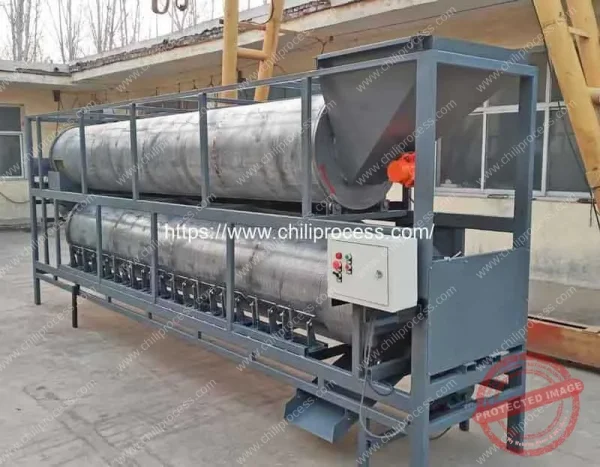
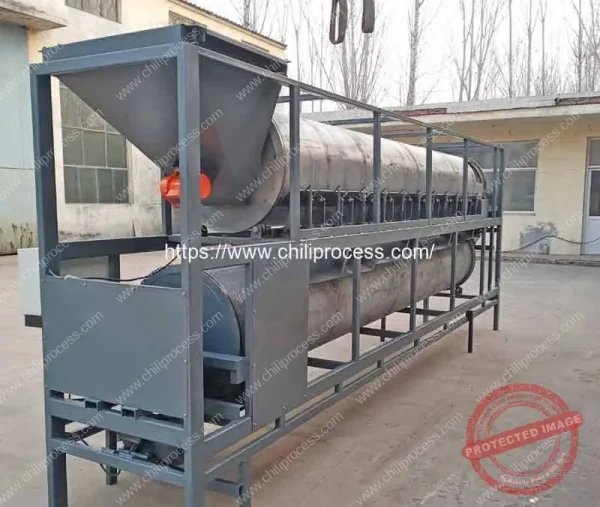
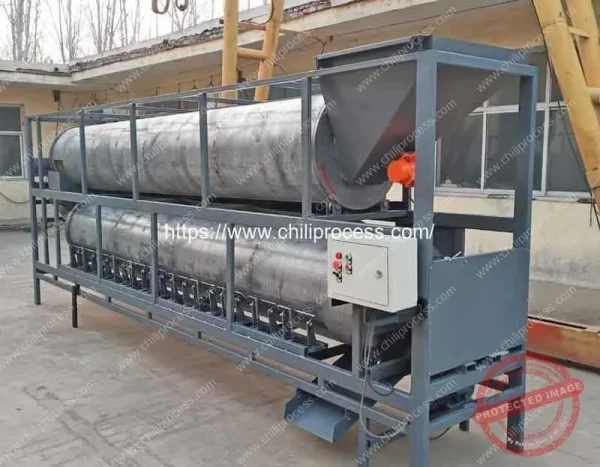
Chili Stem Cutting Machine 600 kg/h
Chili arrives with its handle attached. The stem cluster is woody, bitter, ungradeable, and every process downstream — drying, crushing, seed separation, extraction — is cleaner without it. Cutting stems by hand is exactly as pleasant as it sounds. A chili stem cutting machine feeds pods calyx-first past a blade that shears the stem off at the shoulder, leaving the fruit whole and the calyx where the waste bin is. Simple in sentence, fiddly in engineering: pods vary, stems lean, and the machine’s reputation lives in the percentage it gets right.
How it works
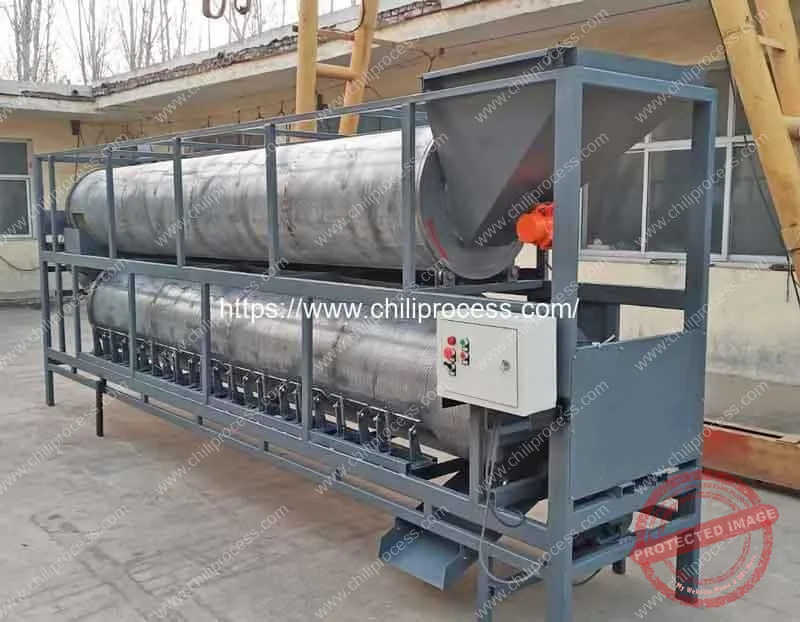
Pods are orientated — by vibrating trays, orienting rollers or operator loading on semi-automatic models — so the calyx leads. Each pod enters the cutting station between spaced rotating discs or a disc-and-counter-holder pair; the blade passes at the pod shoulder, shearing the stem cluster free in one cut. Cut pods discharge whole to an inspection conveyor; severed stems fall to a waste auger. Capacity and cut quality trade against orientation accuracy, which is why fully automatic orienting heads cost what they cost, and why semi-automatic machines with an operator presenting pods remain common at mid volumes. Blade gap and speed adjust for pod size — small bird’s-eye chilies and large paprika pods are different settings, not different machines.
Suitable for
Chili crushing and powder lines, where stems in the crush dilute colour value and tie up sorting capacity; dried chili packers who must sell stem-free whole pods; oleoresin and paprika extractors, where stem material drags down extract quality; seed producers separating seed from clean pod material.
Not suitable for
Producers selling attached-stem traditional products, where the stem is the handle the market wants; very mixed-species streams with wildly different pod geometry, which defeat single-station orientation and want sorting first; tiny volumes for local milling, where a bench cutter and patient hands remain honest economics.
Material & compliance
Frame, chutes and product guides in SUS304 (EN 1.4301); blades stainless tool steel, removable for sharpening; capsaicin is an oil — surfaces must shed it, so smooth welds and washdown-rated motors throughout. Operator guards at the cutting station with interlocks, because fingers and chilies travel the same path in semi-automatic loading.
Supplied with CE declaration of conformity and DoC on request; material certificate EN 10204 3.1 available for contact parts.
Selection notes
Ask for the stem-removal rate and the pod-damage rate on your chili type — both numbers matter, and a machine that removes stems by mangling pods has failed politely. Ask how orientation works: manual presentation, vibratory orienting or full automatic, and what labour each assumes. Check blade change and sharpening access; chili resins build on blades fast and the schedule is real. Confirm dust and fume handling — dry chili cutting raises pungent dust, and your operators will have opinions.
When you should not buy this machine: If your chilies go whole into bipolar extraction where stems are tolerable at low levels, weigh the machine against simply accepting the grade deduction. And if your volume is a farm gate’s worth for a local mill, hand cutting with a simple bench shear is a machine you already own.
Key specifications
| Parameter | Value |
| Capacity | 300-1000 kg/h by model (TYPICAL, confirm with factory) |
| Stem removal rate | 95%+ with oriented feed (TYPICAL) |
| Pod damage rate | Target <3% at correct setting (TYPICAL) |
| Feeding | Manual presentation or automatic orienting |
| Blades | Stainless tool steel disc blades, adjustable gap |
| Contact material | SUS304 (EN 1.4301) |
| Power supply | 380V/3P/50Hz, 1.5-3 kW class |
Specification values are industry-typical ranges for this machine class and are not verified against a specific factory datasheet. Replace them with measured factory data before publication.
FAQ
Will it work on both fresh and dried chilies?
Fresh and dried pods behave differently — dried pods are brittle and crack where fresh pods cut. Machines are tuned per state; tell the factory which you process and insist on a trial with your own stock.
What about the seeds — does cutting lose them?
A clean shoulder cut leaves the seed cavity intact. Cheap cuts or wrong gap settings shave the shoulder and spill seed, which shows up as loss at the seed separation step — one more reason the cut quality number matters.
Semi-automatic or fully automatic?
Semi-automatic with one operator presenting pods is the value point for most mid-size lines; fully automatic orienting pays at high volumes with uniform pod types. Ask what labour each option assumes per 600 kg and price the year, not the machine.
Related equipment
This unit is one stage of a complete processing line. For the full range of cutting and slicing equipment, or to compare this model against the Vegetable Strip Cutter 1000 kg/h, see the complete equipment catalogue. Capacity, material grade and utility requirements can be confirmed through a quote request.
Reviews
There are no reviews yet.