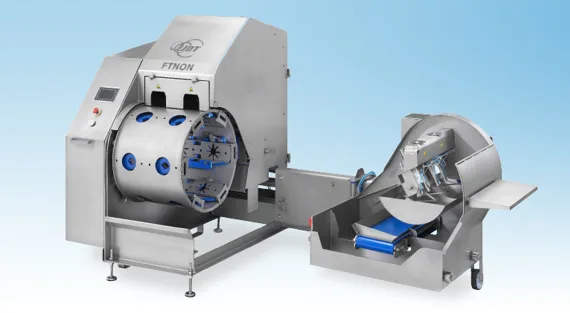
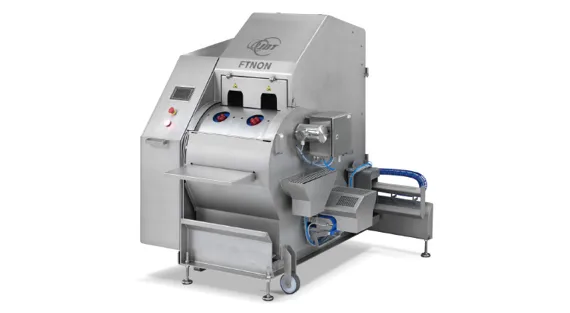
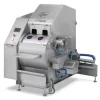
Bell Pepper Coring Machine 1200 pcs/h
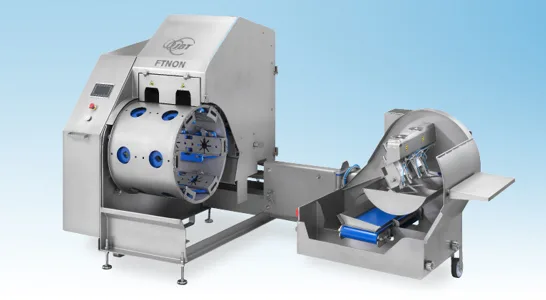
Cutting unit for the one job on a pepper line that resists automation: lifting out the stem and seed core without tearing the shell. Hand coring runs at a few hundred pieces per operator-hour and costs the industry more repetitive-strain claims than almost any other cutting task, which is the problem this machine exists to solve.
How it works
The pepper is seated stem-up in a locating cup. A coring head — a cylindrical cutter sized to the core, with a gripper for the stem — descends, cuts around the core, grips it, and withdraws with stem, seeds and placenta attached. The cored shell stays in the cup and is ejected whole to the discharge. Seed waste drops to a separate chute, because the seed and placenta fraction goes to a different place than the shells.
Pepper geometry is the difficulty. Calyx diameter, core depth and wall thickness vary more between peppers than between most fruit, so machines work over a size class with an adjustable coring head, and small fruit at the edge of the class is sorted out ahead of the machine rather than fought by it.
Suitable for
Pepper processing lines feeding slicing, dicing or stuffing operations; fresh-cut operations where whole cored shells are the product; frozen pepper lines where cores and seeds are an inclusion defect; operations moving labour off hand coring for both cost and ergonomics; chili and paprika processing where seed separation matters for downstream heat specification.
Not suitable for
Mixed pepper sizes without grading — the coring head is set for a class, and an ungraded feed ruins the yield; very small or heavily misshapen fruit outside the cup range; product sold as whole peppers with calyx attached, which this machine dismantles by design; anyone expecting full automation at low volume, where a semi-automatic machine with an operator is the honest configuration.
Material & compliance
Frame, cups and coring heads in SUS304 (EN 1.4301); coring cutter edges in stainless blade steel, removable for sharpening. Seed waste chute and shell discharge separated so cross-contamination does not occur; the machine opens for daily wash-down of the cup area where seeds accumulate.
Supplied with CE declaration of conformity and DoC on request; material certificate EN 10204 3.1 available for contact parts.
Selection notes
Ask for the yield figure measured on your pepper class, not a demo fruit — the difference between 88 % and 94 % shell recovery is the business case. Check how the coring head adjusts between size classes and how long a changeover takes. Check what happens to a pepper that is off-size: a good machine rejects it into the seed stream, a bad one jams on it. Check the guard design, because the stroke cycle is the safety case.
When you should not buy this machine: If your pepper volume is a few hundred kilos a day and you have stable labour, hand coring with a good bench tool is cheaper. Also skip it if your peppers arrive ungraded — buy the grader first, because the coring machine cannot compensate for what the grower mixed.
Key specifications
| Parameter | Value |
| Capacity | 800-2000 pcs/h by model and operator count (TYPICAL, confirm with factory) |
| Operation | Manual load with guided punch, or automatic by model |
| Coring diameter | Adjustable by pepper size class (TYPICAL) |
| Seed waste | Separate discharge stream |
| Shell integrity | Whole shell retained for slicing or stuffing |
| Contact material | SUS304 (EN 1.4301) |
| Power supply | 380V/3P/50Hz or 415V/3P/50Hz, customizable |
Specification values are industry-typical ranges for this machine class and are not verified against a specific factory datasheet. Replace them with measured factory data before publication.
FAQ
Why not automate loading completely?
Peppers will not orient themselves reliably. Every fully automatic pepper line solves orientation with vision systems or singulating feeders, and both add cost that only pays at high volume. A semi-automatic machine with a seated operator is frequently the right answer below about 2000 pieces per hour.
Where do the seeds go?
Into a separate chute, collected dry. Seed and placenta carry most of the capsaicin and the microbiological load; keeping them out of the shell stream is part of the hygiene design, not an accessory.
Does the shell come out intact?
Yes, on graded fruit within the size class. Torn shells are almost always off-size fruit or a worn coring head, and both are fixable before the machine is blamed.
Related equipment
This unit is one stage of a complete processing line. For the full range of cutting and slicing equipment, or to compare this model against the Vegetable Dicing Machine 1500 kg/h, see the complete equipment catalogue. Capacity, material grade and utility requirements can be confirmed through a quote request.
Reviews
There are no reviews yet.