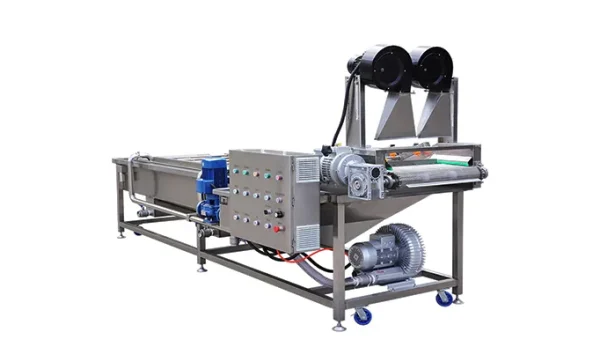
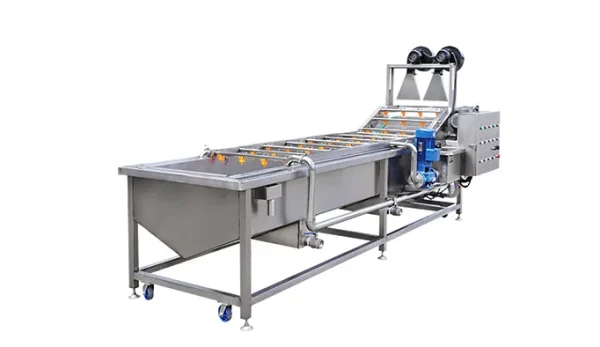
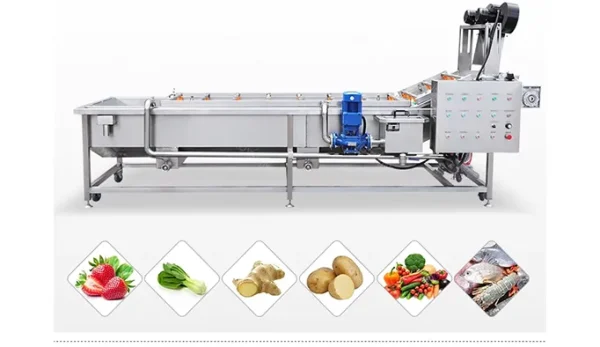
Spray Washing Machine
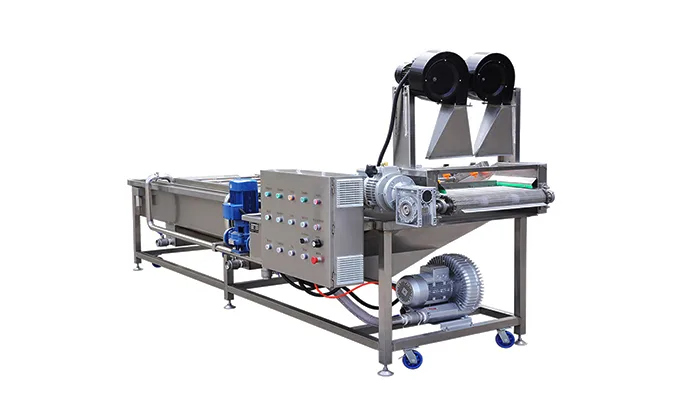
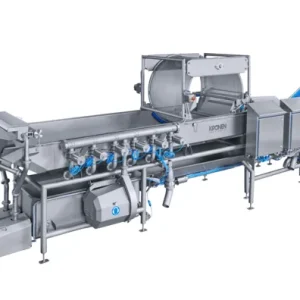
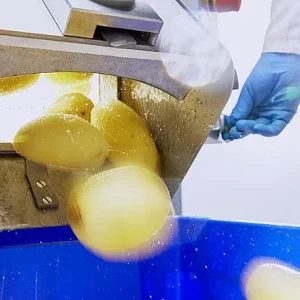
Continuous high-pressure spray washer that rinses cut produce, leafy greens and whole vegetables on a moving belt — no immersion tank, so product never sits in recirculated dirty water.
How it works
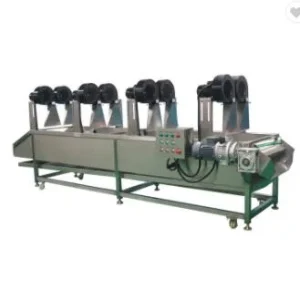
Product travels on a perforated stainless belt through one or more spray chambers. Pump-fed nozzle manifolds mounted above and below the belt deliver filtered water at pressure, stripping surface soil, cell sap and field residue. Sections are usually split into a pre-rinse, a main wash and a final potable-water rinse, each with its own filtration loop and settling tank. An air-knife or vibratory dewatering section is typically fitted at the discharge end.
Because the product is not immersed, the wash water in each section stays cleaner than in a tank system, and dissolved load does not build up on the product surface.
Suitable for
Leafy greens and salad mixes; cut produce after slicing or dicing; blanched product needing a cold rinse; whole vegetables with light to moderate soil; product that must reach a chilled state quickly.
Not suitable for
Heavily clayed root crops — spray alone will not break a dry clay crust, and you need a soak or brush stage first; product that floats and cannot be held on a belt; product where immersion cooling is part of the validated process.
Material & compliance
Belt, chamber and all product-contact surfaces in SUS304 (EN 1.4301); SUS316L (EN 1.4404) on request for saline or acidic rinse water. Food-contact welds ground smooth, Ra <= 0.8 um. Nozzle manifolds removable for cleaning without tools.
Supplied with CE declaration of conformity and DoC on request; material certificate EN 10204 3.1 available for contact parts; hygienic design follows HACCP principles with sloped drainage and no dead legs.
Selection notes
Count the spray sections, not just the total length — a single chamber cannot do pre-rinse, wash and final rinse at the same water quality. Ask whether the final rinse uses fresh potable water or filtered recirculated water; for ready-to-eat salad the final rinse must be potable. Check nozzle access: manifolds that need tools to remove will not be cleaned between shifts.
When you should not buy this machine: If your product arrives with heavy adhered soil, a spray washer will move the dirt around rather than remove it — buy a soak tank or brush washer upstream. Also skip it if you have no filtration on the recirculation loop; unfiltered recirculated water re-deposits soil onto every batch.
Key specifications
| Parameter | Value |
| Capacity | 800-3000 kg/h (TYPICAL, confirm with factory) |
| Chamber material | SUS304 (EN 1.4301) |
| Pump power | 2.2-5.5 kW (TYPICAL) |
| Water consumption | 1.0-2.5 m3/h with recirculation (TYPICAL) |
| Nozzle pressure | 2-6 bar (TYPICAL) |
| Power supply | 380V/3P/50Hz or 415V/3P/50Hz, customizable |
| Automation | Semi-automatic to fully automatic |
Specification values are industry-typical ranges for this machine class and are not verified against a specific factory datasheet. Replace them with measured factory data before publication.
FAQ
Can a spray washer replace a bubble washer?
Only for light soil loads. Bubble washing adds residence time and mechanical agitation that spray alone does not provide. Lines handling field-root crops usually run a soak or bubble stage first and use spray washing as the final rinse.
How much water does it actually use?
With a two-stage recirculation loop and filtration, typical consumption is 1.0-2.5 m3/h. Without recirculation the same machine can use several times more, which is why the filtration package matters more than the pump size.
Does spray washing work for leafy salad?
Yes, and it is the standard approach for cut salad — but the final rinse must be potable water, and dewatering downstream (air knife or centrifuge) is usually required before packing.
Related equipment
This unit is one stage of a complete processing line. For the full range of washing and peeling equipment, or to compare this model against the bubble washing machine, see the complete equipment catalogue. Capacity, material grade and utility requirements can be confirmed through a quote request.
Reviews
There are no reviews yet.