





Fruit Slicing Machine
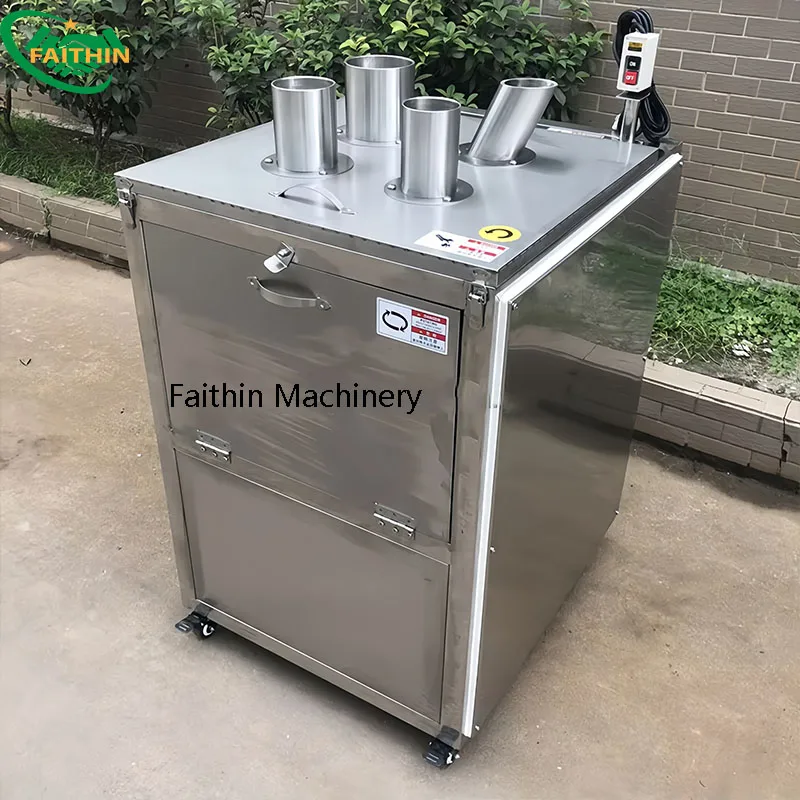
Rotary slicer built for fruit: it holds the piece, presents it to a rotating blade and discharges even slices at a thickness set by the blade head.
How it works
Whole or peeled fruit is fed by hand into a feed chute or by belt into a rotating feed drum. The drum carries the product past a stationary or rotating blade; each pass takes one slice of the thickness set by the blade gap, and the slice is thrown clear through a discharge chute. On citrus and other round fruit the feed orients the piece so slices are cut across the axis. Thickness is changed by the blade head or by a spacer, not by a dial.
Because the cut is a single blade passing a moving product, slice thickness is consistent as long as the product is fed consistently — irregular feed is the main source of variation, not the blade.
Suitable for
Apples and pears for drying, pie filling and canning; citrus for slices and segments; bananas for chips and drying; kiwi, mango and firm stone fruit after pitting; product where an even slice drives drying uniformity or pack appearance.
Not suitable for
Very soft or overripe fruit that deforms before the blade; fruit with stones or large seeds, which must be pitted first; product needing a dice, a wedge or a shaped cut; whole-fruit packs where no cut surface is wanted.
Material & compliance
Blade, feed drum, chute and frame in SUS304 (EN 1.4301); blade in hardened stainless or tool steel and replaceable. Blade guard interlocked; feed chute designed so hands cannot reach the blade. Contact parts removable without tools for washdown.
Supplied with CE declaration of conformity and DoC on request; material certificate EN 10204 3.1 available for contact parts.
Selection notes
Specify the thickness you actually sell and confirm the blade head exists for it — most slicers ship with one head, and a second thickness means a second head. Ask how the fruit is fed: hand feed is fine at low rates but sets your labour cost and your consistency ceiling. Check browning management, since cut fruit surfaces oxidise quickly and the machine should move product to the next stage rather than hold it.
When you should not buy this machine: If your fruit is ungraded, slices will vary in diameter even when thickness is perfect — grade first. Also skip it for soft fruit: a rotary slicer needs the piece to hold its shape against the blade, and anything that squashes will give you ragged slices and juice loss.
Key specifications
| Parameter | Value |
| Capacity | 300-3000 kg/h by model (TYPICAL, confirm with factory) |
| Slice thickness | 2-10 mm by blade set (TYPICAL) |
| Feed method | Hand feed or belt feed by model (TYPICAL) |
| Motor power | 0.75-2.2 kW (TYPICAL) |
| Contact material | SUS304 (EN 1.4301) |
| Power supply | 380V/3P/50Hz or 415V/3P/50Hz, customizable |
Specification values are industry-typical ranges for this machine class and are not verified against a specific factory datasheet. Replace them with measured factory data before publication.
FAQ
Can one machine slice apples and citrus?
Often yes with a feed and blade change, because both are firm and round. Citrus rind is harder on blades, so confirm blade material and expected blade life for the mix you run.
Why are my slices uneven in thickness?
Feed, not blade. Product presented at an angle or in a hurry gives a wedge rather than a slice. Slow the feed and check that the feed drum is gripping consistently.
How do I stop cut fruit browning?
The slicer cannot do it. Move slices quickly to an anti-browning dip, blanching or drying stage, and keep the cut-to-treatment time short and measured.
Related equipment
This unit is one stage of a complete processing line. For the full range of cutting and slicing equipment, or to compare this model against the Vegetable Slicing Machine 1200 kg/h, see the complete equipment catalogue. Capacity, material grade and utility requirements can be confirmed through a quote request.

Reviews
There are no reviews yet.