Blast Freezer
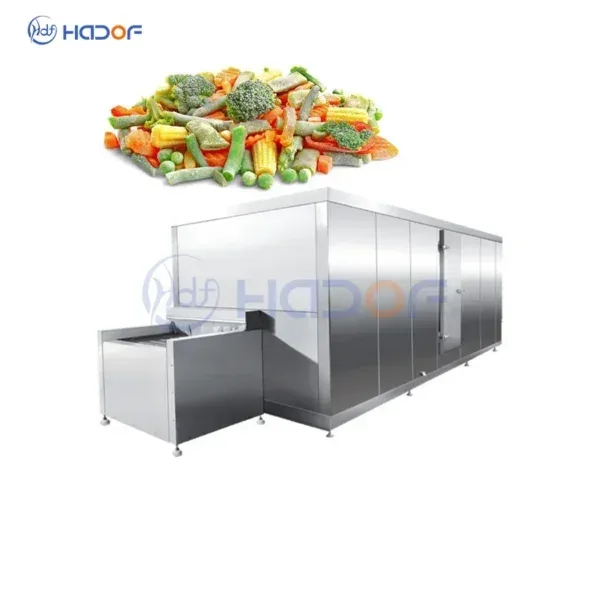
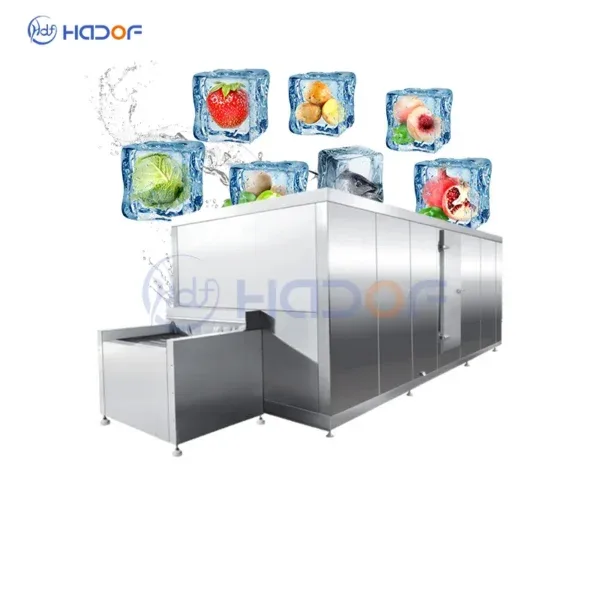
Blast freezer that forces high-velocity cold air over product, freezing it far faster than a cold store and at a fraction of the capital of an IQF line.
How it works
Product on trays, trolleys or a belt is placed in an insulated enclosure through which refrigerated air is driven at high velocity by fans over an evaporator coil. The moving air strips heat from the product surface continuously, and because the air is both cold and fast, the surface heat transfer coefficient is much higher than in still air. Freezing proceeds inward from the surface; when the core reaches target temperature the load is removed or transferred to storage.
Unlike an IQF freezer, product is not kept separate while it freezes — pieces in a tray or a layer will freeze together, which is the fundamental trade-off of the technology.
Suitable for
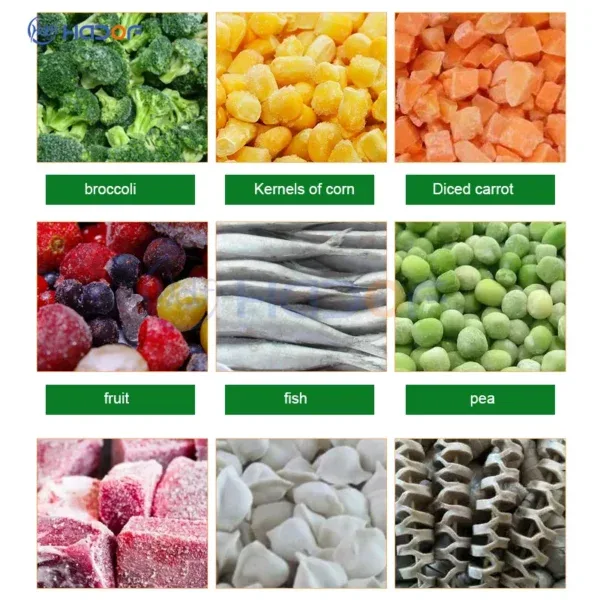
Tray or trolley freezing of berries, cut vegetables and prepared product; freezing product that will be packed as a block or that is processed further after thawing; plants needing more freezing capacity than a cold store gives without IQF capital; seasonal peak handling; product where pieces freezing together is acceptable.
Not suitable for
Product that must stay free-flowing and individually quick frozen; continuous high-volume lines, where a tunnel, spiral or fluidised bed is more efficient per kg; very thin or light product that the air stream will disturb; product where long freezing time causes quality loss through dehydration.
Material & compliance
Enclosure, fan housing, coil casing and racking in SUS304 (EN 1.4301); insulation with a cleanable, vapour-sealed internal surface. Evaporator and defrost arrangements designed for a food environment; floor and drain arranged for washdown; door seals and latches rated for low temperature and safe egress.
Supplied with CE declaration of conformity and DoC on request; material certificate EN 10204 3.1 available for contact parts. Refrigeration plant carries its own documentation and refrigerant compliance requirements.
Selection notes
Size on the heat load and the target core time, not on chamber volume — a chamber full of product at a high inlet temperature is a very different duty from the same chamber at a low one. Ask for the freezing curve on your product to your target core temperature. Check air distribution: a blast freezer with dead spots gives you a load that is partly frozen and partly not, which is worse than a slower, uniform freeze.
When you should not buy this machine: If you need individually quick frozen, free-flowing product, a blast freezer will give you a block — use an IQF tunnel, spiral or fluidised bed instead. Also skip it if your product is thin and light: the air velocity that makes blast freezing fast will also disturb or dry out product that cannot hold its place.
Key specifications
| Parameter | Value |
| Capacity | 200-5000 kg/h by chamber size (TYPICAL, confirm with factory) |
| Air temperature | -30 to -40 °C (TYPICAL) |
| Air velocity | High-velocity forced circulation (TYPICAL) |
| Freezing time | 30-240 min by product and load (TYPICAL) |
| Refrigerant | R404A, R507A or ammonia (R717) (TYPICAL) |
| Contact material | SUS304 (EN 1.4301) |
| Power supply | 380V/3P/50Hz or 415V/3P/50Hz, customizable |
Specification values are industry-typical ranges for this machine class and are not verified against a specific factory datasheet. Replace them with measured factory data before publication.
FAQ
Blast freezer or IQF — what is the real difference?
IQF keeps pieces separate while they freeze, so the product stays free-flowing. Blast freezing lets them freeze together. If your customer pours the product out of the bag, you need IQF.
Why does my load freeze unevenly?
Air distribution or loading. Blocked air paths, over-stacked trays or a coil that has iced up all produce cold zones and warm zones in the same chamber.
How much weight does product lose?
Some, through surface dehydration, and more the longer the freeze takes. Faster freezing and good air humidity control both reduce the loss — it is usually the reason to move from a cold store to a blast freezer in the first place.
Related equipment
This unit is one stage of a complete processing line. For the full range of freezing equipment, or to compare this model against the Spiral Belt Freezer 1500 kg/h, see the complete equipment catalogue. Capacity, material grade and utility requirements can be confirmed through a quote request.

Reviews
There are no reviews yet.