Spiral Belt Freezer
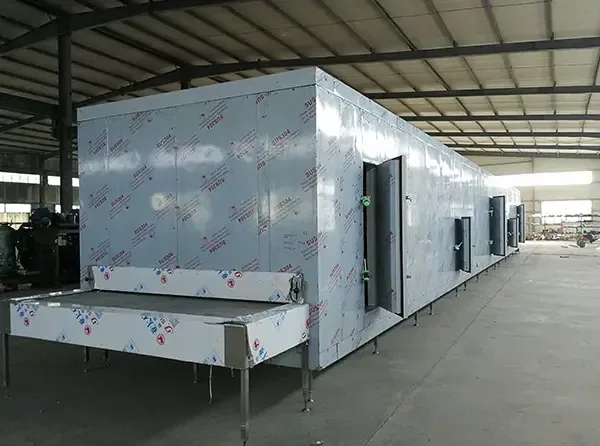
Spiral belt freezer that stacks a long belt run vertically in a compact footprint, giving the long residence time that dense or packaged products need.
How it works
Product enters at the bottom of an enclosed, insulated enclosure and travels on a belt wound around a rotating drum in a helix. Cold air is blown through the product bed by fans across evaporator coils. Belt speed sets residence time; the spiral arrangement gives tens of metres of belt travel within a few metres of floor space.
Because the air passes through the product rather than fluidising it, spiral freezers suit products that would be damaged or would not fluidise in a fluidised-bed IQF unit.
Suitable for
Burgers, patties and formed products; packaged ready meals; bakery items; fish fillets and portions; dense or irregular pieces that will not fluidise; products needing long dwell time to freeze through.
Not suitable for
Small free-flowing pieces such as peas, diced vegetables and berries, where a fluidised-bed IQF freezer is faster and gives better individual quick-freezing; products requiring cryogenic freezing speed; very low volumes where the defrost cycle overhead dominates.
Material & compliance
Belt, drum and enclosure in SUS304 (EN 1.4301); food-grade belting. Enclosure designed for washdown with sloped floor drainage and accessible evaporator section.
Supplied with CE declaration of conformity and DoC on request; material certificate EN 10204 3.1 available for contact parts. Refrigerant plant documentation supplied per the selected refrigerant; ammonia systems carry the additional safety documentation required.
Selection notes
Size on residence time and product thickness, not on kg/h alone — a thicker or denser product needs longer dwell, and undersizing shows up as warm cores rather than reduced throughput. Ask about defrost method and frequency, since defrost is lost production time. Check belt tensioning and drum drive access: spiral belts are the highest-wear component and the most expensive to replace.
When you should not buy this machine: If your product is small, free-flowing and needs true IQF, a fluidised-bed freezer will freeze it faster and keep pieces separate — a spiral will partly block-freeze it. Also skip it if you have no ammonia-trained staff and no refrigerant safety regime; the refrigeration plant is a bigger commitment than the freezer cabinet.
Key specifications
| Parameter | Value |
| Capacity | 500-3000 kg/h by model (TYPICAL, confirm with factory) |
| Belt width | 400-1000 mm (TYPICAL) |
| Evaporating temperature | -35 to -40 °C (TYPICAL) |
| Residence time | 20-90 min adjustable (TYPICAL) |
| Refrigerant | Ammonia (NH3), CO2 (R744) or HFC (TYPICAL) |
| Contact material | SUS304 (EN 1.4301) |
Specification values are industry-typical ranges for this machine class and are not verified against a specific factory datasheet. Replace them with measured factory data before publication.
FAQ
Spiral freezer or fluidised bed — which do I need?
It depends on the product. Free-flowing small pieces (peas, diced carrot, berries) belong in a fluidised bed, which freezes them individually and fast. Larger, denser or packaged products that cannot be fluidised go in a spiral.
Why does my product come out with a warm core?
Residence time too short for the product thickness, or product loaded deeper than the design bed depth. Reduce bed depth or slow the belt rather than lowering air temperature alone.
How often does it need defrosting?
Depends on product moisture load and running hours. Every defrost cycle is lost production, so ask the factory for expected defrost frequency at your throughput and whether defrost can be scheduled around your production pattern.
Related equipment
This unit is one stage of a complete processing line. For the full range of freezing equipment, or to compare this model against the IQF fluidized bed freezer, see the complete equipment catalogue. Capacity, material grade and utility requirements can be confirmed through a quote request.
Reviews
There are no reviews yet.