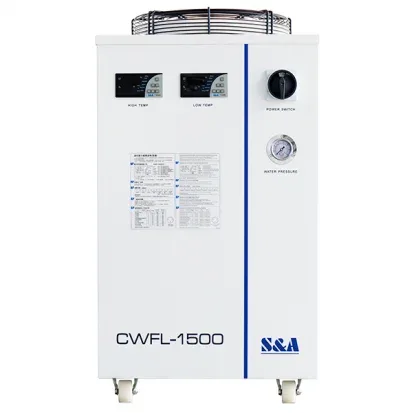
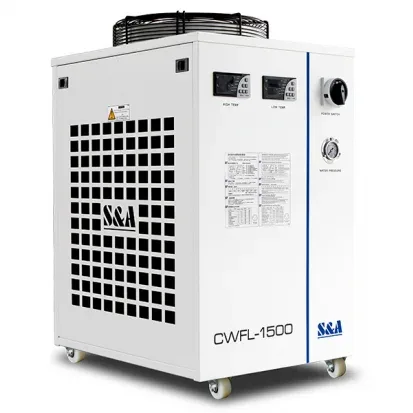
Industrial Chiller Unit 200 kW
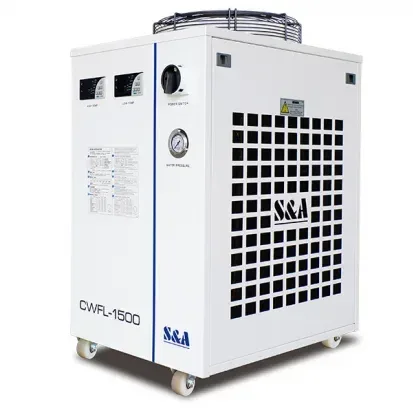
The refrigeration package behind a freezing line or a process cooling load. Freezers and cold rooms are heat loads; this is the machine that removes that heat, and it is the one item on a freezing project where undersizing is expensive and discovered late.
How it works
A compressor circulates refrigerant through a closed circuit: evaporation at low pressure absorbs heat from the process, compression raises the pressure and temperature, condensation rejects that heat to air or water, and expansion returns the refrigerant to low pressure. In a secondary-loop design, the refrigerant chills a glycol or brine solution that is pumped to the loads; in a direct-expansion design, refrigerant goes to the load itself.
The design point is the evaporating temperature, not the nominal capacity. Capacity quoted at -10 °C is not capacity at -40 °C, and the gap between the two is large. Sizing starts from the heat load of the connected equipment — product heat, infiltration, motor heat, defrost heat — and then selects a machine that delivers that duty at the evaporating temperature the process actually needs.
Suitable for
IQF tunnels, spiral and plate freezers that need a low-temperature refrigerant supply at a stable evaporating temperature; cold rooms and blast chilling; process cooling such as hydro-cooling water, jacketed vessel cooling or chilled water for wash circuits; plants consolidating several loads onto one central package.
Not suitable for
Loads that have not been calculated — sizing a chiller by rule of thumb is the most common and most expensive error on a freezing project; applications where a.Local ambient conditions are extreme and the condenser cannot reject heat, unless the design accounts for it; plants with no maintenance capability for refrigeration, which is a skilled trade, not a bolt-on; anyone choosing a refrigerant without checking current and upcoming regulation in the destination market.
Material & compliance
Refrigeration pipework in copper or steel to refrigerant service; glycol or brine contact parts in SUS304 (EN 1.4301) or compatible material. Pressure vessel and piping documentation supplied with the package; refrigerant charge documented for the F-gas register where applicable.
Supplied with CE declaration of conformity and DoC on request. Refrigerant choice must be checked against current F-gas and local environmental regulation for the destination market — this changes, and the machine outlives the rules it was bought under.
Selection notes
Ask for the capacity at your design evaporating temperature and ambient, in writing, and check the units. Ask what the part-load behaviour is, because a freezing line rarely runs at full load all day. Check the condenser type against your water availability and ambient — an air-cooled condenser in a hot climate is a different machine from the same nominal unit in a temperate one. Check who services it locally and what the refrigerant supply looks like in ten years.
When you should not buy this machine: If you have not had the heat load calculated, stop and get it calculated. Every shortcut in chiller sizing shows up as a freezer that never reaches temperature, and by then the freezer is installed and the chiller is the thing everyone blames.
Key specifications
| Parameter | Value |
| Cooling capacity | 100-300 kW at design conditions (TYPICAL, confirm with factory) |
| Refrigerant | R404A / R507A / R717 (ammonia) / CO2 by design |
| Evaporating temperature | -40 to -10 °C by application (TYPICAL) |
| Secondary fluid | Glycol, brine or direct expansion, by design |
| Condenser type | Air-cooled, water-cooled or evaporative (TYPICAL) |
| Compressor type | Screw, reciprocating or scroll by capacity |
| Power supply | 380V/3P/50Hz or 415V/3P/50Hz, customizable |
Specification values are industry-typical ranges for this machine class and are not verified against a specific factory datasheet. Replace them with measured factory data before publication.
FAQ
Why does the quoted capacity drop when I need it most?
Because capacity depends on evaporating temperature. A machine rated at -10 °C delivers far less at -40 °C. Always compare quotes at the same evaporating temperature and ambient.
Direct expansion or a glycol loop?
Direct expansion is more efficient and simpler for a single nearby load. A secondary loop adds a pump and a heat exchange step but makes multiple distant loads easier, and limits the refrigerant charge in the production area.
Which refrigerant should I choose?
The one that is legal, serviceable and available where the machine will run. Synthetic HFCs are being phased down in many markets; ammonia is efficient and cheap but needs trained handling; CO2 systems run at high pressure. Check the destination market’s current rules before specifying.
Related equipment
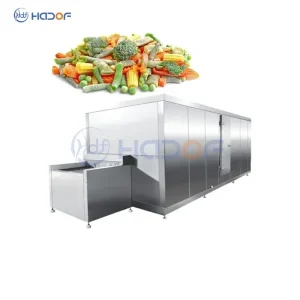
This unit is one stage of a complete processing line. For the full range of freezing equipment, or to compare this model against the IQF Tunnel Freezer 1500 kg/h, see the complete equipment catalogue. Capacity, material grade and utility requirements can be confirmed through a quote request.
Reviews
There are no reviews yet.