Juice Decanter Centrifuge
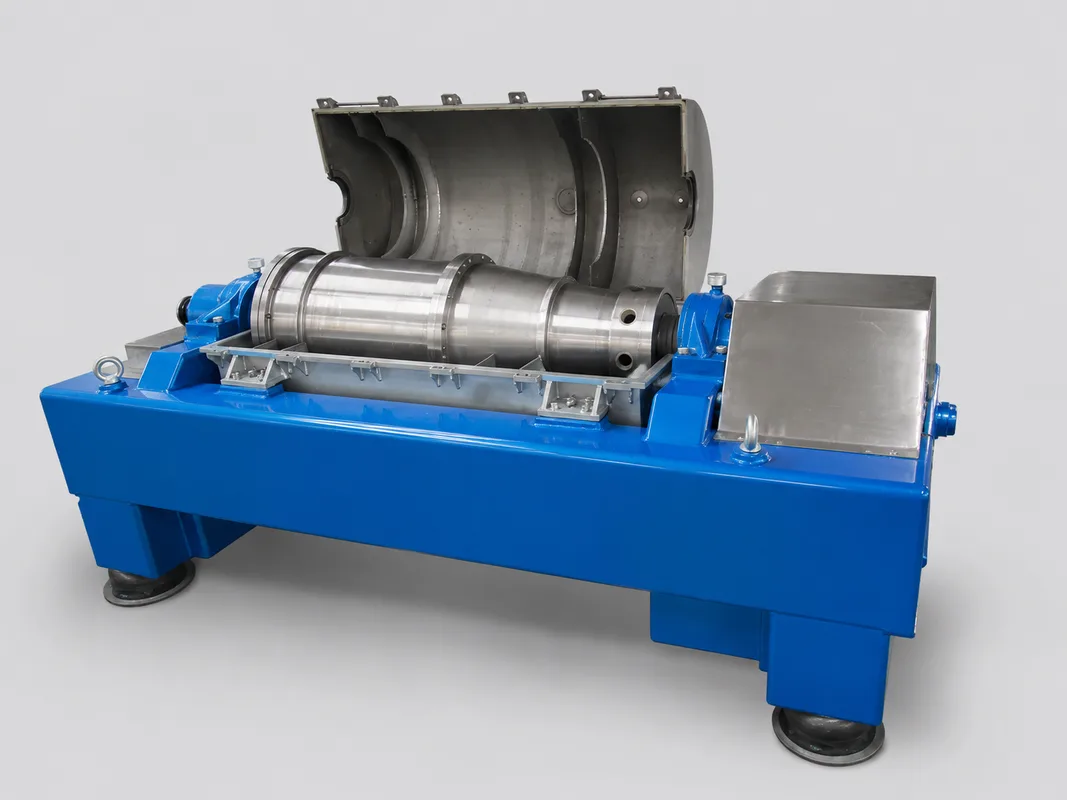
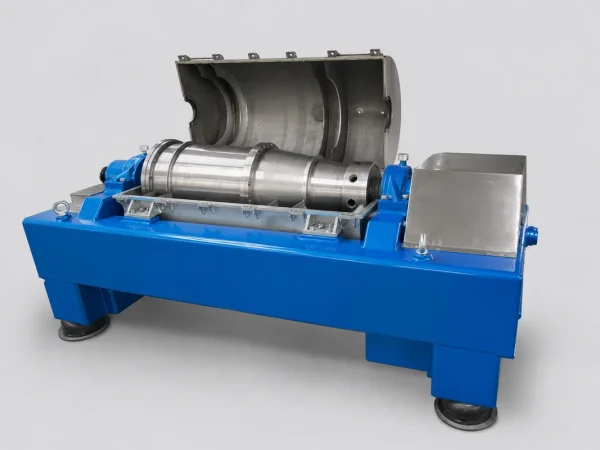
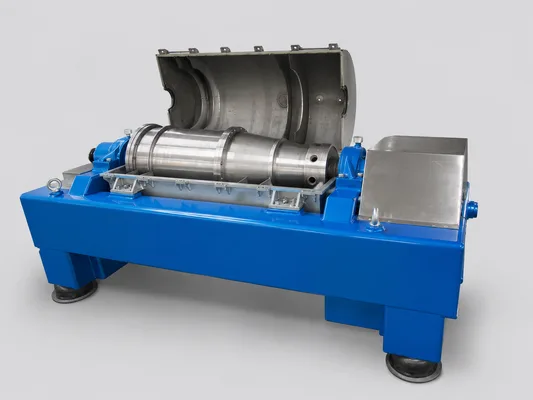
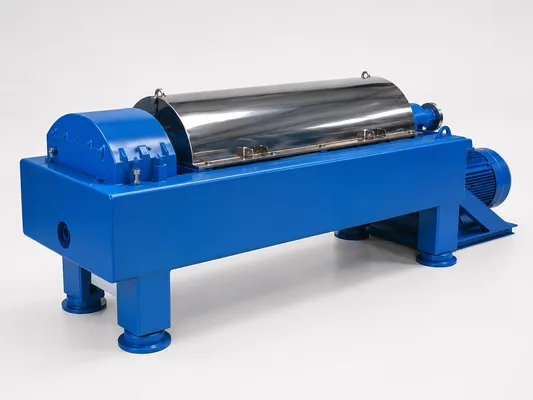
Horizontal decanter that separates juice from suspended solids continuously by centrifugal sedimentation, clarifying the liquid and discharging the solids as a dewatered cake in one pass.
How it works
Mash or cloudy juice is fed through a stationary inlet tube into the centre of a horizontal bowl rotating at speed. Centrifugal force throws the denser solids outward against the bowl wall, while the clarified liquid forms an inner layer and flows to the liquid discharge at the opposite end. An internal scroll conveyor rotates slightly faster or slower than the bowl and continuously screws the settled solids along the wall to a conical beach, where they are discharged. Liquid and solids leave continuously, so the machine runs at line rate rather than in batches.
Two settings govern the result: bowl speed sets the separating force, and the differential speed between scroll and bowl sets how dry the discharged solids are. Running a drier cake usually costs some clarity in the liquid, and that trade is the operator’s main decision.
Suitable for
Clarifying apple, pear and berry juice after pressing; dewatering pomace before disposal or further extraction; tomato juice and puree separation; continuous duty in a juice plant where a batch clarifier would be a bottleneck; reducing suspended solids before filtration, evaporation or concentration.
Not suitable for
Product requiring a bright, polished clarity that only filtration or enzymatic treatment plus filtration gives; very low volumes where a filter press is cheaper; product with abrasive solids that wear the scroll without a wear-protection package; operations that cannot manage the solids discharge downstream.
Material & compliance
Bowl, scroll, casing and discharge in SUS304 (EN 1.4301); SUS316L (EN 1.4404) on request for acidic product. Scroll flights hard-faced or protected where the product is abrasive; seals and gaskets food-grade and specified for the product. CIP connections and draindown arranged for a juice plant washdown.
Supplied with CE declaration of conformity and DoC on request; material certificate EN 10204 3.1 available for contact parts. Food-contact elastomers can be supplied to FDA 21 CFR 175 where required.
Selection notes
Give the factory your mash solids content, particle size and target clarity — decanters are sized on solids load, not on litres per hour, and a feed change of a few percent solids moves the machine you need. Ask about scroll wear protection for your product; tomato seed and berry seed are abrasive and unprotected flights wear quickly. Check what the discharged cake actually looks like, because a wetter cake is a yield loss you will carry every hour.
When you should not buy this machine: If you need polished, brilliant juice, a decanter gets you most of the way and filtration finishes the job — budget for both rather than expecting one machine to do it. Also skip it for low, intermittent volumes: a decanter is a continuous machine, and its cleaning and start-up overhead does not suit a plant that runs a few hours a week.
Key specifications
| Parameter | Value |
| Capacity | 1000-20000 L/h by model (TYPICAL, confirm with factory) |
| Bowl speed | 3000-4500 rpm by model (TYPICAL) |
| Separation principle | Continuous sedimentation under centrifugal force (TYPICAL) |
| Solids discharge | Scroll conveyor, continuous (TYPICAL) |
| Motor power | 11-30 kW (TYPICAL) |
| Contact material | SUS304 (EN 1.4301); SUS316L on request |
| Power supply | 380V/3P/50Hz or 415V/3P/50Hz, customizable |
Specification values are industry-typical ranges for this machine class and are not verified against a specific factory datasheet. Replace them with measured factory data before publication.
FAQ
Decanter or filter — which clarifies better?
A decanter removes the bulk of suspended solids continuously and cheaply; filtration produces the polished clarity customers usually expect. Most plants run both, with the decanter protecting the filter from load.
Why is my discharged cake wet?
The scroll differential is set for a fast solids conveyance. Slowing the differential holds solids in the bowl longer and discharges a drier cake, usually at some cost to liquid clarity.
How much juice is lost with the solids?
It depends on feed solids, bowl speed and differential. Ask for a measured figure on your own mash rather than working from a percentage, because it is a yield number you carry for the life of the machine.
Related equipment
This unit is one stage of a complete processing line. For the full range of pulping and juicing equipment, or to compare this model against the Screw Press Juice Extractor 3000 kg/h, see the complete equipment catalogue. Capacity, material grade and utility requirements can be confirmed through a quote request.
Reviews
There are no reviews yet.