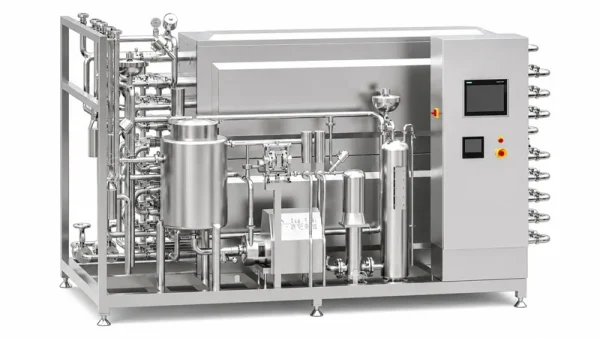
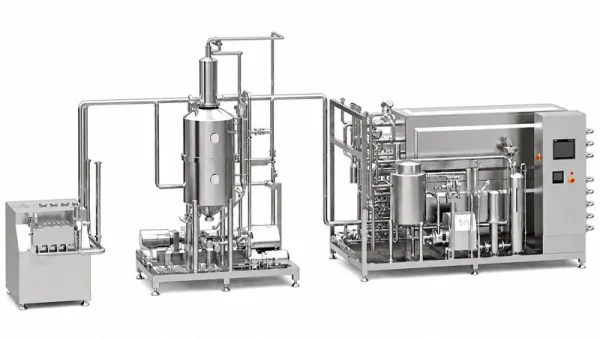
Tubular Juice Sterilizer 3000 L/h
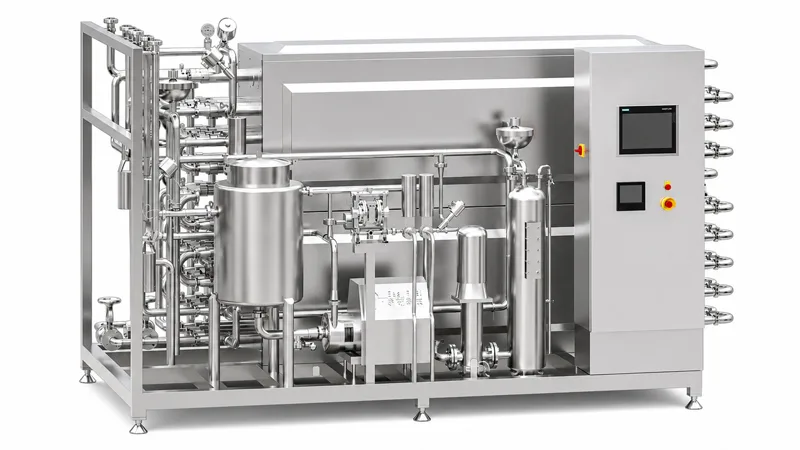
Continuous unit that heats juice to a defined temperature, holds it there for a defined time, and cools it again — all in a closed circuit. It is the step that turns a perishable juice into a product with a shelf life, and it is also the step where a control failure quietly produces a whole tank of under-processed product.
How it works
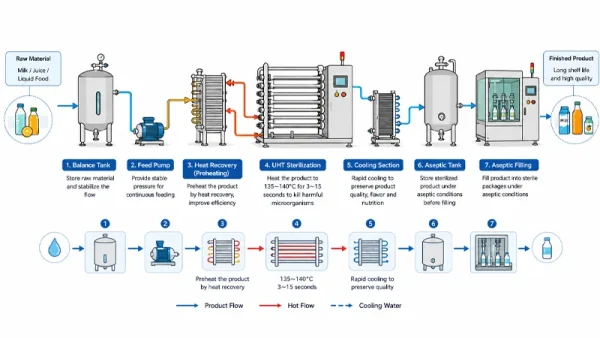
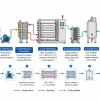
Juice is pumped through a tubular heat exchanger, typically in three sections: a regenerative section where outgoing hot product preheats incoming cold product, a heating section using hot water or steam, and a holding tube of known volume. The holding tube is what delivers the residence time; flow rate and tube volume together define how long the product spends at temperature.
After holding, the product passes back through the regenerative section to be cooled, then through a final cooling section with chilled water or glycol. A temperature sensor at the end of the holding tube controls a flow diversion valve: if the temperature falls below the set point, the valve sends product back to the balance tank rather than forward. That interlock, not the heater, is what makes the process safe.
Suitable for
Clear juices and nectars where pasteurisation is the requirement; pulp-containing juices where a tubular design with a large enough bore is specified; plants needing continuous operation with regenerative heat recovery to hold down energy cost; product where a defined, documented thermal process is required by the buyer or by regulation.
Not suitable for
Product with large particulates or high pulp content that would block a narrow tube — a scraped-surface or a different exchanger type is needed; very viscous concentrates; plants that cannot maintain a CIP circuit, because a pasteuriser that is not cleaned properly is a contamination source rather than a control step; anyone treating the process as approximate — thermal process records are the deliverable, not a formality.
Material & compliance
Product contact in SUS304 (EN 1.4301), with SUS316L (EN 1.4404) available for high-acid or high-chloride product; gaskets in food-grade EPDM or PTFE. Elastomer and plastic parts intended for food contact should be specified against FDA 21 CFR 175 where the destination market requires it.
Supplied with CE declaration of conformity and DoC on request; material certificate EN 10204 3.1 available for contact parts. Temperature recording and divert-event logging should be specified with the control system.
Selection notes
Ask how the holding time is calculated and demonstrated, not just what it is — the tube volume and the flow rate must be documented together. Ask what happens on a temperature dip, and check that the divert valve fails to the safe position. Check the CIP route: every metre of tube has to be cleaned, and dead legs are where the problems start. Check heat recovery, because on a continuous plant it is a large part of the running cost.
When you should not buy this machine: If your juice carries significant pulp or particulates, confirm the bore and the velocity first; a tubular unit chosen for clear juice will block. And if you cannot commit to CIP and to process records, this machine gives you a false sense of control — the risk is worse than not treating at all, because the product looks finished.
Key specifications
| Parameter | Value |
| Capacity | 2000-5000 L/h (TYPICAL, confirm with factory) |
| Treatment temperature | 85-105 °C by product and shelf-life target (TYPICAL) |
| Holding time | 15-60 s by product (TYPICAL) |
| Heat recovery | 80-90 % regenerative by design (TYPICAL) |
| Flow diversion | Automatic divert on low temperature |
| Contact material | SUS304 (EN 1.4301); SUS316L on request |
| Power supply | 380V/3P/50Hz or 415V/3P/50Hz, customizable |
Specification values are industry-typical ranges for this machine class and are not verified against a specific factory datasheet. Replace them with measured factory data before publication.
FAQ
Is pasteurised juice sterile?
No. Pasteurisation reduces the microbial load to a level where the product is stable under the intended storage conditions. Shelf life still depends on the incoming load, the fill hygiene and the cold chain.
What is the holding tube for?
It delivers the residence time. Temperature alone is not a process; temperature held for a defined time is. The tube volume and the flow rate are calculated together, and the diversion valve protects the set point.
Why does juice darken after treatment?
Usually because of remaining dissolved oxygen or an excessive thermal load. Vacuum deaeration before treatment and a tighter temperature-and-time combination both help; the cause has to be found, not covered.
Related equipment
This unit is one stage of a complete processing line. For the full range of pulping and juicing equipment, or to compare this model against the Juice Filtering Machine 3000 L/h, see the complete equipment catalogue. Capacity, material grade and utility requirements can be confirmed through a quote request.
Reviews
There are no reviews yet.