Mango Pulping Machine 3000 kg/h
Mango is the stone fruit that punishes generalists. Its flat fibrous seed does not crush — it shreds into fibres that ruin a pulp — and its skin carries latex that a general pulper smears into the product. A mango pulping machine is therefore two machines in sequence pretending to be one: a destoner that separates flesh from seed cleanly, and a refiner that screens out fibre and skin to a smooth finished pulp.
How it works
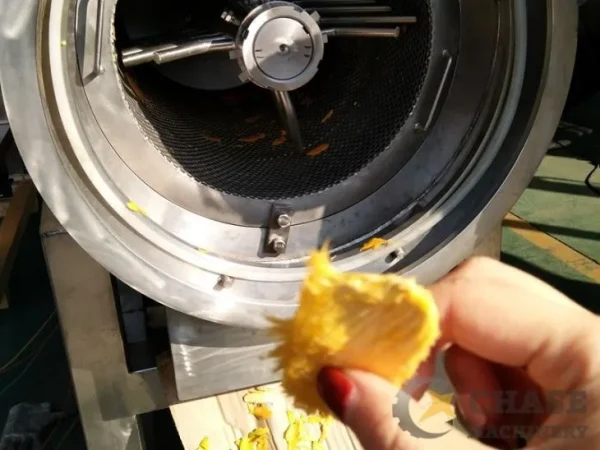
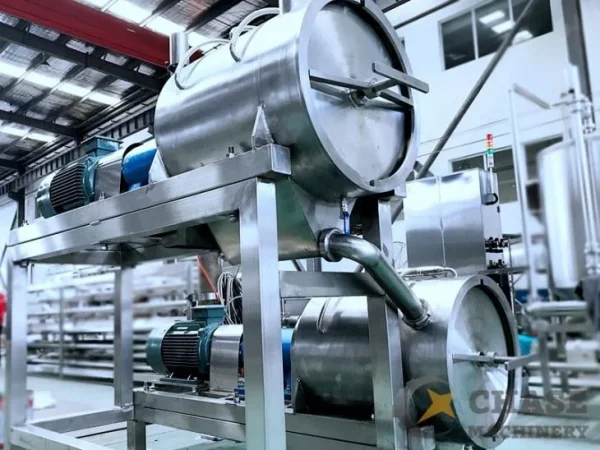
Ripe fruit is fed into the destoning section, where paddles or lobes press fruit against a perforated screen. The soft flesh passes through the screen holes; the seed, too hard and too large, travels along the screen and leaves as a separate stream — the design aim is flesh-off-the-seed with the seed intact, because a broken seed sheds fibre into everything downstream. The flesh-and-skin stream then enters the refining section: one or two stages of paddles against screens of decreasing hole size, where skin and long fibres are held back and the finished pulp passes through. Pulp fineness is set by the final screen, typically 0.8-1.5 mm for drinkable nectar base. Both sections’ waste streams — seeds, skin, fibre — leave continuously, and their condition is the fastest diagnostic of how well the machine is set.
Suitable for
Mango pulp production for juice, nectar, yoghurt base and aseptic bag filling; guava, peach and papaya pulping on changeable screens; tropical-fruit processors adding stone-fruit capability without a second machine; operations feeding an evaporator or pasteuriser downstream, where fibre-free pulp is a process requirement, not a preference.
Not suitable for
Hard or unripe fruit outside the machine’s softness window — the destoner needs the flesh to yield, and unripe mango leaves flesh on every seed; juice-only operations that could run a cheaper crusher-and-finisher without the destoning function; anyone expecting the machine to handle whole unsorted fruit with mixed ripeness — sorting upstream is what keeps the pulp quality consistent.
Material & compliance
Product-contact surfaces — hoppers, screens, paddles, chutes — in SUS304 (EN 1.4301), with SUS316L (EN 1.4404) specified for high-acid fruit where pitting corrosion is the concern. Screens removable for grade change and for cleaning, because mango fibre blinds screens over a shift. Paddle-to-screen clearance adjustable, and this adjustment is the machine’s main process setting. Guards and interlocks on both sections; seed and skin discharges arranged so nobody reaches in.
Supplied with CE declaration of conformity and DoC on request; material certificate EN 10204 3.1 available for contact parts.
Selection notes
Ask for the seed-breakage rate on your mango variety — it is the number that decides pulp quality, and it varies wildly between varieties and ripeness. Ask whether the destoner and refiner clearances are independently adjustable, and how long a screen change takes. Check the screen material and spare screen pricing; screens are the consumable. Check the machine’s actual tolerance of your fruit size range, since small and large mangoes feed differently. And check the waste streams’ arrangement against your collection plan.
When you should not buy this machine: If your fruit arrives pre-stoned or you buy pulp concentrate, this machine duplicates work already done. And if your volume is small and seasonal, a batch pulper with manual destoning serves better than a continuous machine idled most of the year — capacity you cannot feed is cost without output.
Key specifications
| Parameter | Value |
| Capacity | 2000-5000 kg/h by model (TYPICAL, confirm with factory) |
| Sections | Destoner + 1-2 stage refiner in line |
| Screen fineness | 0.8-1.5 mm final pulp (TYPICAL) |
| Seed breakage | Below 5 % on ripe, sorted fruit (TYPICAL) |
| Screens | Removable stainless, per-grade sets |
| Contact material | SUS304 (EN 1.4301); SUS316L for high-acid fruit |
| Drive | 5.5-11 kW total by model (TYPICAL) |
| Power supply | 380V/3P/50Hz or 415V/3P/50Hz, customizable |
Specification values are industry-typical ranges for this machine class and are not verified against a specific factory datasheet. Replace them with measured factory data before publication.
FAQ
Can it run peach and papaya as well as mango?
Yes — these are its standard second products. Peaches need a harder destoning setting for their tougher seed; papaya runs mostly on the refining stage. Screen sets and clearances change per fruit; the frame does not.
What is the difference between this and a fruit pulper-refiner?
The destoning stage. A general pulper assumes you feed it destoned fruit; a mango pulper takes whole fruit and separates seed itself. If your process includes manual or upstream destoning, the general machine is cheaper and just as good — the integration is the product you are paying for here.
How much yield should I expect?
On ripe, sorted mango, 55-70 % pulp yield by weight is typical (TYPICAL), with the balance in seed, skin and fibre. Varieties with heavy fibre run lower. Ask the supplier for yields measured on your variety, not on the one in their demo video.
Related equipment
This unit is one stage of a complete processing line. For the full range of pulping and juicing equipment, or to compare this model against the Fruit Pulper & Refiner 2000 kg/h, see the complete equipment catalogue. Capacity, material grade and utility requirements can be confirmed through a quote request.
Reviews
There are no reviews yet.