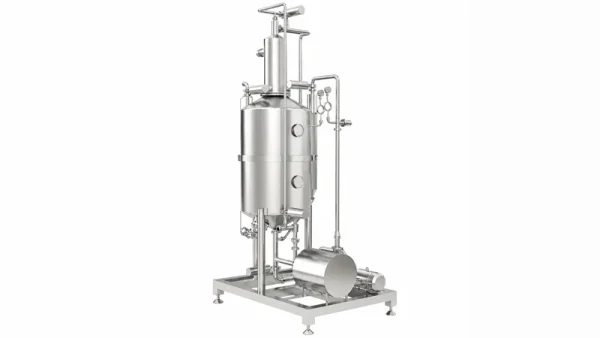
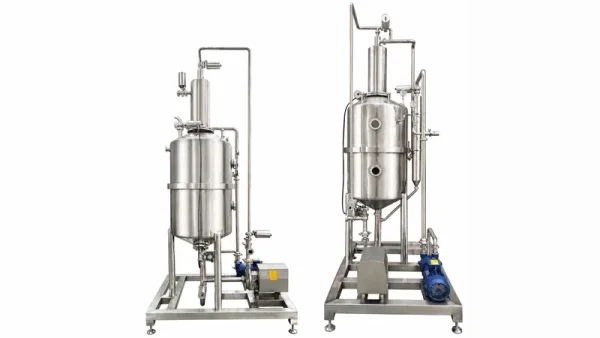
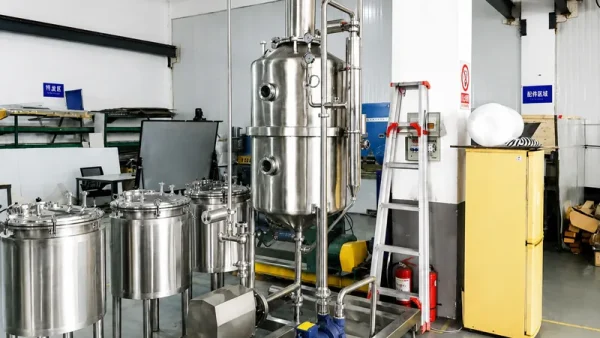
Juice Vacuum Deaerator
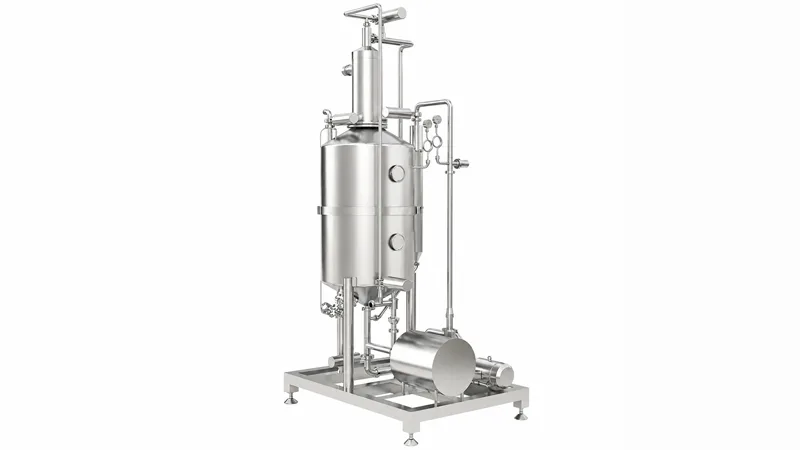
Vacuum deaerator that removes dissolved and entrained air from juice before it goes to the filler or the pasteuriser, so that oxidation is controlled rather than discovered later.
How it works
Juice is sprayed or distributed as a thin film into a vessel held under vacuum. At reduced pressure the solubility of oxygen falls sharply and the gas comes out of solution; the released gas is drawn off by the vacuum pump together with any entrained air and volatile aromatics. Deaerated juice is pumped out of the vessel under level or flow control. Many designs recover the aroma fraction separately so that it can be dosed back, since the volatiles that make juice smell like juice are among the easiest things to lose under vacuum.
The vacuum level and the surface area presented inside the vessel are what decide performance — thin films and high vacuum remove more gas, and also more aroma.
Suitable for
Juice before aseptic or hot filling, where dissolved oxygen drives shelf-life loss; product going into concentration or evaporation, where air causes foaming and fouling; clear and cloudy juice where colour and vitamin retention are part of the specification; lines that have seen browning or flavour flattening after filling.
Not suitable for
Product where the aroma loss is unacceptable and no recovery system is fitted; very viscous puree that will not form a film, which needs a different design; low-value product where the shelf-life benefit does not justify the capital; lines where the oxygen is picked up after the deaerator anyway.
Material & compliance
Vessel, distributor, piping and pump in SUS304 (EN 1.4301); SUS316L (EN 1.4404) on request for acidic product. Vessel built and documented for vacuum service; seals and gaskets food-grade; aroma condenser where recovery is fitted. CIP circuit designed for the vessel and the distributor.
Supplied with CE declaration of conformity and DoC on request; material certificate EN 10204 3.1 available for contact parts. Food-contact elastomers can be supplied to FDA 21 CFR 175 where required.
Selection notes
Ask for a measured residual oxygen figure at your throughput and product temperature — deaeration performance is stated in oxygen, not in vacuum level, and a good vacuum with poor film formation still leaves air in the juice. Check whether aroma recovery is included, because on premium juice the aroma strip is the difference between a deaerator that improves the product and one that flattens it. Confirm that downstream steps do not re-entrain air; a deaerator followed by a splashing transfer is wasted capital.
When you should not buy this machine: If your juice is filled cold, sold fast and not stored long, oxygen control may not pay for itself — fix the obvious air pickup points first. Also skip it if you cannot accept aroma loss and the machine has no recovery stage: deaerating premium juice without aroma return is a trade you will taste.
Key specifications
| Parameter | Value |
| Capacity | 1000-20000 L/h by model (TYPICAL, confirm with factory) |
| Working vacuum | Typically below 0.09 MPa absolute (TYPICAL) |
| Residual oxygen | Product and duty dependent, test required (TYPICAL) |
| Deaeration principle | Vacuum flash into a packed or spray chamber (TYPICAL) |
| Contact material | SUS304 (EN 1.4301); SUS316L on request |
| Power supply | 380V/3P/50Hz or 415V/3P/50Hz, customizable |
Specification values are industry-typical ranges for this machine class and are not verified against a specific factory datasheet. Replace them with measured factory data before publication.
FAQ
Why deaerate juice at all?
Dissolved oxygen drives browning, flavour loss and vitamin degradation during storage. Removing it before filling extends shelf life and keeps the product closer to what it tasted like when it was pressed.
Does it remove aroma as well?
Yes, and that is the trade-off. Volatile aroma compounds come off under vacuum with the air. Aroma recovery condensers capture them so they can be dosed back into the juice.
Where should it go in the line?
After extraction and clarification, before pasteurising and filling. Deaerating early is pointless if the product picks air up again in a transfer or a tank downstream.
Related equipment
This unit is one stage of a complete processing line. For the full range of pulping and juicing equipment, or to compare this model against the Fruit Crusher 3000 kg/h, see the complete equipment catalogue. Capacity, material grade and utility requirements can be confirmed through a quote request.
Reviews
There are no reviews yet.