Fruit Crusher
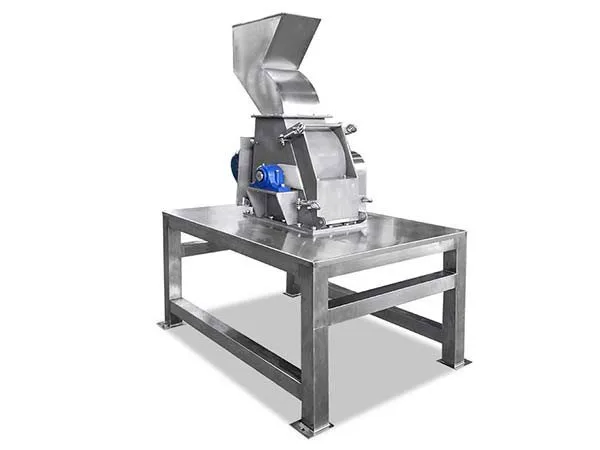
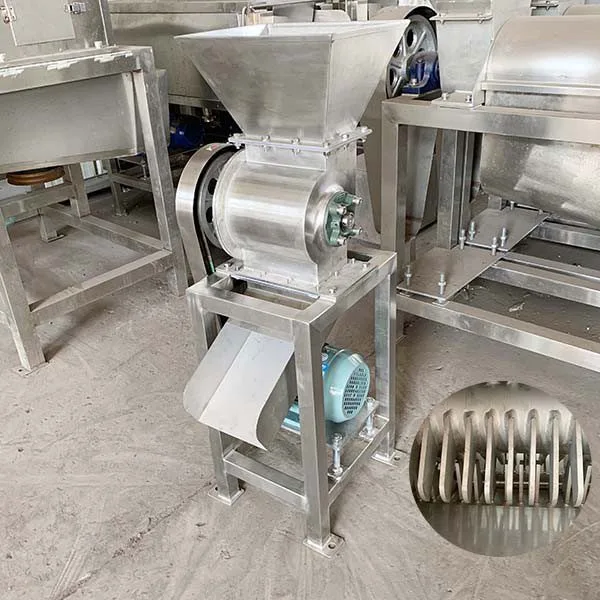
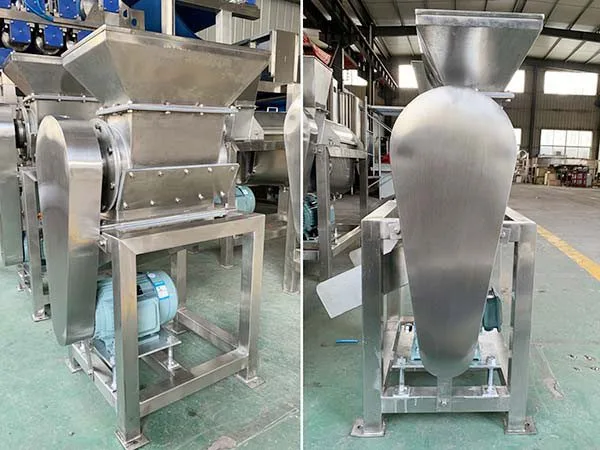
Hammer or toothed-roll crusher that reduces whole fruit to a uniform pumpable mash ahead of pressing, pulping or enzymatic treatment.
How it works
Whole or roughly broken fruit is fed into a chamber where rotating hammers or counter-rotating toothed rolls reduce it to mash. Hammer mills discharge through an interchangeable screen that sets particle size; toothed-roll crushers set it by roll gap and tooth profile. The mash then goes to a press, a pulper-finisher, or an enzymatic mash tank.
Particle size matters downstream: too coarse and press yield suffers; too fine and the mash produces excessive fines that clog press cloths and slow drainage.
Suitable for
Apples and pears before belt or rack pressing; berries and soft fruit before enzymatic treatment; mango, papaya and tropical fruit before refining; tomatoes before hot- or cold-break; any fruit destined for juice, puree or concentrate.
Not suitable for
Stone fruit with pits still in — crush pits and you contaminate the mash with broken stone and bitter almond notes; product requiring whole-fruit processing; very low-moisture material that will not form a mash.
Material & compliance
Crushing chamber, hammers, rolls and screens in SUS304 (EN 1.4301); SUS316L (EN 1.4404) on request for high-acid fruit such as citrus and tomato. Screen and roll changes possible without special tools.
Supplied with CE declaration of conformity and DoC on request; material certificate EN 10204 3.1 available for contact parts. Food-contact elastomers and polymers can be supplied to FDA 21 CFR 175 where required.
Selection notes
Match the crusher to the press or pulper behind it, not to the fruit alone — a press cloth or pulper screen has an optimum mash size, and the crusher exists to deliver it. Ask what screens ship with the machine and whether spares are stocked locally. Check whether the machine handles your fruit with pits or whether a destoner is required upstream.
When you should not buy this machine: If you are processing pitted stone fruit and have no destoner, do not crush — pit fragments will damage downstream equipment and taint the product. Also skip a hammer mill if your downstream process needs coarse, well-drained mash; a toothed-roll crusher produces a more open structure that presses better.
Key specifications
| Parameter | Value |
| Capacity | 1000-10000 kg/h by model (TYPICAL, confirm with factory) |
| Crushing principle | Hammer mill or toothed roll (TYPICAL) |
| Output particle size | Set by screen or roll gap (TYPICAL) |
| Motor power | 4.0-11.0 kW (TYPICAL) |
| Contact material | SUS304 (EN 1.4301) |
| Power supply | 380V/3P/50Hz or 415V/3P/50Hz, customizable |
Specification values are industry-typical ranges for this machine class and are not verified against a specific factory datasheet. Replace them with measured factory data before publication.
FAQ
Hammer mill or toothed roll — which should I choose?
Hammer mills give finer, more uniform mash and handle a wider range of fruit. Toothed rolls produce a coarser, more open mash that drains and presses better. Choose based on what your press or pulper expects, not on the fruit alone.
Can I crush stone fruit without removing the pits first?
No. Pit fragments damage downstream equipment and release bitterness into the mash. Either destone first or buy a crusher designed to separate pits rather than break them.
What particle size should I target for pressing?
It depends on the press type and cloth. Too coarse reduces yield; too fine generates fines that clog the cloth. The practical approach is to test two or three screen sizes on your own fruit and measure yield and drainage.
Related equipment
This unit is one stage of a complete processing line. For the full range of pulping and juicing equipment, or to compare this model against the fruit pulper and refiner, see the complete equipment catalogue. Capacity, material grade and utility requirements can be confirmed through a quote request.


Reviews
There are no reviews yet.