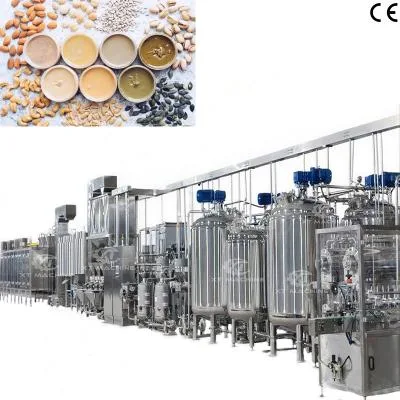
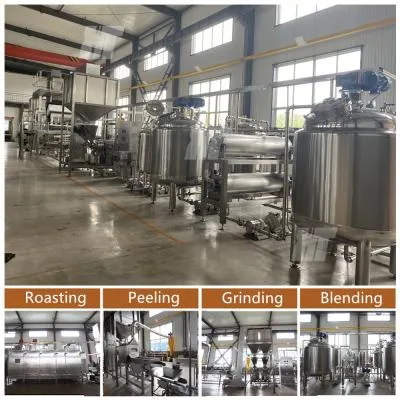


Colloid Mill 1500 kg/h
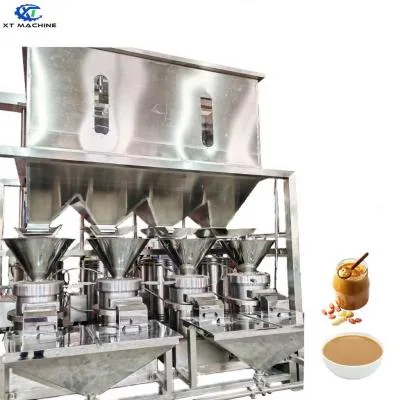
Wet milling unit for the texture nobody gets by sieving. Where a pulper removes seeds and skins, a colloid mill reduces what remains — fibre, cell fragments, dispersed solids — to a particle size small enough that the puree reads as smooth and holds together without separating. It is the difference between a pulp and a product.
How it works
Product is fed into the gap between a high-speed rotor and a matching stator. The gap is set at a fraction of a millimetre, adjustable with micrometer precision. As the rotor turns, product is accelerated into the gap, sheared intensely, and discharged. The work is shear, not impact: particles are torn apart by velocity gradients in the gap, which is why the machine runs flooded and why feed consistency matters.
One pass reduces particle size; tighter gaps and multiple passes reduce it further. Gap, rotor speed and the number of passes are the three settings, and they are tuned against the target texture — a baby-food puree and a pizza sauce base run different settings on the same machine.
Suitable for
Fruit and vegetable purees where smoothness and suspension stability are the specification; pastes and spreads including nut and seed pastes; products that separate on storage and need particle-size reduction for stability; pre-treatment ahead of evaporation or sterilisation where a homogeneous feed protects heat exchangers; standardising texture across batches before filling.
Not suitable for
Products with seeds, pits or hard inclusions, which must be removed by a pulper first — a colloid mill reduces soft tissue, not hard objects, and hard objects destroy the gap surfaces; very high-solids pastes beyond the machine’s flow limit; products where fibre texture is the selling point; dry milling of any kind — this machine runs on liquid content.
Material & compliance
Rotor, stator, chamber and hopper in SUS304 (EN 1.4301), with SUS316L (EN 1.4404) available for acidic product; gap surfaces hardened where hard contaminants are a process reality, though prevention remains better than hardness. The machine strips down for cleaning; the rotor-stator gap must be cleaned and inspected as a routine, because residue in the gap degrades texture and harbours contamination.
Supplied with CE declaration of conformity and DoC on request; material certificate EN 10204 3.1 available for contact parts.
Selection notes
Ask what particle size the machine reaches on your product and in how many passes — a single-pass figure on a dilute slurry means little on your thick puree. Check whether the gap is adjusted under load or only at standstill; in-production adjustment matters on changing products. Check the seal arrangement and what happens on dry running, because a colloid mill run dry destroys its faces in seconds. Check the throughput curve against product viscosity, not just water.
When you should not buy this machine: If your product only needs seed and skin removal, a pulper does that job and the colloid mill is an extra fine-texture step you may not need. And if hard inclusions reach this machine with any regularity, fix the pulping stage first — every mill supplier has a story about a stone that cost a rotor and stator set.
Key specifications
| Parameter | Value |
| Capacity | 300-3000 kg/h by product viscosity (TYPICAL, confirm with factory) |
| Gap adjustment | Micrometer-scale, typically 0.05-1 mm (TYPICAL) |
| Rotor speed | About 2800-3600 rpm at 50 Hz (TYPICAL) |
| Particle size | Down to sub-100 μm depending on product and passes (TYPICAL) |
| Configuration | Vertical or horizontal, single or multi-stage |
| Contact material | SUS304 (EN 1.4301); SUS316L on request |
| Power supply | 380V/3P/50Hz or 415V/3P/50Hz, customizable |
Specification values are industry-typical ranges for this machine class and are not verified against a specific factory datasheet. Replace them with measured factory data before publication.
FAQ
Is a colloid mill the same as a hammer mill?
No. A hammer mill is dry impact milling; a colloid mill is wet shear milling of a pumpable product. They solve different problems and a fruit line usually needs the second one, after pulping.
Why does my puree separate in storage despite milling?
Particle size may still be too coarse for the solids density, or the product genuinely needs a stabiliser — milling narrows the size distribution, it does not repeal physics. Check the target texture against what a finer gap and a second pass deliver before reformulating.
What destroys a colloid mill fastest?
Dry running and hard objects. Both wreck the rotor-stator faces, and the gap geometry is the whole machine. Feed-side protection and operator discipline on start-up order are cheap insurance.
Related equipment
This unit is one stage of a complete processing line. For the full range of pulping and juicing equipment, or to compare this model against the Fruit Pulper & Refiner 2000 kg/h, see the complete equipment catalogue. Capacity, material grade and utility requirements can be confirmed through a quote request.
Reviews
There are no reviews yet.