Pomegranate Juicing Machine 1500 kg/h
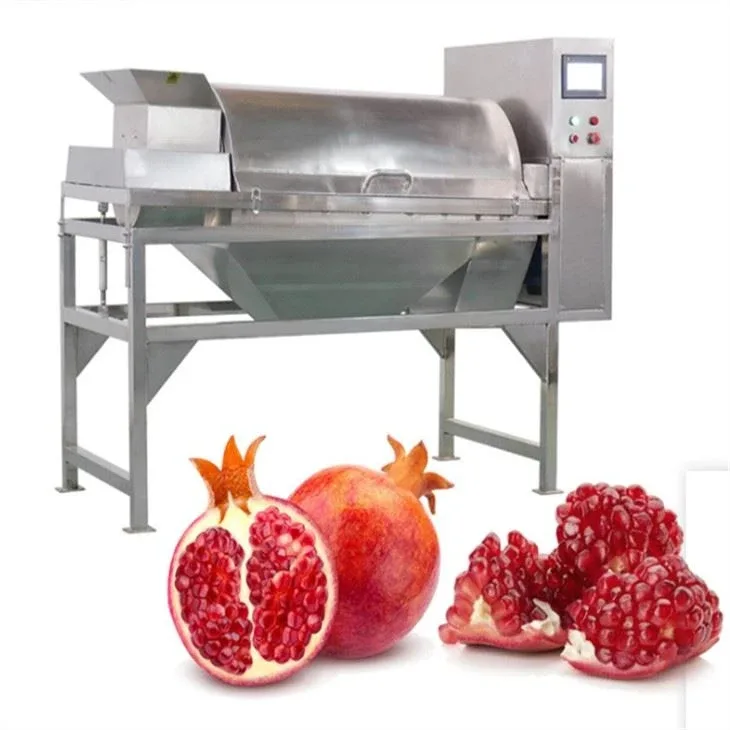
Pomegranate juice is won against its own fruit. The arils — the seed sacs — carry all the value; the rind and the membranes between them carry bitterness and tannin. Crush a pomegranate like an apple and the juice comes out brown, astringent and already spoiling. A pomegranate juicer therefore never grinds: it halves the fruit and squeezes the halves in a way that pushes juice out of the arils while the rind stays outside the juice stream.
How it works
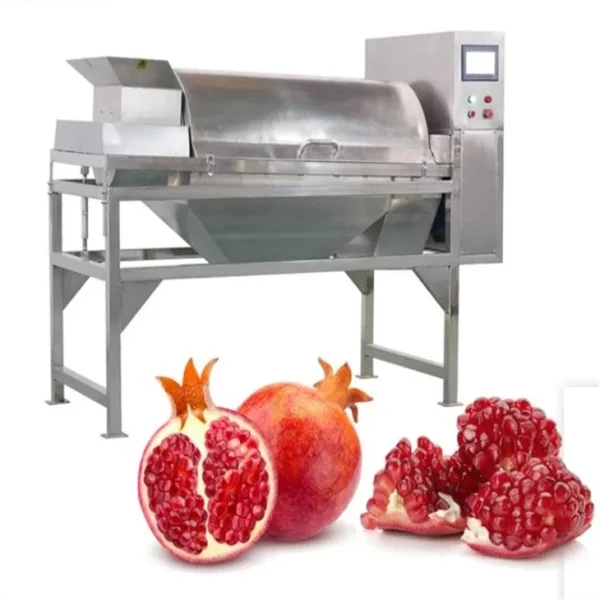
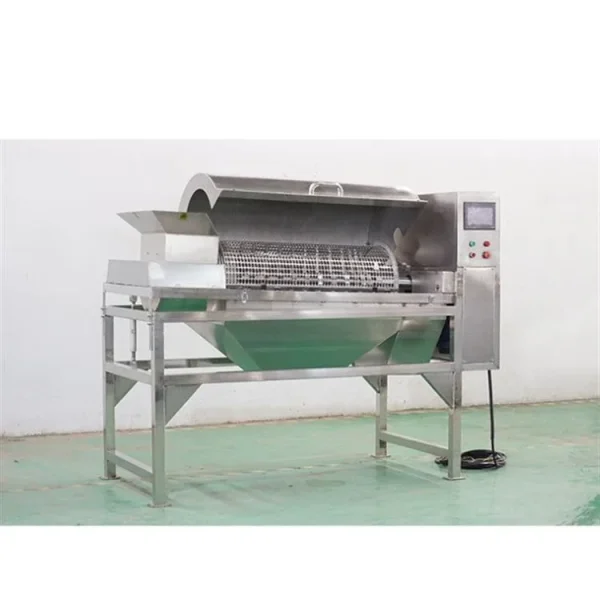
Fruit is singulated into pockets and cut in half by a blade or split by a cam. Each half travels to a pressing station where two shaped cups close around it — one static, one driven — and squeeze the aril mass out through a gap or grid. The design principle is that the rind compresses last and stays on the outside of the cup: juice and aril contents exit through the strainer, while most of the rind and membrane leave as a separate peel stream. Juice flows through a fine screen that catches seed fragments and membrane flecks, and leaves at the juice outlet for immediate straining or chilling. Throughput is set by the feeding and pressing cycle rate; output per kilo depends heavily on fruit variety and ripeness.
Suitable for
Fresh pomegranate juice bars and NFC juice bottling, where juice quality is judged by absence of bitterness; juice processors running seasonal pomegranate campaigns on a dedicated or shared machine; mixed citrus-pomegranate lines, because the halve-and-press geometry also handles oranges and lemons; operations currently hand-pressing or reaming fruit and losing both labour and yield.
Not suitable for
Clear single-strength juice at industrial scale from other fruits with different structure — apples and grapes need crushers and presses, not halvers; fruit too small or too irregular for the pocketing system, which jams or presses unevenly; operations without a juice chilling or pasteurising step behind the machine, because pressed pomegranate juice is highly perishable; anyone expecting the machine to also de-seed arils for fresh-pack sale — aril extraction is a different machine class.
Material & compliance
Frame, fruit pockets, pressing cups and juice channels in SUS304 (EN 1.4301); pressing cups food-grade with profiled surface matched to the fruit size range. Juice-wetted parts fully drainable and opening for wash-down, because pomegranate juice sugars ferment within a shift. Blade guarded; pressing station interlocked. Peel and membrane discharge arranged for continuous collection.
Supplied with CE declaration of conformity and DoC on request; material certificate EN 10204 3.1 available for contact parts.
Selection notes
Ask for the juice yield and, more importantly, for a taste test on your fruit variety — the whole point of this machine class is juice without rind contact, and the proof is a tasting, not a datasheet. Check the fruit size range the pockets and cups accept, and what changeover between small and large fruit involves. Check how juice and peel streams separate and whether the juice outlet suits your chilling step. Check the pressing cycle rate honestly against your daily tonnage, including feeding labour.
When you should not buy this machine: If your product is pomegranate concentrate or blended juice where some tannin is acceptable, a crusher and finisher costs less and yields more. And if your fruit supply is mixed-variance farm intake, sort or grade it first — this machine pays for uniformity, and charges for its absence in jams and uneven presses.
Key specifications
| Parameter | Value |
| Capacity | 800-3000 kg/h by model (TYPICAL, confirm with factory) |
| Extraction | Halving + profiled cup press, no crushing |
| Juice yield | 55-70 % by fruit weight (TYPICAL) |
| Fruit size range | 60-120 mm diameter by pocket set (TYPICAL) |
| Juice outlet | Screened, for immediate straining/chilling |
| Peel discharge | Continuous separate stream |
| Contact material | SUS304 (EN 1.4301) |
| Power supply | 380V/3P/50Hz or 415V/3P/50Hz, customizable |
Specification values are industry-typical ranges for this machine class and are not verified against a specific factory datasheet. Replace them with measured factory data before publication.
FAQ
How does it avoid bitter rind tannins in the juice?
Geometry, not chemistry. The fruit is halved and pressed in shaped cups so the rind stays outside the juice path and leaves as peel; the juice is expressed from the aril mass through a screen. Crushing — the cheap alternative — shreds rind and membrane into the juice, which is where the bitterness comes from.
Can it juice oranges too?
Yes — the halve-and-press geometry is essentially how premium citrus juicers work, and most suppliers sell the machine as dual-use. Pocket size and cup profile change with the fruit.
What yield should I expect?
Fifty-five to seventy percent of fruit weight as juice (TYPICAL), depending on variety and ripeness. Pomegranate varies more than most fruits — run a yield test with your fruit before setting production plans.
Related equipment
This unit is one stage of a complete processing line. For the full range of pulping and juicing equipment, or to compare this model against the Screw Press Juice Extractor 3000 kg/h, see the complete equipment catalogue. Capacity, material grade and utility requirements can be confirmed through a quote request.
Reviews
There are no reviews yet.