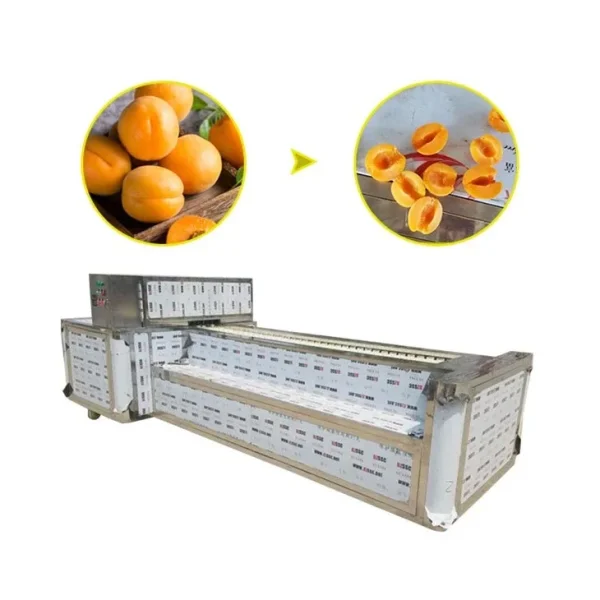
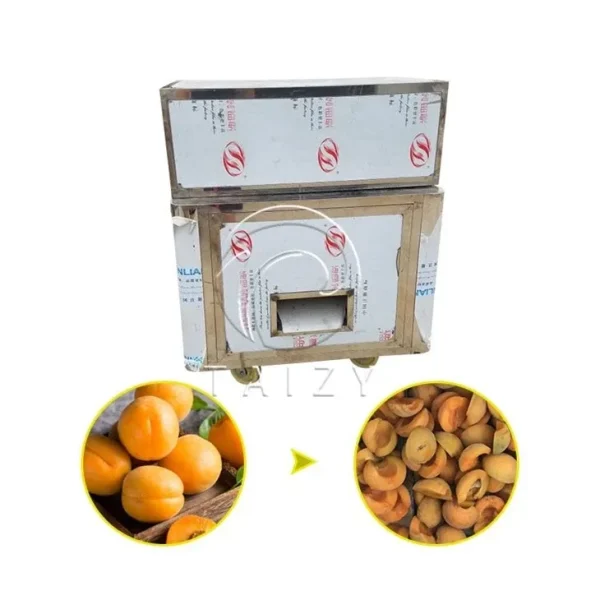
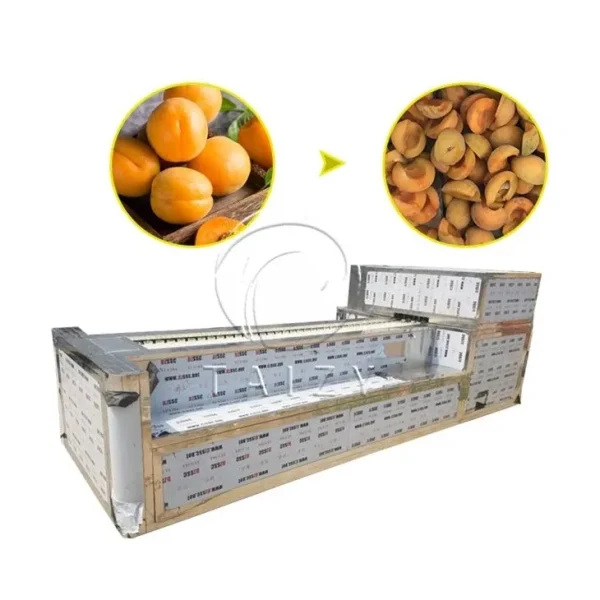
Fruit Halving Machine 1200 pcs/h
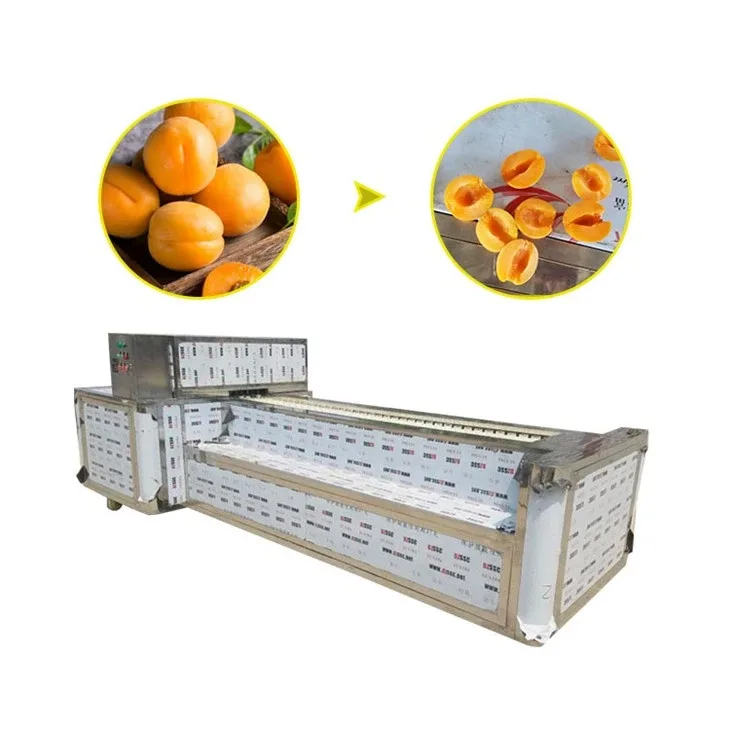
Cutting unit for stone fruit, where the cut has to go through the pit plane rather than through the pit. Peaches, apricots and plums are halved for drying, canning and freezing, and the whole job is one guided stroke that either finds the seam or makes a mess of a delicate fruit.
How it works
Fruit is seated in a cup, usually calyx-end down, by an operator or by a singulating feeder. The fruit travels to a cutting station where a blade descends along the vertical axis and splits it in two. What happens to the pit depends on the design and the product: on clingstone fruit the halves are pulled apart from the pit by grippers, on freestone fruit the pit releases with one half or is removed by a separate device. The halves discharge down one chute, the pit and any waste down another.
The seam is the difficulty. A peach splits along its natural suture cleanly when it is oriented to it; cut across the suture and the blade crushes flesh and shatters the pit. Orientation is either mechanical — by the fruit settling in the cup — or operator-assisted. Ripeness is the other variable: firm fruit halves cleanly, soft fruit tears, and a line running halving on soft fruit is fighting its own product specification.
Suitable for
Dried fruit operations where halves are the dried product; canning lines preparing halves for syrup filling; freezing lines where halves are frozen before further processing; operations replacing hand halving and pitting, which is slow and gives variable cut quality; apricot, plum, nectarine and mango lines with changeover cups, where similar geometry applies.
Not suitable for
Clingstone fruit on a machine specified for freestone, or the reverse — the pit removal arrangement is designed for one behaviour; very soft or overripe fruit, which tears instead of splitting; ungraded fruit, because the cup and blade are set per diameter class; anyone expecting pit-free halves without checking the pit separation method, because that is exactly the specification to confirm.
Material & compliance
Frame, cups, guides and chutes in SUS304 (EN 1.4301); blades and pit-removal tooling in stainless blade steel, removable for sharpening and set as consumables. Cutting station guarded with interlocked access. The machine opens for daily wash-down, because stone fruit juice is sugary and dries hard in the cup area.
Supplied with CE declaration of conformity and DoC on request; material certificate EN 10204 3.1 available for contact parts.
Selection notes
Ask for halving yield — halves without pit fragments, halves that hold together — measured on your variety and ripeness window, not on demo fruit. Ask specifically how the machine handles clingstone versus freestone, and what the pit discharge looks like. Check cup changeover between diameter classes and how long it takes. Check blade supply and change procedure; a dull blade ruins the cut face long before it stops cutting.
When you should not buy this machine: If your fruit goes to puree or juice, halving and pitting are steps you pay for and then undo — a pulper handles whole fruit more cheaply. And if your supply is genuinely mixed and ungraded, fix grading first; every yield figure a supplier quotes assumes fruit seated correctly in a correctly sized cup.
Key specifications
| Parameter | Value |
| Capacity | 800-2000 pcs/h by model and feed method (TYPICAL, confirm with factory) |
| Operation | Blade halving with pit separation or pit retention by model |
| Fruit diameter | Graded classes by cup size (TYPICAL) |
| Feed | Manual placement in cups or automatic singulation |
| Halves | Whole halves retained; pit discharged separately |
| Blade type | Stainless blade steel, replaceable |
| Contact material | SUS304 (EN 1.4301) |
| Power supply | 380V/3P/50Hz or 415V/3P/50Hz, customizable |
Specification values are industry-typical ranges for this machine class and are not verified against a specific factory datasheet. Replace them with measured factory data before publication.
FAQ
What is the difference between clingstone and freestone handling?
Freestone pits release from the flesh; clingstone pits hold. A machine specified for freestone will leave pit material in clingstone halves, and the reverse machine will tear flesh on freestone fruit. State your variety and its behaviour when you buy.
Why do my halves come out ragged?
Blade condition or orientation. A dull blade pushes rather than cuts, and fruit seated off the seam is cut across the suture instead of along it. Check cut faces first, then cup seating, then blades.
Does halving also peel?
No. Halving splits the fruit; the skin stays on. Peeling, where required, is a separate step, usually by lye or steam on stone fruit lines.
Related equipment
This unit is one stage of a complete processing line. For the full range of cutting and slicing equipment, or to compare this model against the Fruit Pitting Machine 1200 kg/h, see the complete equipment catalogue. Capacity, material grade and utility requirements can be confirmed through a quote request.
Reviews
There are no reviews yet.