Pea and Bean Shelling Machine 800 kg/h
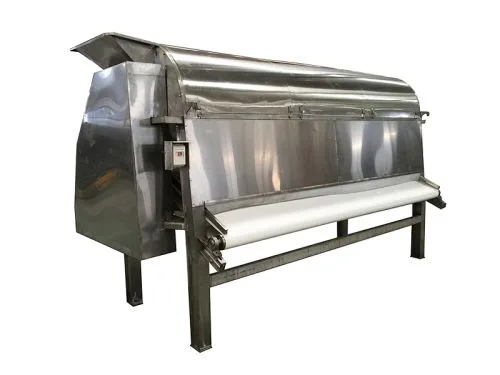
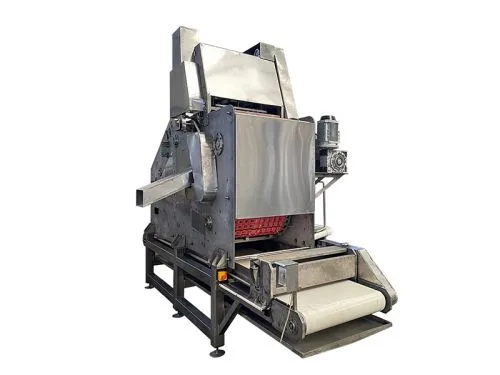
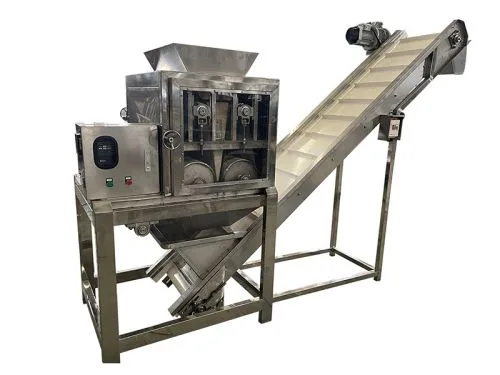
Shelling unit that turns pods into kernels. It looks like a separation problem and it is really a damage problem: the pod has to open without the kernel inside being crushed, and the kernel-to-pod weight ratio is the number the whole operation is measured on.
How it works
Pods are fed between counter-rotating rollers covered with food-grade rubber, or into a chamber with a beating drum, depending on the design and the crop. The rollers grip the pod and split it along its seam by shear rather than by cutting; the beating route opens pods by impact against a lined drum and is gentler on broad beans. The opened pod releases its kernels, and the mixed stream falls onto a screening and aspiration section where kernels pass through and the pod material is separated and discharged.
Roller gap and speed are set against pod size and firmness. Too tight and the rollers crush kernels; too loose and pods pass through unopened, which is why most installations either grade pods first or accept a second pass. Kernel damage rises sharply once pods are wet or over-mature, because the seam stops splitting cleanly and starts tearing.
Suitable for
Pea lines feeding blanching and freezing, where shelling is the first processing step; broad bean and green bean operations supplying fresh, frozen or canned product; plants replacing hand shelling at any scale past a few hundred kilos a day; operations where pods arrive field-fresh and need shelling within hours, because pod quality drops with holding time; lines where the pod waste has a feed or compost route already in place.
Not suitable for
Dried peas and beans, which are threshed by impact when dry and are a different machine for a different moisture state; wet or rain-damaged pods, which tear rather than split and smear the rollers; ungraded pods with a wide size spread, where one gap setting cannot serve the range; product sold in the pod, which this machine dismantles by definition; anyone without a route for the pod waste, which leaves at several times the kernel weight.
Material & compliance
Frame, hopper, chutes and screens in SUS304 (EN 1.4301); rollers with food-grade rubber covering, replaceable as a consumable and the defined wear part on this machine class. Aspiration ducting arranged so dust does not discharge into the workroom; the machine opens for daily cleaning because pea juice and pod debris build up fast and are difficult once dried.
Supplied with CE declaration of conformity and DoC on request; material certificate EN 10204 3.1 available for contact parts.
Selection notes
Ask for the kernel damage rate and the unshelled-pod rate at the same setting — a machine that shells everything and bruises a tenth of the kernels has failed the actual specification, because bruised peas darken in the freezer. Check the roller covering’s stated life and whether spares are stocked; it wears faster on gritty field pods. Check whether the machine needs graded pods, and if so, what grading the supplier assumes. Check the aspiration and screening arrangement against your pod waste route.
When you should not buy this machine: If your pods are dried, this is the wrong machine — dried legumes are threshed, not shelled. And if your pods arrive wet from field rain, dry them first; no roller setting compensates for pods that tear instead of splitting.
Key specifications
| Parameter | Value |
| Capacity | 300-1200 kg/h pods by model (TYPICAL, confirm with factory) |
| Shelling method | Counter-rotating rubber rollers or beating drum |
| Kernel damage | Low on uniform, graded pods (TYPICAL) |
| Pod waste | Separate discharge with aspiration |
| Setting | Adjustable roller gap by pod size |
| Contact material | SUS304 (EN 1.4301) |
| Power supply | 380V/3P/50Hz or 415V/3P/50Hz, customizable |
Specification values are industry-typical ranges for this machine class and are not verified against a specific factory datasheet. Replace them with measured factory data before publication.
FAQ
Why does kernel damage matter so much on peas?
Because damage shows up later, not now. A bruised pea looks acceptable at shelling and darkens during blanching and freezing. Damage rate is therefore a finished-product specification, not a machine statistic.
Can one machine handle peas and broad beans?
Often yes, with a gap change and sometimes a different roller set — the pods differ in size and firmness. Treat it as a changeover with defined settings, and confirm with the supplier which crops the machine is actually tooled for.
What is the pod-to-kernel ratio I should plan for?
It varies by crop and maturity, and it is the number that sizes your waste handling. Ask the supplier for it on your crop; the pod stream is several times the kernel weight and needs a route planned before installation, not discovered after.
Related equipment
This unit is one stage of a complete processing line. For the full range of sorting and grading equipment, or to compare this model against the Vegetable Destoner Machine 3000 kg/h, see the complete equipment catalogue. Capacity, material grade and utility requirements can be confirmed through a quote request.
Reviews
There are no reviews yet.