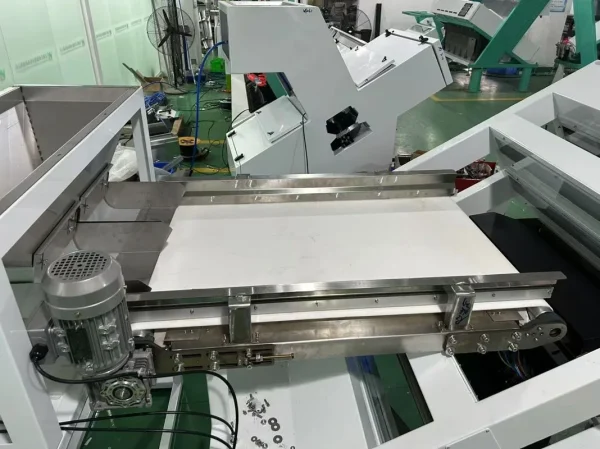
Optical Sorting Machine
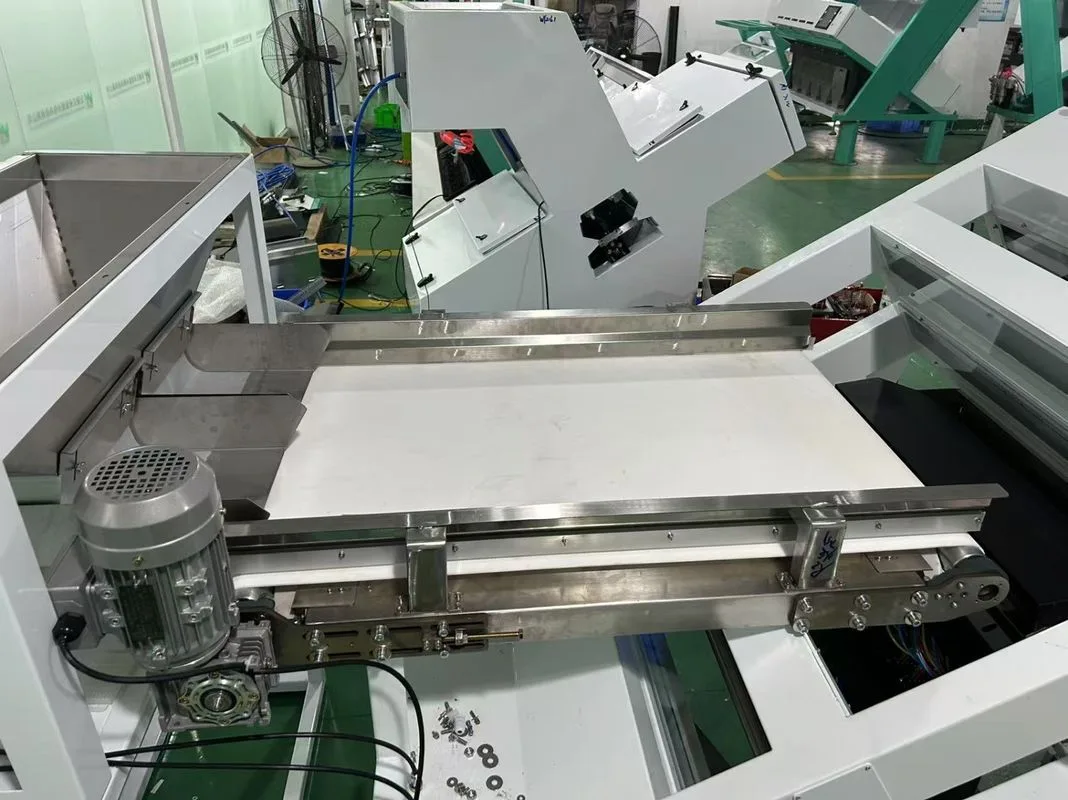
Camera and laser-based sorter that detects colour defects, foreign material and shape outliers on a fast-moving product stream and ejects them with pulsed air valves.
How it works
Product is singulated onto a chute or belt and presented to an inspection zone. Cameras (visible colour, NIR, or a laser scanner) build an image of each piece; the control system compares the image against accept criteria the operator sets. Pieces that fail are tracked to the eject bank, where a short air pulse blows them into a reject collection. Accept product continues on the main belt.
Performance depends on presentation as much as optics: product that overlaps or tumbles cannot be evaluated as a single piece.
Suitable for
Berries, diced and sliced vegetables, peas and beans, nuts and dried fruit; product where defect removal is the value driver; lines replacing manual inspection; cleaning product before freezing or packing.
Not suitable for
Product that cannot be singulated; heavily soiled product where the surface is not visible; very low-value product where the capital cannot be recovered; applications needing internal defect detection without an NIR or X-ray option.
Material & compliance
Product-contact chutes and frames in SUS304 (EN 1.4301); food-grade belting. Inspection zone enclosed and washdown-rated to the level the plant requires.
Supplied with CE declaration of conformity and DoC on request; material certificate EN 10204 3.1 available for contact parts.
Selection notes
Test on your own product before buying — datasheet sorting accuracy is measured on a controlled sample, not your stream. Ask what false-reject rate the factory expects at your throughput, because ejecting good product is a direct yield loss. Check compressed air demand: the valve bank is the largest utility cost and often underestimated.
When you should not buy this machine: If your defect rate is very low and your product is cheap, manual inspection or a simple size grader is the better use of capital. Also skip it if you cannot supply clean, dry compressed air — wet air fouls valves and causes intermittent ejection faults that are hard to trace.
Key specifications
| Parameter | Value |
| Capacity | 500-6000 kg/h by model (TYPICAL, confirm with factory) |
| Detection | CCD colour camera, laser, or NIR (TYPICAL) |
| Ejection | Pneumatic valve bank (TYPICAL) |
| Compressed air | 0.6-0.8 MPa, volume by valve count (TYPICAL) |
| Contact material | SUS304 (EN 1.4301) |
| Power supply | 380V/3P/50Hz or 415V/3P/50Hz, customizable |
Specification values are industry-typical ranges for this machine class and are not verified against a specific factory datasheet. Replace them with measured factory data before publication.
FAQ
Can an optical sorter detect internal defects?
Visible-colour cameras cannot. NIR and some laser configurations detect sub-surface bruising and internal disorder, and X-ray handles dense foreign material. Specify the detection type against the defect you actually need to remove.
What is a realistic false-reject rate?
It depends on how tightly the accept criteria are set and how consistent the product is. Tight settings remove more defect but discard more good product. Run a trial on your own stream and weigh defect removal against yield loss.
How much compressed air does it need?
Enough that the valve bank can fire at full reject rate without pressure drop. Undersized compressors cause falling pressure during peak rejection, which shows up as missed rejects. Size the compressor from the valve count and expected reject rate, not from the machine’s average draw.
Related equipment
This unit is one stage of a complete processing line. For the full range of sorting and grading equipment, or to compare this model against the roller size grading machine, see the complete equipment catalogue. Capacity, material grade and utility requirements can be confirmed through a quote request.
Reviews
There are no reviews yet.