Citrus Juice Extractor 2000 kg/h
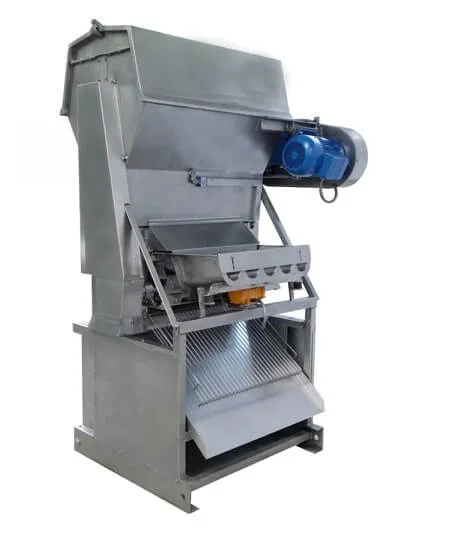
Extraction unit built around one awkward fruit. Citrus holds its juice in vesicles inside a peel full of bitter compounds, and the whole job is to get the juice out without pressing the peel hard enough to drag limonin and peel oil into it. Every design on the market is a different answer to that one problem.
How it works
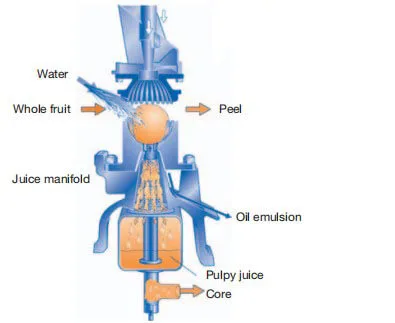
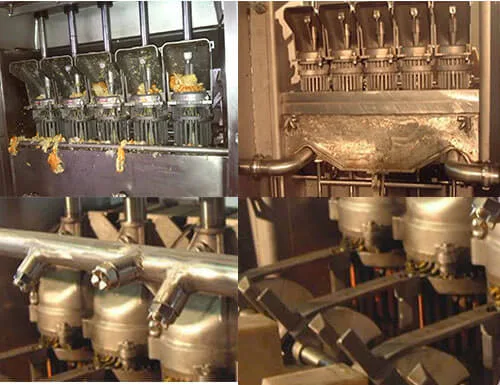
Fruit is singulated into cups sized to its diameter class. A knife or a cup pair halves the fruit, and each half is presented to an extraction head. In the reamer design, a rotating head enters the half and reams the flesh out while a strainer tube holds the juice path; in the cup-press design, the two halves are pressed between matched cups and the juice is expressed through a strainer. In both cases the juice leaves through the strainer tube and the peel, seeds and pulp leave as separate streams.
The strainer tube is where the bitter compounds are managed. Its perforation and its position decide how much peel oil and how much pulp ends up in the juice, and changing the tube is how a plant changes the juice specification. Pressure is the other control: press harder and yield goes up while bitterness goes up with it, and every citrus plant runs that trade-off deliberately against its product specification.
Suitable for
Fresh juice operations where the extractor’s separation behaviour is part of the flavour specification; concentrate and not-from-concentrate lines feeding evaporation or chilling; lemon and lime lines where peel oil recovery is a second revenue stream; operations running different citrus species with cup and strainer changeover; plants that need peel discharged as a clean stream for oil recovery, pectin or feed.
Not suitable for
Ungraded fruit — cups are set per diameter class and a mixed feed halves badly; very soft or damaged fruit, which collapses in the cup instead of halving; operations wanting cloudy, high-pulp juice, where the strainer tube is working against the specification; anyone expecting one head to cover a wide fruit range without cup changeover; plants that cannot handle the peel stream, which leaves at roughly half the intake weight.
Material & compliance
Cups, extraction heads, strainer tubes and juice troughs in SUS304 (EN 1.4301), with SUS316L (EN 1.4404) specified for acidic juice service. Juice contact surfaces finished for cleanability; the machine opens for full wash-down because citrus sugar and acid dry hard and fast. Guards with interlocked access around the halving and extraction stations.
Supplied with CE declaration of conformity and DoC on request; material certificate EN 10204 3.1 available for contact parts.
Selection notes
Ask for juice yield and for the bitterness outcome at the same setting — yield alone is meaningless on citrus, because yield bought with peel pressure is a quality problem sold as a quantity gain. Ask which strainer tube sizes exist and how the tube is changed. Check cup changeover between fruit classes and how long it takes. Check the peel discharge arrangement if peel oil or pectin is part of your economics, because that stream’s condition determines what it is worth.
When you should not buy this machine: If your product is whole-fruit puree or a cloudy high-pulp juice, a pulper or screw press is the better tool — a citrus extractor is designed to keep peel out, which is the opposite of what that product needs. And if your fruit arrives ungraded, buy the grader first; halving is the step where mixed sizes show up as lost yield.
Key specifications
| Parameter | Value |
| Capacity | 1000-5000 kg/h whole fruit by model (TYPICAL, confirm with factory) |
| Extraction | Reamer or cup press, by model |
| Fruit range | Graded classes by cup size (TYPICAL) |
| Juice yield | 40-50 % by fruit, variety and season (TYPICAL) |
| By-products | Peel, seeds and pulp separated by model |
| Contact material | SUS304 (EN 1.4301); SUS316L on acidic product |
| Power supply | 380V/3P/50Hz or 415V/3P/50Hz, customizable |
Specification values are industry-typical ranges for this machine class and are not verified against a specific factory datasheet. Replace them with measured factory data before publication.
FAQ
Why does citrus juice turn bitter after extraction?
Limonin and peel oil. Both come from pressing the peel too hard or leaving juice in contact with peel material. The strainer tube and the pressure setting control it, and juice held warm continues to develop bitterness after extraction — chilling early is part of the control.
What is the strainer tube for?
It sets the separation: how much pulp and how much peel-derived material reaches the juice. Changing the tube is how a plant moves between a clear juice and a pulpy one on the same machine.
Can one machine run oranges and lemons?
Usually, with cup and strainer changeover and different pressure settings. Confirm the cup range covers both diameter classes — lemons and limes sit well below oranges, and that difference is exactly where single-cup machines fail.
Related equipment
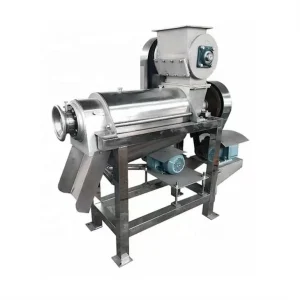
This unit is one stage of a complete processing line. For the full range of pulping and juicing equipment, or to compare this model against the Screw Press Juice Extractor 3000 kg/h, see the complete equipment catalogue. Capacity, material grade and utility requirements can be confirmed through a quote request.
Reviews
There are no reviews yet.