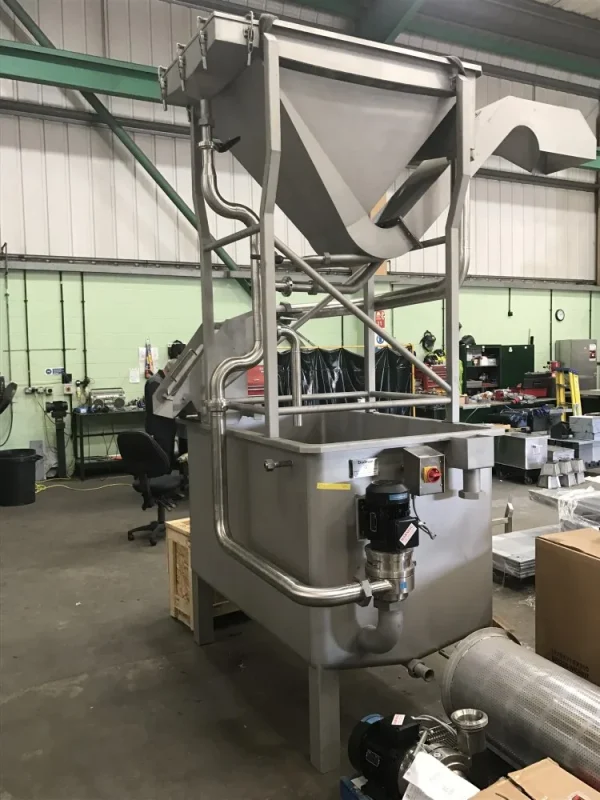
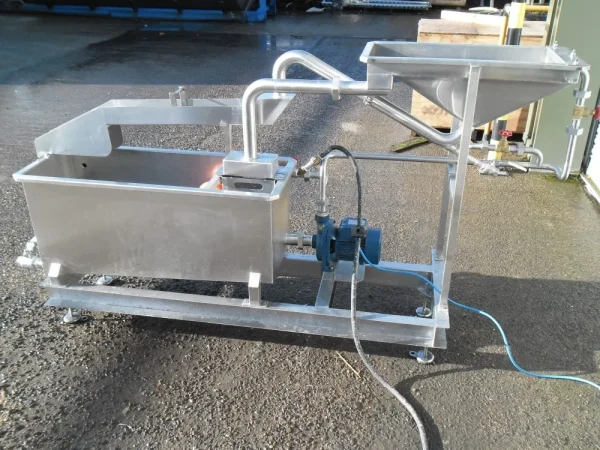


Floating Separation Tank 2000 L
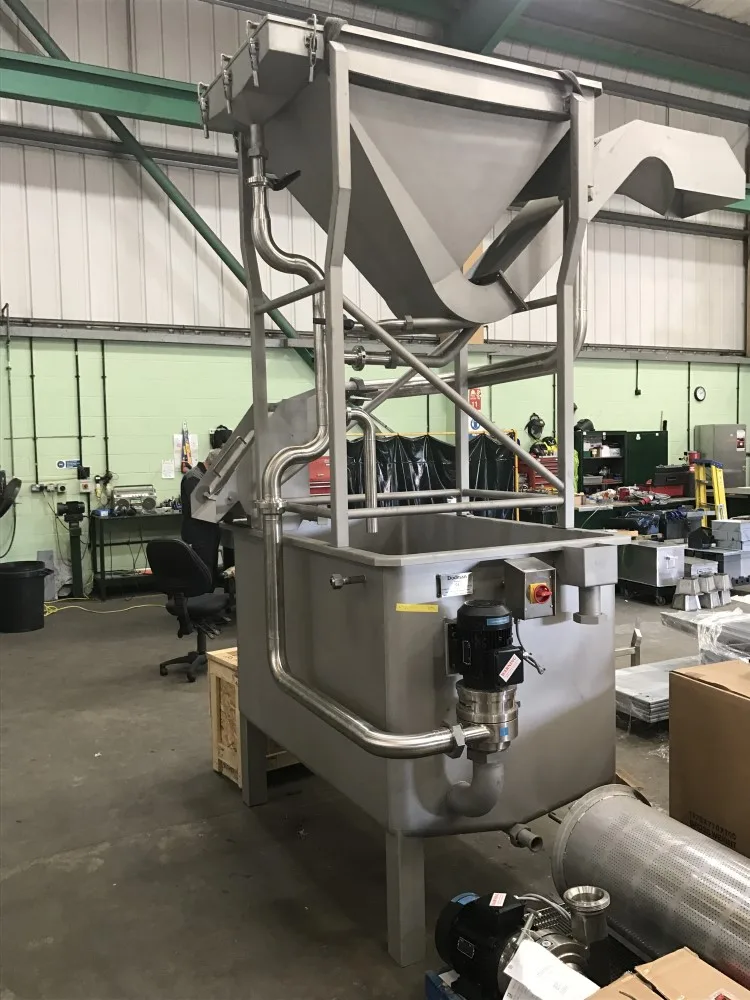
Separation unit that sorts by weight in water. It is the quietest machine on a vegetable line and one of the most useful: sound product floats, damaged pieces and heavy debris sink, and the split happens without anything touching the product. On lines where the alternative is a belt of inspectors making the same judgement by eye, a flotation tank does the job continuously, cheaply, and without fatigue.
How it works
Product enters a tank of water, sometimes with a controlled inflow at the inlet end that spreads the stream and starts the separation. Pieces with density lower than the bath float; pieces that are denser — damaged, hollowed, over-mature, or carrying soil and stones — sink. The floating product is carried to the discharge weir by the surface flow or by a skimming conveyor; the sunken material leaves through an underflow or is collected on a settling shelf for periodic removal.
Water temperature and agitation are the two operating controls. Warmer water reduces the density difference and slows the separation; agitation mixes the layer and can carry marginal pieces over the weir that should have sunk. On vegetable lines the tank typically sits right after cutting or after washing, where a high share of the incoming stream is sound product and the rejects are the small minority worth separating. Water is filtered and recirculated, with the recovered organic fines going to the same waste route as the rejects.
Suitable for
Pre-sorting diced and cut vegetables ahead of inspection, frying or freezing, where floating pieces are the saleable fraction; removing loose pulp, seeds and skin fragments from washed product; separating sound fruit pieces from damaged ones in canning and freezing lines; herb and leafy product washing where the water does the separating and the conveying at once; operations where the reject stream is small but expensive to miss.
Not suitable for
Products whose density difference between good and reject is too small to separate cleanly, where the tank splits a stream nobody wanted split; product that must not be wetted, where flotation contradicts the process; operations without water filtration and waste handling, because the tank concentrates the fines it removes; anyone wanting a precise grade split, which is what a grader or optical sorter is for — flotation is a coarse separation, not a grade.
Material & compliance
Tank, weir, skimmers and chutes in SUS304 (EN 1.4301); weirs adjustable to change the split point, with the setting visible and repeatable. Tank bottom sloped to a drain with a settling shelf for reject collection; the whole interior is cleanable by hose because organic fines settle wherever the water slows. Water circuit filtered, with the filter and the reject route designed together, since the fines this tank removes are the ones that block filters.
Supplied with CE declaration of conformity and DoC on request; material certificate EN 10204 3.1 available for contact parts.
Selection notes
Ask for the density window the tank separates, not just its volume — a flotation tank is specified by the density difference between your good and reject fractions, and that number is either in your product or it is not. Check how the split point is adjusted and how repeatable the setting is between operators. Check the reject collection arrangement, because a tank that has to be drained to remove sunken material is a tank that stops production. Check the filtration duty against the fines load from your product.
When you should not buy this machine: If your good and reject fractions have similar density, no amount of water separates them and the tank will split the stream arbitrarily — use an inspection conveyor or optical sorter instead. And if your product cannot be wetted, this is not your machine at any price.
Key specifications
| Parameter | Value |
| Tank volume | 1000-5000 L by line (TYPICAL, confirm with factory) |
| Separation principle | Density difference in a water bath |
| Water temperature | Ambient or controlled by option (TYPICAL) |
| Agitation | Controlled inflow, adjustable by weir |
| Discharge | Floating product over a weir; rejects by underflow |
| Water circuit | Recirculated with filtration; top-up at inlet |
| Contact material | SUS304 (EN 1.4301) |
| Power supply | 380V/3P/50Hz or 415V/3P/50Hz, customizable |
Specification values are industry-typical ranges for this machine class and are not verified against a specific factory datasheet. Replace them with measured factory data before publication.
FAQ
How is this different from a washer?
A washer moves water to clean; a flotation tank holds still water to sort. Some machines do both, but the specifications differ — a washer is specified on cleaning and a flotation tank on density split. If you need both, buy them as one machine or as two, but know which job each is doing.
Why does the split point drift?
Water density. Product fines, temperature change and recirculation load all shift the density window. Tanks hold their setting best when filtration keeps the water clean and the weir setting is mechanical rather than estimated.
Can it separate underripe fruit?
Partly. Underripe fruit often sinks and ripe fruit floats, which is why flotation is used on some fruit lines at harvest. But the density difference varies by variety and season — test on your crop before specifying the tank around it.
Related equipment
This unit is one stage of a complete processing line. For the full range of sorting and grading equipment, or to compare this model against the Immersion Washing Machine 2000 kg/h, see the complete equipment catalogue. Capacity, material grade and utility requirements can be confirmed through a quote request.
Reviews
There are no reviews yet.