
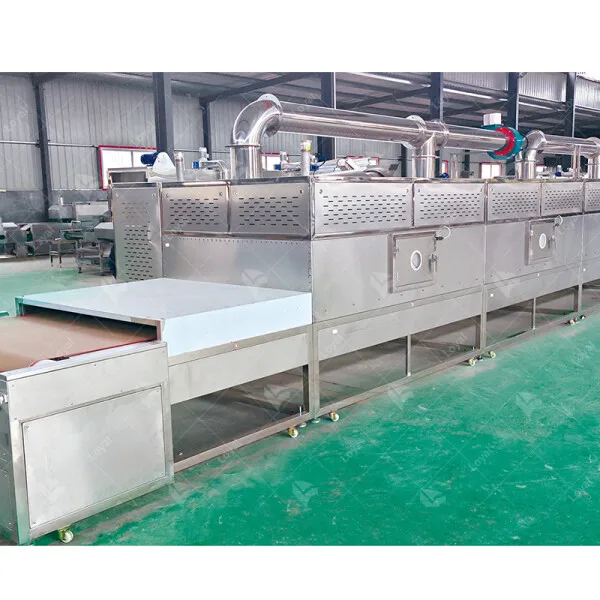


Microwave Dryer 200 kg/h
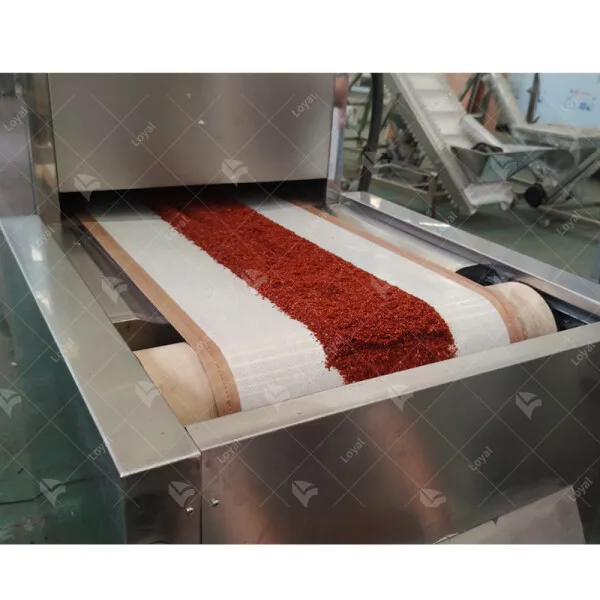
Drying unit that heats from the inside. Conventional drying works from the surface in — hot air meets the wet outside, and the inside dries only when the moisture can migrate to the surface, which is slow and drives the surface hotter than the core. Microwave energy does the opposite: it couples with the water itself, so the moisture inside the piece is the part that heats, and the product dries from within at a low surface temperature. For herbs, spices and heat-sensitive fruit, that difference is the entire reason the machine exists.
How it works
Product travels through a tunnel on a belt that microwave energy passes through. Magnetrons above and below the tunnel generate the field; the water in the product absorbs the energy and heats, while the dry structural material absorbs far less. Moisture evaporates from the inside outward, often reaching the surface as vapour and leaving through the belt and the extraction, and the drying time collapses from hours to minutes. Airflow through the tunnel carries the vapour away; on many designs a hot-air section works alongside the microwave to finish the surface and raise throughput.
The engineering is in the field uniformity. Microwave drying has a reputation for uneven results — hot spots and cold spots — and that reputation is a design question: the mode stirrer, the belt and the power distribution decide whether the field is even across the tunnel width. On a well-designed machine the product leaves uniformly dry; on a poorly designed one it leaves with the same average moisture and twice the variance, which is worse than no dryer at all for a quality specification.
Suitable for
Herbs, spices and botanicals where volatile compounds and colour are the value; heat-sensitive fruit and vegetable products where a hot-air cycle cooks the surface before the core dries; products with a high initial moisture that must be dried fast to avoid enzymatic or microbial change; final-stage drying after a hot-air or belt dryer, where microwave takes the last few percent off quickly and gently; small-footprint continuous drying where a tray dryer’s labour and floor area do not fit the operation.
Not suitable for
Products with metal fragments or metallic packaging, where microwave is unsafe; products where the moisture is bound rather than free, because the coupling is weaker and the economics fall apart; operations without electrical infrastructure for the installed power, which is large; anyone expecting microwave to be cheap per kilogram — the energy cost per kilogram of water removed is high, and the justification is quality, not running cost; products whose specification tolerates a long, hot, cheap cycle, where conventional drying is simply better.
Material & compliance
Tunnel, conveyor frames, chutes and covers in SUS304 (EN 1.4301); conveyor in a microwave-transparent food-grade belt. The enclosure is a microwave safety device first and a machine second: interlocks, leakage limits and door seals are the governing specification, and they must be certified to the local radio equipment and machine safety rules. Extraction sized to remove vapour without condensing it back onto the product.
Supplied with CE declaration of conformity and DoC on request; material certificate EN 10204 3.1 available for contact parts.
Selection notes
Ask for moisture uniformity across the belt width on your product, measured, not claimed — this is the single number that separates a good microwave dryer from an expensive one. Ask what the microwave power costs per kilogram of water removed and compare that against the quality gain, because the answer is usually that the machine is bought for quality alone. Check the electrical load and whether your supply can carry it. Check the interlock and leakage certification for your market, and ask about magnetron life and replacement cost, since magnetrons are the consumable on this machine class.
When you should not buy this machine: If your product dries perfectly well in hot air, buy hot air — microwave is the expensive answer to a quality problem, not a default. And if you cannot supply the electrical load, or your site cannot host the safety requirements, the machine is not an option at any specification.
Key specifications
| Parameter | Value |
| Microwave power | 50-500 kW installed by model (TYPICAL, confirm with factory) |
| Frequency | 2450 MHz or 915 MHz by design |
| Drying temperature | Product core 40-80 °C, surface lower (TYPICAL) |
| Drying time | Minutes, not hours (TYPICAL) |
| Conveyor | Microwave-transparent belt through the tunnel |
| Heating mode | Microwave alone or with hot-air assist |
| Contact material | SUS304 (EN 1.4301) |
| Power supply | 380V/3P/50Hz, sized by magnetron load |
Specification values are industry-typical ranges for this machine class and are not verified against a specific factory datasheet. Replace them with measured factory data before publication.
FAQ
Why is microwave drying so fast?
Because it heats the water, not the product. The moisture inside the piece is what absorbs the energy, so drying starts in the core rather than waiting for heat and vapour to migrate through the material. Minutes instead of hours is the normal result.
Is the running cost worth it?
Rarely on cost alone. Energy per kilogram of water removed is typically several times a hot-air dryer’s. The machine is justified when the quality gain — colour, volatile retention, active compounds — is worth the difference, and that is a product decision, not a utility one.
What is the main maintenance item?
Magnetrons. They are consumables with a defined life, and replacement cost and local availability should be established before purchase. The belt, the interlocks and the extraction are routine; the magnetrons are the operating risk.
Related equipment
This unit is one stage of a complete processing line. For the full range of drying and dehydration equipment, or to compare this model against the Vacuum Belt Dryer 200 kg/h, see the complete equipment catalogue. Capacity, material grade and utility requirements can be confirmed through a quote request.

Reviews
There are no reviews yet.